|
1
|
|
|
2
|
- 2000- Campaign pledge to deploy an effective missile shield
- Presidential Promise
- December 17th, 2002- Promised to have a Ballistic Missile Defense
Program running by 2004-2005
|
|
3
|
- Important to understand the threat in order to plan an appropriate
defense
- 2 opposing camps
- Proponents of ballistic missile defense
- Conservatives
- Believe that an imminent threat exists that makes it necessary to
speed up our ballistic missile defense program
- Opponents of ballistic missile defense
- Liberals
- Believe that the threat that the United States presently faces from
the nuclear states is not great enough to merit rushing a defense
program that has not been fully developed
|
|
4
|
- Testing
- Costs
- Countermeasures
|
|
5
|
- Proponents
- Not necessary to test
- Testing will reveal the secrets of our defense capabilities
- Current defensive capabilities are sufficient for primitive nuclear
missile attacks
- Test
- Opponents
- Only 8 of the 19 tests have been conducted, and with mixed results
- Tests start out simple and get more complex
- Only simple tests have been conducted; still in R & D phase
- Tests that have been conducted have not been accurate because the
testing conditions were not realistic
- Simplified tests
- Involved “surrogate components” (i.e. slower defensive rockets than
the ones that would be used in a real situation; GPS satellites)
- The government has been misrepresenting the testing success they have
had
- NY Times April 18th, May 18th
- Wall Street Journal January 14th 2000
|
|
6
|
- Proponents
- Defense needs to be number one priority of the United States government
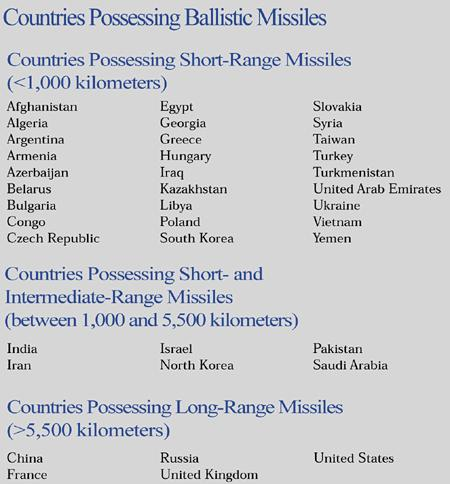
- The nuclear states, specifically North Korea, Russia, China, Iran and
Iraq, have made huge technological gains
- Most countries that have the technology can produce nuclear arms
within a matter of months
- Russia and China have long-range ballistic missiles capable of
reaching the United States
- North Korea, Iran and Iraq are within 10 years of having missiles that
can reach United States
- Opponents
- The government is devoting too much money to ballistic missile defense
- 10 billion dollars a year too much to spend
- Spending billions of dollars to defend against a threat that does not
exist
- North Korea not as much of a military threat as a proliferation threat
- Country low on money- can’t
even afford the fuel to keep their fighter pilots in the air
- It is profitable to sell nuclear secrets and materials
|
|
7
|
- Proponents
- The nations that we face as threats do not possess the ability to
produce countermeasures complex enough to deceive our defenses
- Must keep in mind who it is we are defending against (North Korea’s
economic resources; sophistication of Soviet Union)
- We have prepared for countermeasures which are far more complex than
anything the offense could use
- Opponents
- Too many unknowns
- BMD program cannot be pushed forward before we understand how to deal
with the countermeasures of the offense
- We do not yet know what countermeasures are within the technological
capabilities of the threatening nuclear states, nor how effective our
program would be in defending against them
- Countermeasures
|
|
8
|
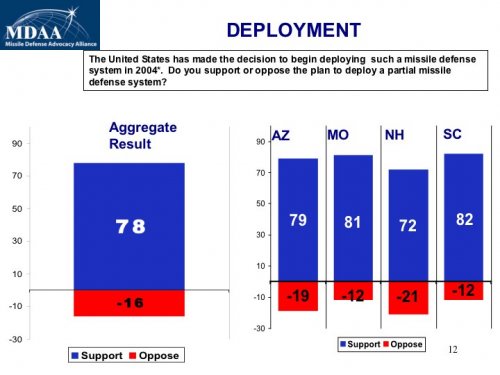
- Missile Defense Advocacy Alliance (MDAA)
- Conducted polls of registered voters in AZ, MS, NH, SC and PA over the
past year (most recent 05/26/04)
- 78% support the plan to deploy a partial missile defense system in 2004
|
|
9
|
- Coalition to Reduce Nuclear Dangers
- April 2000 survey of 1000 adults was conducted by the Coalition to
Reduce Nuclear Dangers, the Council for a Livable World Education Fund,
and the Fourth Freedom Forum
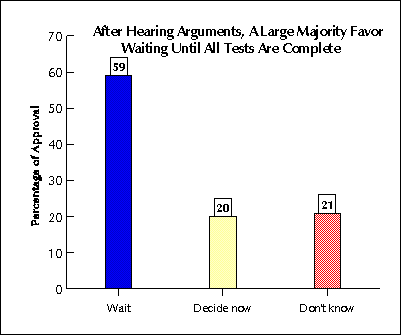
- 59% support waiting to decide on deployment of national missile
defenses until after the 19 tests are complete
|
|
10
|
- Contradicting polls results have been published on a continual basis
over the past 10 years
- Both sides use techniques to skew the results:
- Preliminary questions to elevate concerns
- Remind people about continuing Russian/ Chinese threat
- Introductory clause
- “knowing that…” (US cannot currently stop one incoming missile…/ many
scientists conclude that it is unlikely such a system will work…)
- Compare costs to another cause (popular/unpopular)
- Health care and education/ peacekeeping in Bosnia
|
|
11
|
- Poll results do not always give an accurate representation of public
opinion
- The ease at which the opinions of respondents can be skewed could
indicate a general lack of knowledge of Ballistic Missile Defense, and
lack of exposure to all sides of the issue
- Political propaganda, world events, and the media are also reasons for
constant fluctuations in results
|
|
12
|
|
|
13
|
- Special Thanks To:
- Dean Wilkening
- Michael May
- Carlos Seligo
- Dena Slothower
- Work Cited
- Butler, Richard. Fatal Choice. Cambridge: Westview Press, 2001.
- Carter, Ashton B. ed. and N. Schwartz, ed. Ballistic Missile Defense.
Washington D.C.: The Brookings Institution, 1984.
- www.clw.org/coalition/pollmd2.htm
- http://www.brookings.edu/views/op-ed/ohanlon/20040412.htm
- http://www.state.gov/t/ac/rls/fs/2001/4892.htm
- http://www.ucsusa.org/
- http://www.whitehouse.gov/news/releases/2002/12/20021217.html
- http://www.clw.org/pub/clw/coalition/polling.htm#bmd
|

 Notes
Notes