|
1
|
|
|
2
|
- Media as “extensions of man” (Marshall MacLuhan)
- Tools further powers that begin in the human body
- The body as the original tool
|
|
3
|
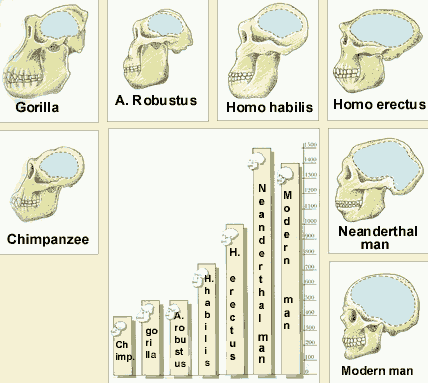
- Paleoanthropology: how do physical and cultural anthropology relate?
- Definition of the human: what we are or what we do
|
|
4
|
- Communication tools mediate social interactions
- Society extends the powers of the individual human
|
|
5
|
- What is a simulation?
- A model (TT, p. 57): “the object is to construct a model and to study
its properties and its different reactions in laboratory conditions in
order later to apply the observations to the interpretation of empirical
happenings”
- Thinking is a simulation
|
|
6
|
- The relation between a prior medium and its successor: e.g., the
relation between handwriting and typing, or between typewriter writing
and computer writing
- Imitation and extension or reconfiguration
|
|
7
|
- But media have properties of their own
- Thus, unexpected consequences
- For example, the printed book
- “Ostranenie”: “making-strange”
|
|
8
|
- Writing in TT
- Epic communication in the Odyssey
- Writing and poetry in PB
|
|
9
|
- “genre”: literary and anthropological term
- A genre formats and predefines what is to be said, what purposes are to
be achieved, etc.
- Genres as media or tools: the speech act as an “extension” of social
power or even physical force
|
|
10
|
- But speech genres, like media or tools, have their own properties and
escape a narrow definition of their function
- Richard II as king
- The Nambikwara chief as king
- Both mediated by speech genres in the course of transformation
|

 Notes
Notes