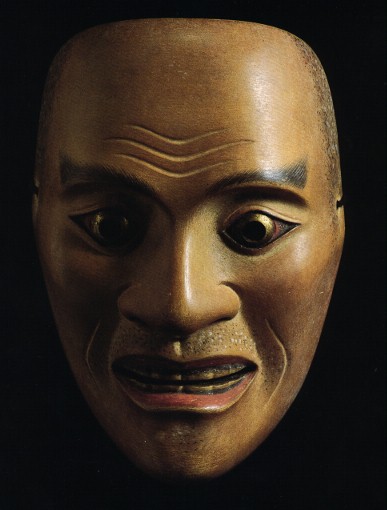
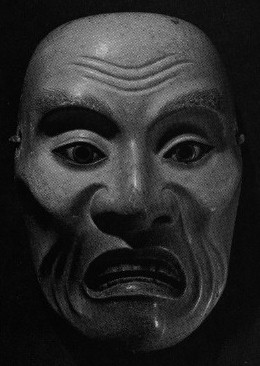
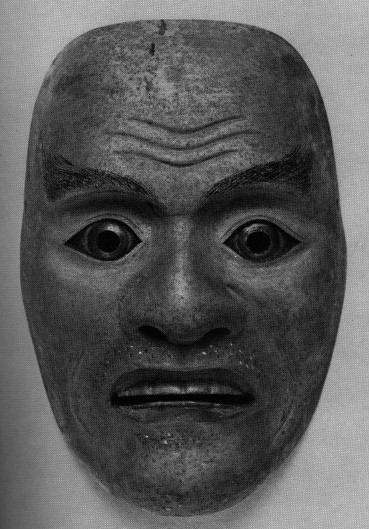
Herebelow you see three masks which could be used in performance of the role, Yorimasa.
They are, indeed, exclusively for the role of Yorimasa, which is unusual in noh. Generally, a given mask type can be used for a range of roles.
The masks below, for example (from left to right called "heita" "warai-jô" and "chûjô") might each be used in a variety of roles. They articulate various differences along spectra of age, social class and so on. It hardly needs saying, that "warai-jô" is used for the roles of older men. "Chûjô" for its part, appears on men of high social position, especially courtiers.


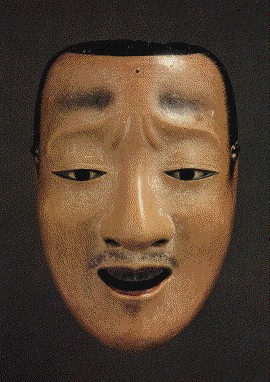
Seen in this way, the three masks above offer insights about the construction of the semiotics of the mask in noh. Particular character types are created, and when the actor approaches a role, he decides upon a mask from one of the types which is acceptable for the role in question. The schools have, in the course of the development of noh, established conventions about which mask types can be used for which roles. In most cases there is a choice of type. For the samurai roles which might be performed with "heita," one might alternatively choose the somewhat younger-looking "imawaka" mask.
The case of Yorimasa, though, is different. Here, a mask has been specially designated for the role, and no other mask type is specified as acceptable (at least in Kanze*). Yet when you look at the masks which fall into that category, there is significant variation.
The masks pictured earlier all have eyes marked out with a golden iris. This is relatively unusual, and reveals an affinity between the Yorimasa mask and other so marked masks. Those masks, however, are not for use in the protrayal of samurai. One, quite strikingly, is intended for the role of the audacious mountain crone in the play Yamamba. Compare it below with the Yorimasa masks:
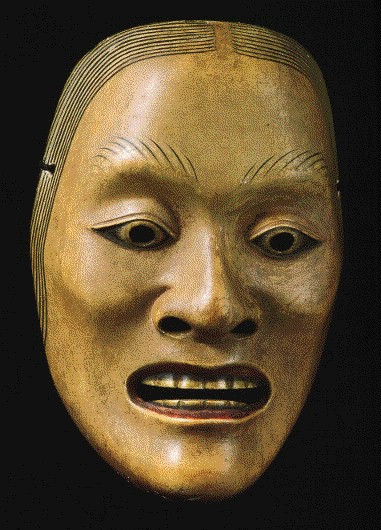
Yamamba's resemblance to the Yorimasa mask on the right is perhaps most striking, but note the way the mouth is carved in Yamamba and in the Yorimasa mask on the left. There are several other features that could be compared too, to fill out the points of resemblance.
But the resemblance between Yamamba and the two Yorimasa masks just mentioned above is closer than the resemblance of either of the previously mentioned Yorimasa masks with the one we haven't talked about yet, the one in the middle. How do we explain the difference?