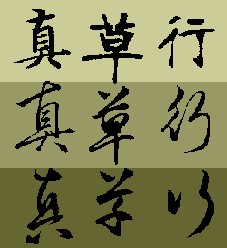
 The kanji in the left column are versions of "shin," one of the words meaning "true" or "truth." The kanji in the middle column, pronounced "sô," means "grass." The kanji in the right column, "gyô," means "running." This may seem an eccentric group of words to use in an example, but these three words are, in fact, the most common terms to refer to the three basic script styles, which range from a block form ("shin") to a highly cursivized form, "sô," to a less dramatically cursivized form, "gyô." Each of the kanji in question is displayed in each of the forms mentioned: The top column shows each in its "shin" form, the middle column shows each in its "gyô" form, and the bottom shows each in its "sô" form. (It may seem odd that the terminology, "shin-sô-gyô" doesn't shade gradually from block to fully cursive form, but instead starts with the two extremes and then refers to the compromise between them. This choice seems to come from a concern for the way the word "shin-sô-gyô" sounds rather than from a conceptual or formal approach to the terminology.)
All the texts below all come from chûsei, or the "medieval period." They were all written by Japanese, but the language in which they are written is Chinese, with the exception of the text by Shunzei. The first below is an example of "shin" calligraphy by the Sôtô Zen patriarch, Dôgen. The strokes in each kanji are for the most part independently written, with careful attention in each stroke to the gradation of width and to placement within an imaginary square or rectangle. (The text is entitled "Fukan zazen gi.")
The text below is written mostly in "gyô" style calligraphy. In this case, the strokes in the kanji are sometimes run together, and as a whole, the writing shows considerable fluidity. Note, however, that each kanji is written independently. The text is the opening of Nichiren's "Risshô ankoku ron."
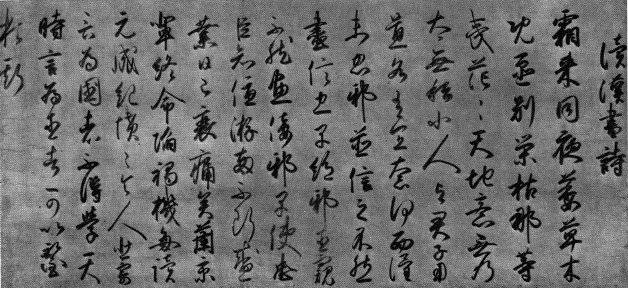
The next example, by Emperor Fushimi, is written in a relatively legible and restrained form of "sô" style calligraphy. Now the strokes are often run together and the individual kanji are themselves sometimes linked together.
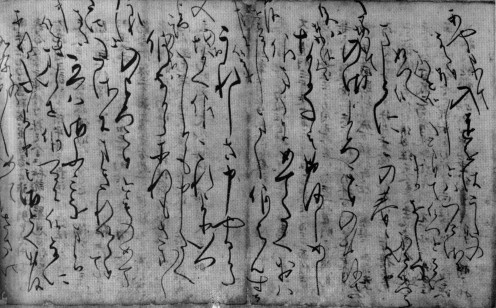
The example below is, unlike the previous examples, written in Japanese, and is comprised almost exclusively of kana, or Japanese phonetic writing, rather than kanji. It is a letter by the great poet Shunzei, dating from the very beginning of the Kamakura period.


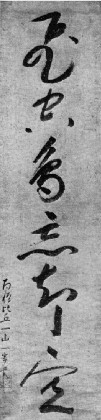 This example, on your left, is a yet more dramatically cursivized sort of "sô" style calligraphy. It was written by the Zen priest Issan Ichinei. In some cases, what would have been several strokes in "shin" style have been combined into a single sweep of the brush.