 |
|

 |
allpolitics.com |  |


.gif)






 (
(.gif) | |
 | |
| |
| |
|
EDITIONS: | |
|
MULTIMEDIA: | |
|
E-MAIL: |
|
Subscribe to one
of our news e-mail
lists. Enter your address: |
|
DISCUSSION: |
|
CNN WEB
SITES: |
 |
|
TIME INC.
SITES: |
|
CNN
NETWORKS: |
 |
|
SITE
INFO: |
|
WEB
SERVICES: |
| CNN e-store |

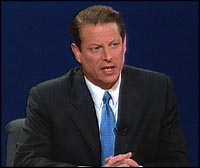
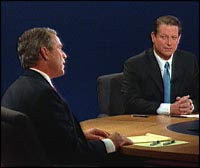
Bush, Gore stick close to initial strategies in restrained contestSecond debate produces some prime moments for the coming week's highlight reelsWINSTON-SALEM, North Carolina (CNN) -- With just a small space separating the Republican and Democratic contestants for the Oval Office here Wednesday night, Texas Gov. George W. Bush and Vice President Al Gore engaged in a contained repartee in which both appeared determined to not make the sort of mistake that could end up dominating the Sunday network political talk shows. For the most part, they succeeded, with a notable exception -- Bush's declaration that the three men convicted in the James Byrd murder case in Texas are to be put to death, and that the death penalty is the ultimate panacea for murder motivated by hatred.
But the moment did not characterize the tone of the evening. Bush, the Republican hopeful, and Gore, the Democratic presidential contestant, refrained from the sort of personal lashings that marred their meeting in Boston last week, and at points managed to cool potentially troublesome situations with kind words for each other. This second of three debates between the candidates, sponsored by the bipartisan Commission on Presidential debates, took place in the colonial-style Wait Chapel on the campus of Wake Forest University. The chapel was the site of the first-ever debate sponsored by the commission -- a 1988 bout between then-President George Bush, father of the Texas governor, and Massachusetts Gov. Michael Dukakis. When addressing the Byrd case, the governor was responding to a question posed by moderator Jim Lehrer about the nature of hate crimes, and the creation of potential federal statutes to protect minorities and other groups from crimes based solely on prejudice. James Byrd of Jasper, Texas, was dragged to his death in 1998 after being chained to a pickup truck occupied by three men. Jasper was African-American; the three men are white. Initially, Bush misspoke, saying all three men had been sentenced to death.
His campaign scrambled to correct the error before the debate ended. In fact, two of the three were sentenced to death. The third received a life sentence. "The three men who murdered James Byrd, guess what's going to happen to them?" Bush said as he leaned back in his chair. "They'll be put to death. A jury found them guilty. It will be hard to punish them any worse after they get put to death." The comment, interpreted by Gore advisers on site as flippant, could well leave Bush open to days worth of media scrutiny and Democratic attacks. In his two terms as Texas governor, 145 people have been executed at Texas' Huntsville State Prison, home of the state's death row. Forty-five minutes of international policy, and restraintSeated at a 'C' shaped table on chairs with little swivel or sideways movement, as per a prior agreement, Bush and Gore spent the first half of the debate -- a full 45 minutes -- discussing broad issues of international policy and the conduct of the United States in a world that could react with respect, or loathing. The significant time devoted to international affairs produced a wide-ranging discussion that eventually resulted in opposing views on the role of the U.S. military, diplomatic efforts and use of international aid dollars in a number of world crisis areas, most notably, the Middle East.
Lehrer's choice to keep the international policy discussion flowing amounted to a bonanza for the Bush camp, which had spent countless hours drilling the governor on international affairs leading into Wednesday's contest, in a concerted effort to overcome perceptions that his geopolitical knowledge was lacking. Bush, hinting at his intention to recast and rebuild the U.S. military into a "force that can fight and win wars," said the U.S. must remain the world's most powerful nation, but must stay humble in the process. "If we're an arrogant nation they'll resent us," he said. "If we're a humble nation but strong they'll welcome us. Our nation stands alone in the world right now in terms of power. That's why we've got to be humble and yet project strength in a way that promotes freedom. Gore's first statements were nearly identical. "It is a great tribute to our founders that 224 years later this nation is now looked to by the peoples on every other continent and the peoples from every part of this Earth as a kind of model for what their future could be," Gore said.
"And I don't think that's just the kind of exaggeration that we take pride in," Gore added, seemingly understanding the irony of his choice of words as he spoke. But the lengthy exchange initially produced little in the way of disagreement, even as the two candidates were challenged by Lehrer to rate the last two decades' worth of American international intervention -- from Lebanon in the 1980s to the Balkans in the 1990s. And Bush, who has roundly criticized the Clinton-Gore administration for altering the mission of the U.S. military in the post-Cold War era, was remarkably complimentary of some of its international activities, specifically the NATO air campaign to drive Yugoslavian ground forces from the province of Kosovo. "I think the president made the right decision in joining NATO in bombing Serbia," Bush said. "I think it is good public policy, I think it worked, and I think this is a legitimate use of our military power." "Seems like we're having a great love-fest here tonight," Bush commented as the debate continued and the subject matter stayed the same. Differences arose as Lehrer prompted the candidates on the concept of nation-building, an activity on which Bush says the U.S. has devoted too much time, personnel and material. Gore argued that the years following the Second World War provided ample evidence that "nation-building" -- a concept that encompasses the use of U.S. ground troops to maintain order in a vanquished or needy region, coupled with material and economic aid -- was a workable, necessary and powerful tool of American diplomacy. "In the aftermath of our great victory in World War II, we laid down the Marshall Plan," Gore said. We got intimately involved in building NATO and other structures there. And what did we do in the late '40s and '50s and '60s? We were nation building." "It was economic," he continued. "It was also military. Those countries recovering from the wounds of war had (confidence) by having troops there." "I think what we need to do is convince people who live in the lands they live in to build the nations," Bush responded, adding later, "We can't be all things to all people." Caution prevailsThe 45 minutes devoted to global philosophy, the agreements Bush and Gore reached regularly as they spoke, and the cross-table discussion format used in this debate squelched early possibilities that either candidate could engage in negative characterizations or outbursts. Gore, lambasted in the days following the Boston debate for heaving sighs and embellishing anecdotes to bolster his policy arguments, kept still through much of Wednesday's contest, shook his head only once when Bush declared that his targeted middle class tax cuts would not benefit 50 million Americans, and refrained from unshelving an anecdote until the hate crimes discussion was initiated with a question about racial profiling by local police departments. "I talked to an African-American police officer in Springfield, Massachusetts, not long ago who raised this question and said that in his opinion, one of the biggest solutions is in the training," Gore said, somewhat tentatively, when asked how racial profiling could be eradicated. It was on hate crimes, and the Byrd case, that Gore finally saw fit to open up his attacks on Bush's record as governor -- even after the Gore campaign had touted his intention to let Bush have it on his state's environmental, health-care and civil rights records. Lieberman, Gore's running mate, blitzes Texas beginning Thursday to press the strategy.
Gore attacked Bush for turning back a comprehensive hate crimes law in Texas following the Byrd incident, saying the Byrd tragedy was just the sort of case that called out for such legislation. Bush countered that Texas did have a hate crimes law on the books, then made his assertion that the death penalty amounted to the ultimate hate crimes deterrent. "In this case when you murder somebody it's hate," Bush said. "The crime is hate and they got the ultimate punishment. I'm not exactly sure how you enhance the penalty any more than the death penalty." The Gore campaign leapt on Bush's demeanor during the hate crimes exchange. "He seemed to be happy this was happening," said Gore communications director Mark Fabiani. "He seemed proud that these guys are getting the death penalty." Gore also hit Bush on health insurance distribution in Texas, saying national studies have indicated Texas ranks 49th in the nation in insurance provision for children, 49th for women, and 50th for families. He challenged Bush to deny those rankings -- a challenge Bush refused. "If he's trying to allege I'm a hard-hearted person and I don't care about children he's absolutely wrong," Bush said. "We've spent $4.7 billion a year in the state of Texas for uninsured people. And they get health care." Gore responded that he didn't at all intend to insinuate Bush was hard-hearted. "I think he's a good person. "I believe him when he says that he has a good heart," Gore said. Gore's surrogates blasted Bush following the debate for ducking the implications of the numbers. "You have to address that," said Sen. Christopher Dodd, D-Connecticut. Bush was given his chance to sideswipe Gore when asked by Lehrer to comment on Gore's credibility. "We all make mistakes, Bush said, joking, "I've been known to mangle a syll-a-ble or two myself, if you know what I mean." "But I think credibility is important. It is going to be important for the president to be credible with Congress, important for the president to be credible with foreign nations and yes, I think it's something that people need to consider." Of his embellishments last week in Boston, including his claim to have visited fire ravaged areas in Texas with FEMA director James Lee Witt, Gore said, "I got some of the details wrong last week in the examples I used last week, and I'm sorry about that, and I'm going to try to do better. "I thought the vice president overcompensated after the criticism he got from the first debate," said Bush's younger brother Jeb, the Republican governor the battleground state of Florida. "He was too calm." For his part, Fabiani was relieved. "We avoided the distractions of sighs and such," he said, adding that he was certain Gore was victorious. Asked to rate his older brother's performance, Jeb Bush said simply, "He was awesome." |
| ||||||||||||||||||||||||||||||||||||||||||||||||||||||||||||||||||||||||||||||||||||||||||||||||||||||||||




MORE STORIES:
Thursday, October 12, 2000
- Bush,
Gore stick close to initial strategies in restrained contest
- Fewer
jabs, but plenty of 'spin' after second presidential debate
- Bush
gets the edge in debate performance poll
- Buffalo
nickel design returning as a $1 piece
- GOP
drops disputed water provision that prompted veto fight
- Debate
coaches says pounding on Bush's Texas record won it for
Gore