The Island of the Colorblind
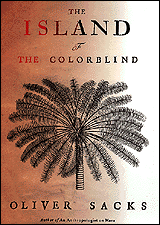
 You may order one or more hardback copies of The Island of the Colorblind, by Oliver Sacks, by sending a check or money order made payable to Frances Futterman (facilitator of the Achromatopsia Network) and mailed to Frances Futterman, P.O. Box 214, Berkeley, CA 94701-0214 USA.
Up until December of 1998, hardback copies of this 1997 book were available in bookstores for $24 plus tax, but it is no longer possible to obtain the
hardback copies in these stores. I am making these available for $11 per copy for persons
in the U.S., $15 per copy for Canadians, and $29 per copy for persons outside the
U.S. and Canada. These prices include shipping costs.
Checks or money orders from outside the U.S. should be in U.S.
dollars. Outside the U.S., payment may be made by obtaining an International Money Order, an International Postal Money Order, a Canadian Postal Money Order, or a bank check
drawn on a U.S. bank.
The sale of these hardback copies of Dr. Sacks' book has been
arranged partly as a fundraiser for this network and partly as a way of making it easy and affordable for persons interested in achromatopsia to obtain copies for themselves or to give to family, friends, teachers, eye care professionals, or others.
If you order more than 1 copy of this book, the price is $1 less for additional copies. For example, someone in the U.S. would pay $11 for 1 copy, $21 for 2 copies, $31 for 3 copies, and $41 for 4 copies. Someone in Canada would pay $15 for 1 copy, $29 for 2 copies, etc.
You may order up to 5 copies. Remember to make your check or money order payable to Frances Futterman, who serves as facilitator of this network.
Before Oliver Sacks wrote The Island of the Colorblind, there had never been a book available to the public which dealt with the subject of achromatopsia. This book, which has been translated into numerous languages, includes information about our network.
The story of Dr. Sacks' journey to Pingelap and Pohnpei Islands, along with networker Knut Nordby and others, to meet the islanders who have achromatopsia (there is a high incidence of achromatopsia on these islands)
takes up roughly the first half of this book. The remainder of the book tells about Dr. Sacks' explorations in connection with other subjects and other islands. Quite a few networkers have told me that, while they had obtained this book in order to read what was presented in it about achromatopsia and about the islanders who have achromatopsia, they were delighted to discover how very interesting and readable the entire book is.
By ordering this book, you can treat yourself to a memorable reading
experience, obtain a handsome hardback copy of a book which has made history in terms
of raising public and professional awareness regarding this extraordinary vision
disorder, and also help to support this network. The money raised by the sale of this book goes to a fund for developing special network projects.
From the book jacket of the U.K. edition of The Island of the
Colorblind: "Drawn to the tiny Pacific atoll of Pingelap by intriguing reports
of an isolated community of islanders born totally colorblind (about 6% of the Pingelapese
have achromatopsia), Sacks has woven an unforgettable narrative, which immerses us
in the romance of island life, and he shares his own compelling vision of the complexities
of being human."
From another published review of this book: "Sacks' compassion and curiosity
have led him to become one of the world's most rewarding writers about science, medicine,
and the vicissitudes of the human experience. His book, The Island of the
Colorblind, is a series of essays about his experiences in the Pacific Islands,
including the isolated island of Pingelap, where a disproportionate number of natives
have been born completely colorblind. This book includes information about The Achromatopsia
Network . . . . Other essays in the book deal with Sacks' lifelong love of botany
and how a favorite variety of cycad tree may have been responsible for a crippling
disease on a separate Pacific Island. The Island of the Colorblind is quintessential
Sacks -- a compelling blend of case studies, medical and natural history, and offhanded
personal observation."