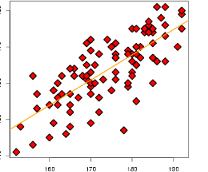
One sample problem
One sample problem

One sample problem
- Suppose I want to test \(H_0:\mu=(50,50,50,50,50)\).
Choosing a statistic
- A natural choice? How should we standardize?
Gaussian model
- Common statistical model:
\[ X_i = X[i] \overset{IID}{\sim} N(\mu, \Sigma), \qquad 1 \leq i \leq n \]
- Density:
\[ f(x) = \det(2\pi\Sigma)^{-1/2} \exp\left((x-\mu)^T\Sigma^{-1}(x-\mu)\right) \]
- MGF:
\[ E[e^{a^TX}] = \exp\left(a^T\mu + \frac{1}{2} a^T\Sigma a \right) \]
- Assume \(\Sigma>0\) known to start
Likelihood
- Likelihood is
\[ \begin{aligned} -\log L(\mu | X) &= \sum_{i=1}^n \frac{1}{2}(X_i-\mu)^T\Sigma^{-1}(X_i-\mu) \\ &= \frac{1}{2} \text{Tr}\left(\Sigma^{-1}(X-1\mu^T)^T(X-1\mu^T)\right) \\ \end{aligned} \]
- MLE does not depend on \(\Sigma\). Why?
- Enough to solve MLE when \(\Sigma=I\)
\[ \begin{aligned} \hat{\mu} &= \text{argmin}_{\mu} \|X-1\mu^T\|_F^2 \\ &= \text{argmin}_{\mu} \sum_{j=1}^p \|X[,j]-\mu_j \cdot 1\|_2^2 \\ \end{aligned} \]
- So,
\[ \hat{\mu} = \bar{X} \sim N\left(\mu, n^{-1}\Sigma\right) \]
Testing \(H_0: \mu=\mu_0\)
- Log-likelihood under \(H_0\)
\[ -\frac{1}{2} \text{Tr}\left(\Sigma^{-1}(X-\mu_0 1^T)^T(X-\mu_0 1^T)\right) \]
- Log-likelihood under \(H_a\)
\[ -\frac{1}{2} \text{Tr}\left(\Sigma^{-1}\left(X^T\left(I-\frac{1}{n}11^T\right) \right) X \right) \]
- Difference
\[ \begin{aligned} \frac{1}{2} \text{Tr}\left(\Sigma^{-1}((X-\mu_0 1)^T \left[\frac{1}{n}11^T \right](X-\mu_0 1^T) \right) &= \frac{n}{2} \text{Tr}\left(\Sigma^{-1}(\hat{\mu}-\mu_0)(\hat{\mu}-\mu_0)^T\right) \\ &= \frac{n}{2} (\hat{\mu}-\mu_0)^T\Sigma^{-1}(\hat{\mu}-\mu_0) \end{aligned} \]
Mahalanobis distance
- Given \(\Sigma > 0\)
\[ d_{\Sigma}(x,y) = (x-y)^T\Sigma^{-1}(x-y) \]
- LRT with \(\Sigma\) known is
\[ d_{n^{-1}\Sigma}(\hat{\mu}, \mu_0) \]
- Claim: \(Z \sim N(\mu,\Sigma) \implies d_{\Sigma}(Z, \mu) \sim \chi^2_p\)
Unknown \(\Sigma\)
What if we don’t know \(\Sigma\)?
Univariate case \(p=1\), MLE is
\[ \begin{aligned} \hat{\sigma}^2_{MLE} &= \frac{1}{n} \sum_{i=1}^n (X_i-\bar{X})^2 \\ &= \frac{1}{n} X^T\left(I-\frac{1}{n}11^T\right)X \\ \end{aligned} \]
Also, we know \(n \cdot \hat{\sigma}^2_{MLE} \sim \sigma^2 \cdot \chi^2_{n-1}\).
What is analog for \(p>1\)?
Maximizing likelihood
- With \(\Sigma\) unknown, after maximizing over \(\mu\) the (profile) likelihood for \(\Sigma\) is
\[ -\frac{n}{2} \log \det(2\pi\Sigma) - \frac{1}{2} \text{Tr}\left(\Sigma^{-1}\left(X^T\left(I-\frac{1}{n}11^T\right)X\right)\right) \]
- Introducing precision matrix \(\Theta=\Sigma^{-1}\) likelihood is
\[ \frac{n}{2} \log \det(\Theta) - \frac{1}{2} \text{Tr}\left(\Theta\left(X^T\left(I-\frac{1}{n}11^T\right)X\right)\right) \]
- Differentiate w.r.t. \(\Theta\) using:
\[ \nabla \log \det(\Theta) = \Theta^{-1} \]
- Yields
\[ (\hat{\Sigma}_{MLE})_{p \times p} = \hat{\Theta}^{-1}_{MLE} = \frac{1}{n} X^T\left(I-\frac{1}{n}11^T\right)X \]
- A sum of squares matrix…
Wishart distribution
- Suppose \(Z_i \overset{IID}{\sim} N(0, \Sigma), 1 \leq i \leq k\)
\[ Z^TZ \overset{\text{def}}{\sim} \textrm{Wishart}(k, \Sigma) \]
- Claim:
\[ n \cdot \hat{\Sigma}_{MLE} \sim \textrm{Wishart}(n-1, \Sigma) \]
- Unbiased estimate: (using fact \(E[Z^TZ]=k\Sigma\))
\[ \hat{\Sigma} = \frac{1}{n-1} X^T\left(I - \frac{1}{n}11^T\right)X \]
- Analogous to univariate case except sums of squares are matrices!
Estimate of covariance
Back to test
W.l.o.g. we take \(\mu_0=0\) below
Under \(H_0\), maximized log-likelihood is
\[ \begin{aligned} - \frac{n}{2} \log \det \left(\hat{\Sigma}_{0,MLE} \right) &= - \frac{n}{2} \log \det \left(\frac{1}{n}(X-1\mu_0)^T(X-1\mu_0^T)\right) \\ &= - \frac{n}{2} \log \det \left(\frac{1}{n}X^TX\right) \\ \end{aligned} \]
- Under \(H_a\), we claim maximized log-likelihood is
\[ \begin{aligned} - \frac{n}{2} \log \det \left(\hat{\Sigma}_{MLE} \right) &= - \frac{n}{2} \log \det \left(\frac{1}{n}X^T\left(I-\frac{1}{n}11^T\right)X\right) \\ \end{aligned} \]
- LRT is based on
\[ \begin{aligned} n \cdot \log \det \left(X^TX\left(X^T\left(I-\frac{1}{n}11^T\right)X\right)^{-1}\right) &= n \cdot \log \det(I + \hat{\mu}\hat{\mu}^T \hat{\Sigma}_{MLE}^{-1}) \\ &= n \cdot \log(1 + \hat{\mu}^T\hat{\Sigma}_{MLE}^{-1}\hat{\mu}) \end{aligned} \]
- Spring 2025: Initial version had a mistaken \(n\)…
Hotelling’s \(T^2\)
Suppose \(W \sim \text{Wishart}(k, \Sigma)\), independent of \(Z \sim N(0, \Sigma)\) with \(\mu \in \mathbb{R}^p, \Sigma \in \mathbb{R}^{p \times p } > 0\)
The random variable
\[ Z^T(k^{-1}W)^{-1}Z \sim T^2_k \]
As \(k \to \infty\), \(T^2_k \overset{D}{\to} \chi^2_p\).
In one-sample problem, LRT equivalent to
\[ T^2 = d_{n^{-1}\hat{\Sigma}}(\hat{\mu}, \mu_0) \]
The “right” statistic
Recap of one-sample problem
Estimation of mean structure – independent of \(\Sigma\). Leads to uncoupled estimation of \(\mu\).
Estimates of \(\Sigma\) involve sum-of-squared error matrix.
Wishart distribution is analog of \(\chi^2\).
Hotelling’s \(T^2\) is the LRT with \(\Sigma\) unknown. Analogous to Student’s \(T\) in univariate case.
While multivariate normal model is likely simplification, using the likelihood provides reasonably intuitive methods and tests.
Distribution theory of LRT can get hairy, though in this case
\[ T^2 \overset{D}{=} C_{n, p} \cdot F_{p, n-p} \]