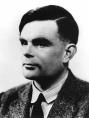
Alan Turing, 1912-1954. "On Computable Numbers, with an Application to the Entscheidungsproblem" Proceedings of the London Mathematical Society 42 (1936-37: 230-65. (Read Nov. 12, 1936)

Source: "The Turing Machine," http://www.brunel.ac.uk/depts/AI/alife/al-turin.htm
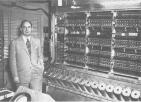
John Von Neumann, 1903-1957, and MANIAC (mathematical analyzer, numerical integrator and computer) at Princeton's Institute for Advanced Study.
Project to create a "universal constructor" or "self-reproducing automaton" as a simulation of a self-reproducing automatic factory. Stanislaw Ulam suggested that an abstract mathematical model would be sufficient for study of the conditions for making such a machine. Developed Cellular Automata, a two-dimensional grid in which each cell could exist in one of 29 states, as a Turing Finite State Machine.
"VON NEUMANN MACHINE: A machine which is able to build a working copy of itself using materials in its environment. This is often proposed as a cheap way to mine or colonize the entire solar system or galaxy. An early fictional treatment was the short story "Autofac" by Philip K. Dick, published in 1955, which actually seems to precede John von Neumann's original paper about self-reproducing machines." Transhumanist Resources, http://www.aleph.se/Trans/Words/v.html.
First published in Theory of Self-Reproducing Automata, edited and completed by Arthur W. Burks (Urbana: Univ. of Illinois Press, 1966). Dick's "Autofac" was published in Galaxy (Nov. 1955).