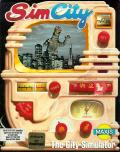
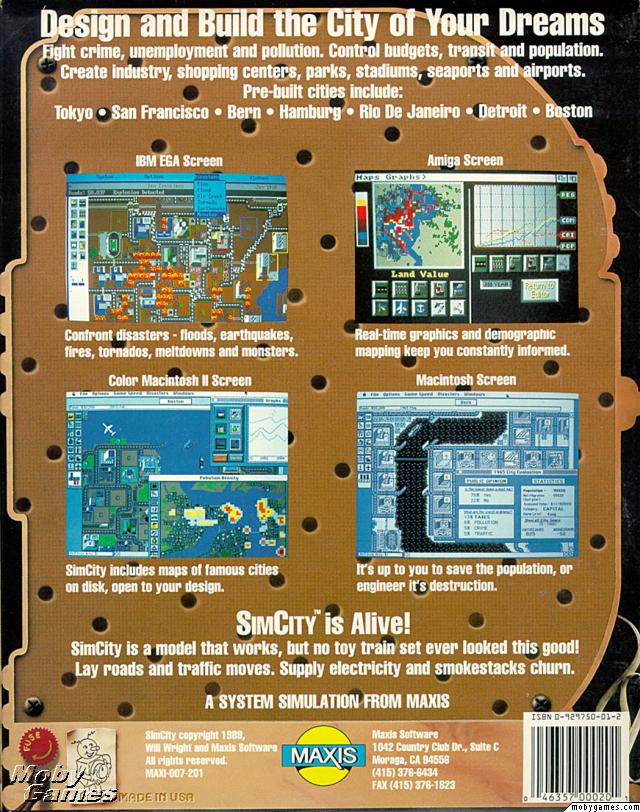
SimCity (1989). Developed by Maxis for Broderbund. Concept and Design by Will Wright.
"A system simulation from Maxis." (Back cover)
Inspired by work as programmer for Raid on Bungeling Bay (terraforming) and readings in urban planning, especially the work of Jay Forrester.
Maxis website (java version of SimCity Classic)
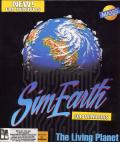
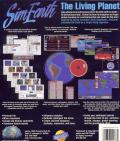
SimEarth (1990). Published by Maxis. Concept and design by Fred Haslam and Will Wright, with assistance from James Lovelock (Gaia Hypothesis).
"Instead of a city to run, SimEarth gives you the reins to the entire planet. Evolution, continental drift, climate, atmosphere, hurricanes, nuclear fallout, acid rain, civilization, and a bunch of other disasters. All the cool stuff you need to rule the world." Ad in Compute (Jan. 1991).
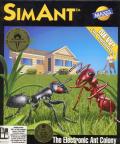
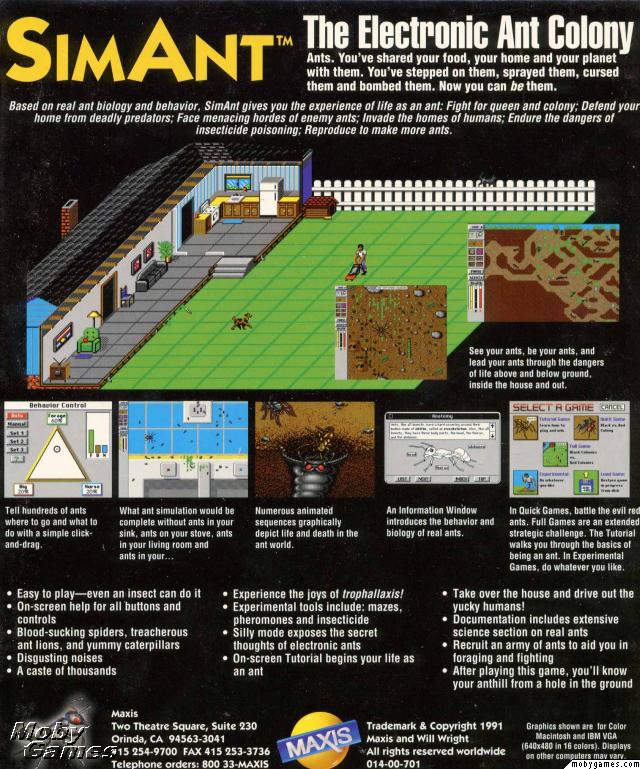
SimAnt (1991. Published by Maxis.
Inspired by Edward O. Wilson and Bert Holldobler, The Ants.
"The Electronic Ant Colony."
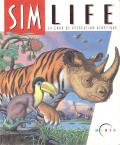
SimLife (1992). Developed by Maxis for Mindscape. Concept and design by Ken Karakotsios, with design assistance from Will Wright.
"The Genetic Playground."
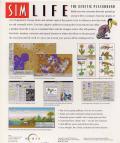
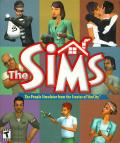
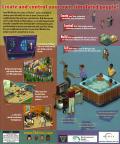
The Sims (2000). Electronic Arts (Maxis Studio). Lead Design: Will Wright.
"Probably the primary inspiration came from the book A Pattern Language by Christopher Alexander. In it he describes a language of design that encompasses everything from designing cities to designing hallways in a house. I wanted a game where I could play with some of these principles through architecture. The game sort of evolved from there and ended up with a much stronger focus on the people than originally envisioned." Source: "Lord of the Sims." Amazon.com interview with Will Wright. Available at: http://www.amazon.com/exec/obidos/tg/feature/-/25294/103-1969137-7722236
Alsol based on the "hierarchy of human needs," the behavioral grid developed by the psychologist Abraham Maslow during the 1960s.