Remediation
Immediacy
Hypermediacy
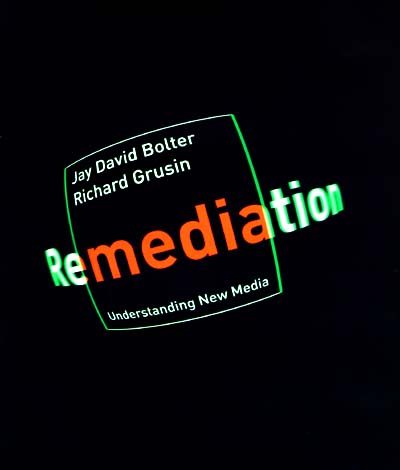
Jay David Bolter and Richard Grusin. Remediation: Understanding New Media (MIT Press, 1999)
"The very act of remediation, however, ensures that the older medium cannot be entirely effaced; the new medium remains dependent on the older one in acknowledged or unacknowledged ways. For example, the genre of computer games like Myst or Doom remediates cinema, and such games are sometimes called 'interactive films.' The idea is that the players become characters in a cinematic narrative. They have some control over both the narrative itself and the stylistic representation of it, in the sense that they can decide where to go and what to do in an effort to dispatch villains (in Doom) or solve puzzles (in Myst)." (47)
"...Players of action-style games are called on to conduct an ongoing surveillance. They are assigned explicitly or implicitly the role of security guards, whose simple task is to shoot anything that appears threatening. Because the ultimate threat is that the enemy will destroy the player himself, the player must constantly scan the visual field and direct his fire appropriately. Ideologically, the player is asked to defend or reestablish the status quo, so that even though the violence of the games appears to be antisocial, the ultimate message is not. It is a message that has prevailed from the early games as Space Invaders in the 1970s to such games as Doom and Quake in the 1990s." (p.93).