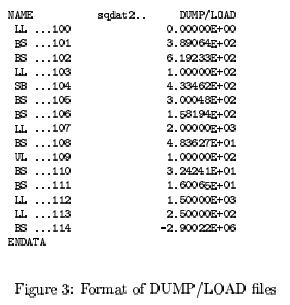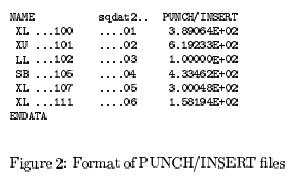
These files are similar to PUNCH and INSERT files, but they record solution information in a manner that is more direct and more easily modified. In particular, no distinction is made between columns and slacks. Apart from the first and last line, each entry has the form
|
Columns |
2-3 |
5-12 |
25-36 |
|
Contents |
Key |
Name |
Value |
as illustrated in Figure 3. The keys LL, UL, BS and SB mean Lower Limit, Upper Limit, Basic and Superbasic respectively.
A line is output for every variable, columns followed by slacks.
Nonbasic variables between their bounds will be output with key LL and their current value.
Before a LOAD file is read, all columns and slacks are made nonbasic at their smallest bound in absolute magnitude. The basis is initially empty.
BS causes Name to become basic.
SB causes Name to become superbasic at the specified Value.
LL or UL cause Name to be nonbasic at the specified Value.
An entry will be ignored if Name is already basic or superbasic. (Thus, only the first BS or SB line takes effect for any given Name.)
An SB line will not alter the status of Name if the Superbasics limit has been reached, but the associated Value will be retained if Name is a Jacobian variable.
(Partial basis) Let m be the number of rows in the problem. If fewer than m variables are specified to be basic, a tentative basis list will be constructed by adding the requisite number of slacks, starting from the first row and taking those that were not previously specified to be basic or superbasic. (If the resulting basis proves to be singular, the basis factorization routine will replace a number of basic variables by other slacks.)
(Too many basics) If m variables have already been specified as basic, any further BS keys will be treated as though they were SB. This feature may be useful for combining solutions to smaller problems.