|
1. |
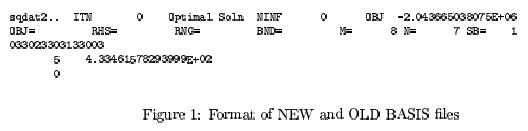
A line containing the problem name, the
iteration number when the file was created, the status of the solution
(Optimal Soln, Infeasible,
Unbounded, Excess Itns,
Error Condn, or Proceeding),
the number of infeasibilities, and the current objective value (or the
sum of infeasibilities). |
|
2. |
A line containing the OBJECTIVE,
RHS, RANGES
and BOUNDS names, M
= m, the number of rows
in the constraint matrix, N =
n, the number of columns in the
constraint matrix, and SB = the
number of superbasic variables. |
|
3. |
A set of (n+m-1)/80 + 1 lines
indicating the state of the n column variables and the m slack variables
in that order. One
character hs(j) is recorded for
each j = 1:n+m as follows, written with format(80i1).
|
hs(j) |
State of the jth variable |
|
0 |
Nonbasic at lower bound |
|
1 |
Nonbasic at upper bound |
|
2 |
Superbasic |
|
3 |
Basic |
If variable j is nonbasic, it may be
fixed (lower bound = upper bound), or free
(infinite bounds), or it may be strictly between its bounds. In
such cases, hs(j) = 0. (Free
variables will almost always be basic.) |
|
4. |
A set of lines of the form
j
xi
written with format(i8,
1p, e24.14) and terminated by an entry with j=0,
where j denotes the jth
variable and xi is a real
value. The
jth variable is either the jth column or the (j-n)th slack, if j>n. Typically,
hs(j)
= 2 (superbasic). When
nonlinear constraints are present, this list of superbasic variables is
extended to include all basic nonlinear variables. The
Jacobian matrix can then be reconstructed exactly for a restart. The
list also includes nonbasic variables that lie strictly between their
bounds. |
The
first line is input and printed but otherwise not used.
The values labeled
M and N
on the second line must agree with m
and n for the problem that has
just been defined. The
value labeled SB is input and
printed but is not used.
The next set of lines
must contain exactly m values
hs(j)
= 3, denoting the basic variables.
The list of j and xj values must include an entry
for every variable whose state is hs(j) = 2 (the superbasic variables).
Further j
and xj values may be included,
in any order.
For any j
in this list, if hs(j) = 3 (basic), the value xj
will be recorded for nonlinear variables, but the variable
will remain basic.
If hs(j)  3, variable j will be initialized at the value
xj and its state will be reset
to 2 (superbasic). If
the number of superbasic variables has already reached the Superbasics
limit, then variable j
will be made nonbasic at its current value (even if it is not equal to
one of its bounds).
3, variable j will be initialized at the value
xj and its state will be reset
to 2 (superbasic). If
the number of superbasic variables has already reached the Superbasics
limit, then variable j
will be made nonbasic at its current value (even if it is not equal to
one of its bounds).