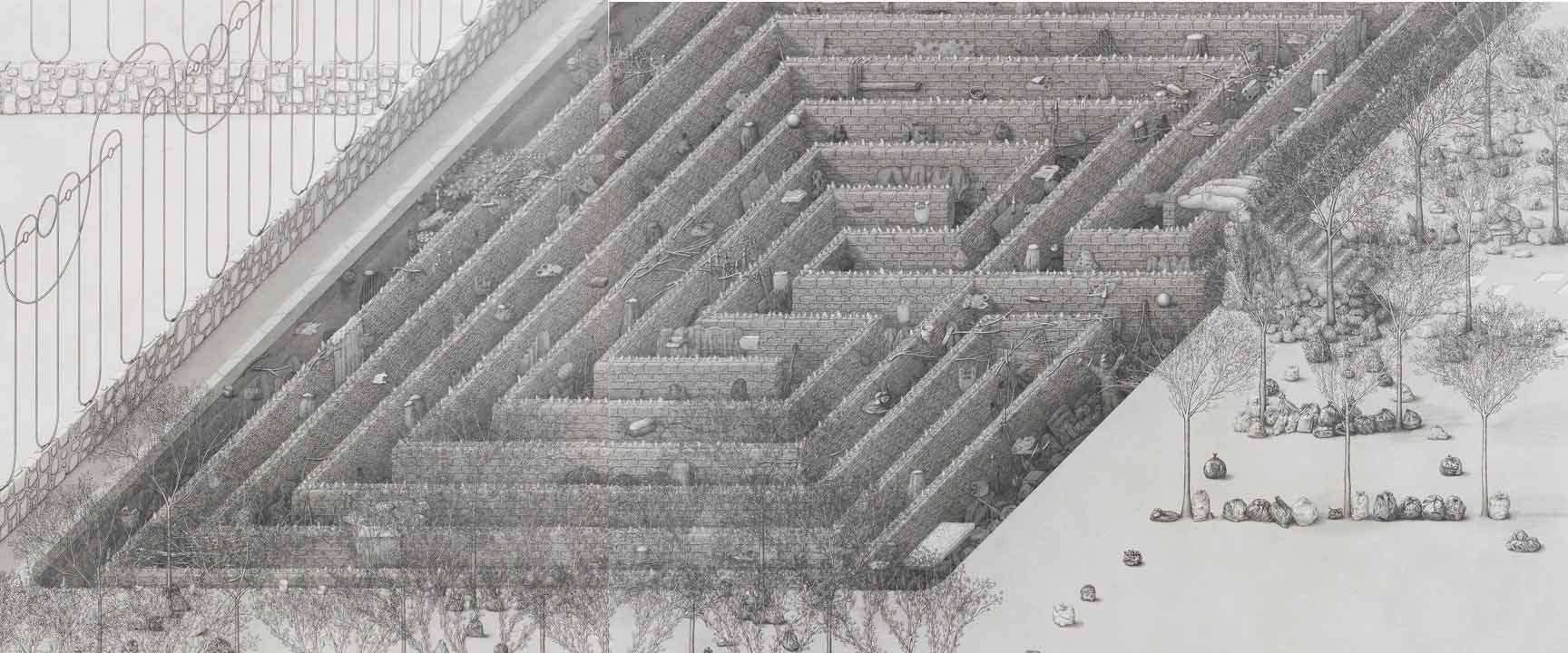
MS: There’s an underground labyrinth in Welcome to Nobson, flooded and filled with garbage. There’s a prevalent feeling of the labyrinthine in crossing paths, complex geometries, the folded architectures that request you make sense of them.
The principle of the labyrinth is a powerful one.
Labyrinths are about both containment and release. A prison and puzzle, built by trickster architects or engineers like Daedalus, here you might encounter death and the Minotaur, monstrous hybrids, an end or an escape. With its network of dark chambers and corridors of caves, the labyrinth is also a maternal world of the womb, appropriate home for testing the identity of human offspring against animal. The labyrinth is a drunken space where axes of orientation (up and down, left and right, back and forth) go astray, where navigation is always hazardous. Its principle is anti-structure — the best labyrinths have no independent Archimedean point to provide orientation and direction. Labyrinths are acephalus structures, anti-hierarchical, anarchic — one never moves ahead, but rather loses one’s head.