Technology
A few alternatives to petrol and diesel that might limit the effects of the decline of fossil fuel sources. Obviously, there is no guarantee at what rates these might be adopted before oil prices rise or how painless the adoption of the new fuels will be. Something to leave for our scenarios, perhaps?
I'll list some ramifications/ possible outcomes at the top of this page -- descriptions of and links to further info on the various alternatives are further down the page.
- Fuel for cars is cheaper than ever (Biodiesel?).
- Fuel for cars is about the same price.
- Fuel for cars actually becomes more expensive than gasoline, a consequence of the complex processes involved in producing the new fuel (might apply to hydrogen cells and electric cars).
Factors that might prevent the development of new fuels in the short term
- Resistance from the oil industry?
- Little short term incentive for consumers to switch?
- Suggestions?
Here's the Department of Energy's website for alternative fuels.
http://www.eere.energy.gov/afdc/
Biodiesel
David Platt: I first came across this in Newsweek a couple of weeks ago. Biodiesel is an alternative fuel source based on vegetable oils. As I understand it, this is the choice that could most easily be made available, requiring little of the developmental research that most of the alternatives (it's "just" a matter of converting cars and getting the sales outlets up and running)
June 6, 2005, Newsweek, U.S. Edition
By Paul Tolme
Environment: Running On Veggies
In 1900, when Rudolf Diesel rolled out his namesake engine, he said, "The use of vegetable oils for engine fuels may seem insignificant today. But such oils may become, in course of time, as important as petroleum." That time hasn't arrived yet. But high gas prices and fears about dwindling oil reserves are garnering mainstream attention for vegetable-oil auto fuel (or biodiesel).
About 400 retail outlets nationwide sell the clean-burning fuel, which powers virtually any ...
One high profile seller of "Biodiesel" is Willie Nelson -- or at least his name is attached to the company.
Just in case nobody can quite believe this:
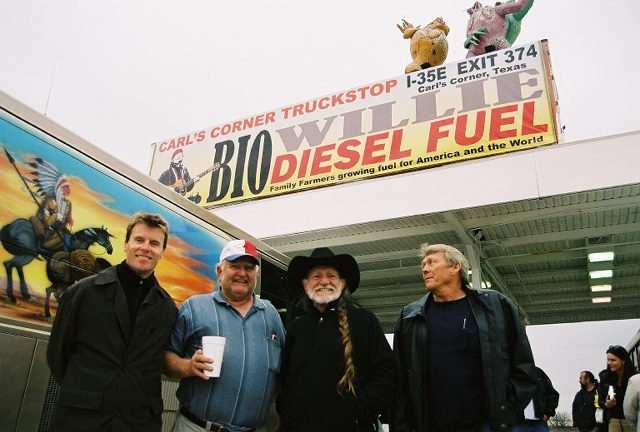
Willie Nelson's Biodiesel company.
Rebecca Daly: Thought I'd add a couple of things here too.
Here are a couple of general links on biodiesel. They discuss not only using the fuel, but also methods for making it yourself. It seems that diesel cars can run on biediesel, which is a mixture of vegetable oil with a catalyst and potentially a wide variety of other stuff, including normal diesel, kerosene, and a bunch of additives for smoothness or lowering the freezing point, etc. They can also apparently run on vegetable oil alone, but this will require some modifications to some engine parts, including injectors, fuel preheaters, and filters. While biodiesel may well become much bigger, the straight vegetable oil fuel system probably won't- among other reasons, it also requires fairly large quantities of oil, and there are a finite number of fast food restaurants one can buy waste oil from.
http://www.biodieselamerica.org/biosite/index.php?id=141,0,0,1,0,0
http://www.dancingrabbit.org/biodiesel/
http://journeytoforever.org/biodiesel_make.html
Hydrogen Cells
David Platt: I'll add some material, later, unless someone else wants to pick this up. In the meantime, here's a cheery article from salon.com arguing that hybrid cars make more sense, as a means of combatting global-warming, than hydrogen-powered vehicles:Rebecca Daly: I'll pick this up. it looks like hydrogen cells are actually getting close to the point of practicality, and might be there in the next 15-20 years.
- Even the administration has gotten sort of behind this- Bush proposed putting $1.2 Billion up for research into fuel cell cars in the state of the union address in January 2003. The author of the article below says that he "vowed that within 20 years...fuel cell cars will "make our air significantly cleaner and our country less dependent on foreign sources of oil"." The article discusses some specifics of the Bush proposal, which ,while claiming to be very green and emphasizing the non-polluting nature of the fuel-cell cars, concentrates on deriving the necessary hydrogen not from renewable resources but from the same non-renewable fossil fuels we currently run our cars on. I guess this would concentrate pollution in fewer places and perhaps produce a lower rate, but it still seems like poor planning. It would certainly help in the promotion of fuel cell cars if the government gets involved with the modification of the current gas station network to carry hydrogen. It is interesting that the major petroleum companies are getting involved in early attempts to legislate hydrogen production for cunsumer use, and it probably does explain why Bush suggests using fossil fuels to manufacture the hydrogen.
http://www.motherjones.com/news/outfront/2003/05/ma_375_01.html
- Hydrogen Fuel cell cars are beginning to hit the road across the US. I've got one review by an author who was lent a 2005 Honda FCX (Fuel Cell Experimental) car for a week, which is a lot longer than most test-drives, and I think gives him a pretty good feel for the car. This is a "street-ready hydrogen car", only 20 of which are currently in existance (in the US and Japan only). The author is impressed by how much it drives like a normal car (only quieter), with reasonable pick-up (0-60 in 11 seconds), "no noticeable lag or flat spots in the power delivery", and fast start-up times. It has a relatively low top accelleration of 93mph and at the moment only works down to 4 degrees F, which limits significantly the places it can be used in. It also has a 190 mile range on a full tank, and when combined with the extremely limited number of places one can actually BUY the hydrogen fuel, this really limits both how far and where one can go at the moment. "The California Fuel Cell Partnership puts the average capital cost to add low-volume hydrogen refueling to gas stations in that state at $450,000", which means it will be a heavy entry-load investment to get fuel cell cars integrated, but it's certainly not impossible.
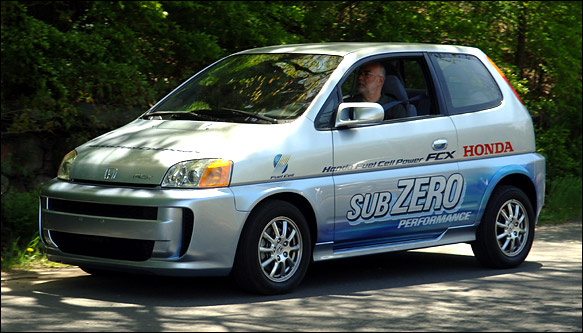
(you might have to register to read this, if you do, let me know and I'll post the text here)
http://www.nytimes.com/2005/06/05/automobiles/05AUTO.html?ex=1118808000&en=0c97db18525ab768&ei=5070
- It is apparently now possible to get yourself a fuel-cell car right now! (actually, since early 2004--see the article below) This can only be done aftermarket though, as there is still no one who sells them to the public. At least two companies exist for the general market, Intergalactic Hydrogen and The Hydrogen Car Company, but of which will either take your new car and refit it as a hydrogen car, or will actually buy the car for you and refit it before you ever see it. There are a couple of downsides to this process:
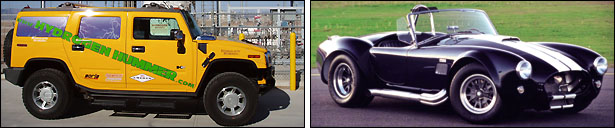
- The first is price. Only a few models have been approved (and they have to go through some sort of testing process to demonstrate that their conversions are safe, which on the whole I approve of!), a Hummer modified by Intergalactig Hydrogen and a Shelby Cobra modified by The Hydrogen Car Company. The Hummer costs $60,000 for the modifications alone (you have to provide the car), and the Shelby comes in at $149,000, just under $100,000 of which is the car itself. The Hydrogen Car Company hopes to begin selling a wide range of trucks and SUVs in the near future, which they plan to price between $30,000 and $80,000 depending on the model.
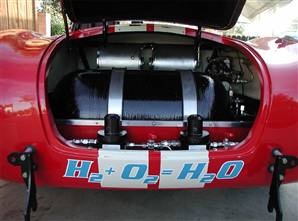
- The second is fueling. As I mentioned above, there are very few places one can buy hydrogen fuel. According to the article, California has a maximum of 13 gas stations that carry hydrogen, although the state apparently plans to expand that number to 170 by 2010. In addition, the cost of Hydrogen can vary widely, ranging from $1 to $20 per kilo (roughly equivalent in energy content to a gallon and in distance to three gallons). Some companies, such as Stuart Energy, are attempting to address this by designing home fueling stations, which would make refueling simple and give the maximum range of travel on short trips from home. No price has been set for these, but they will probably be fairly expensive.
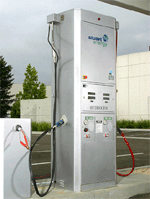
- there are other companies selling hydrogen fuel-cell cars to businesses who need fleets, and who will probably be installing their own fueling station. Anuvu, in Sacramento, is one of these: they plan to bring out a line of converted Nissan pickups and cargo-vans, ranging from $99,000 to $149,000. These will actually be hybrid fuel cell vehicles, replacing the gasoline component in hybrids such as the Insight and the Prius with a small hydrogen fuel cell. It will provide AC and DC power, but may occasionally need to be plugged in.
- One of the reasons the prices are so high for these fuel-cell vehicles is that they are made in such small numbers. Each of the Humvee and Cobra conversions is done individually, and even Anuvu is only making a few hundred converted pickups at a time. Newhouse, from Anuvu, speculates that the converted Nissan pickups "could be sold for $20,000-$25,000 if 100,000 were built" at a time.
- as of yet, very few of these have been sold- two Cobras have been ordered since the company lanched less than a month ago, and no Humvees (although apparently Schwartzenagger pledged to convert one of his Hummers in a campaign speech).
http://www.msnbc.msn.com/id/4563676/
http://www.intergalactichydrogen.com/
http://www.h2carco.com/home.html
- There is apparently a Hydrogen and Fuel Cell cars Business Magazine, which I'll post below, but I'm not going to summarize everything in there! Unless people think it's important, so let me know if you do- until then, I'l just do the two or three things I think are key.
- There is an article about our friends at DaimlerChrysler. They've had a fuel-cell Mercedes Benz, called the F-cell, out in Europe since mid 2004, and have been expanding their placement ever since- two have just been given to the Bay Area Air Quality Management District for daily use, as part of their testing program, which involves "more than 100 fuel cell vehicles under varying weather, traffic conditions and driving styles in different locations worldwide". The entire fuel cell system is housed in the floor of the vehicle, leaving full use of the passenger and cargo spaces. It has a range of approximately 100 miles and a top speed of 85 mph. The electric motor develops 88 hp (65 kW), enabling acceleration from 0 to 60 mph in 16 seconds.
- The Department of Energy pledged in late May to support 70 hydrogen research projects led by 50 institutions in 25 states and with a total cost of $65 Billion. The stated goal is to make "hydrogen fuel cell vehicles and refueling stations available, practical and affordable for American consumers by 2020". The projects can be divided into several groups, including investigations into Novel Materials for Hydrogen Storage, Solar Hydrogen Production, and Bio-inspired Materials and Processes.
- Toyota has developed a high pressure tank for hydrogen storage, which could extend the range of a vehicle from the slightly problematic 100-150 miles to a much more reasonable 310 miles per refill.
http://www.h2cars.biz/artman/publish/index.shtml
http://www.h2cars.biz/artman/publish/article_734.shtml
http://www.daimlerchrysler.com/dccom/0,,0-5-7145-1-199810-1-0-0-0-0-0-9-0-0-0-0-0-0-0-0,00.html
http://www.h2cars.biz/artman/publish/article_729.shtml
http://www.h2cars.biz/artman/publish/article_724.shtml
Here's a smattering of other articles on hydrogen fuel cell technology. They all discuss the reasons it has taken so long, and several speculate on the methods they will use, the speed with which they will become available to the general public, and who will make the best ones. The last one is a pro-con editorial.
http://www.newstarget.com/000118.html
http://archives.cnn.com/2002/TECH/ptech/10/09/fuelcell/
http://www.sfgate.com/cgi-bin/article.cgi?file=/c/a/2005/06/02/FUELCELL.TMP
http://news.uns.purdue.edu/html4ever/2005/050510.Agrawal.fuelcells.html
http://www.progressiveengineer.com/PEWebBackissues2003/PEWeb%2043%20Oct%2003-2/43editor.htm
Most of the major car manufacturers do seem to be looking into fuel-cell technology with some energy, I think in large part because the hybrid cars are selling so well they have to accept that people are eventually going to demand this. Here's some of their 'environment' or 'technology' websites
http://www.gm.com/company/gmability/adv_tech/400_fcv/
http://corporate.honda.com/environment/fuel_cells.aspx?id=fuel_cells_overview
http://www.ford.com/en/innovation/engineFuelTechnology/fuelCells/default.htm
http://www.toyota.com/about/environment/technology/index.html
Electric Cars
David Platt: I'll add some material, later, unless someone else wants to pick this up ...
Rebecca Daly: and again, I'll pick this up.
Electric cars have a long history: as far back as the 20s and 30s, there were electric delivery trucks operating in Dallas, and Nikola Tesla demonstrated his experimental (and controversial) electric car in 1931. This vehicle drove for a week, with speeds of up to 90mph, running on an electric power source that no one has been able to duplicate (in part because the media accused Tesla of practicing black magic and he became so offended that he removed and possibly destroyed the power source).
http://www.keelynet.com/energy/teslafe1.htm
http://www.nuenergy.org/rare/tesla_car.htm
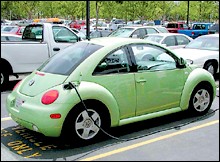
Electric cars never really caught on, despite all the hype and the energy people put into them. Even now, there are reserved parking spaces with plugs all over California, and they are almost never used. This has a lot to do with the fact that electric cars never really felt the same as other cars. They had to be plugged in, they couldn't go that fast, they couldn't go very far, and they didn't accelerate very well. This is no longer the case.
- The "world's fastest electric car" accelerates 0-60 in 3.6 seconds, can go 280 to 300 miles at 60mph on a single charge, and can easily go much faster. The Manufacturer says the tzero"that has compared favorably in acceleration tests to Corvettes, Porsche 911s--and even a Ferrari F355, which it claims to have "out-accelerated...by eight car lengths" in one-eighth-mile drag races." It's made by AC Propulsion and costs $220,000, making it an extremely expensive sports car.

http://www.forbes.com/lifestyle/collecting/2003/10/21/cx_dl_1021vow.html
The record speed for an electric car is 245 mph, although teams are trying to beat that. This car, like other cars designed to break speed records, is not really comfortable for passengers: however, once the technology is developed, it can be modified for more common use.
http://news.bbc.co.uk/2/hi/science/nature/4513529.stm
- There's a really fascinating new design for electric cars that has become slightly more common, but hasn't really caught on yet. This is the use of an electric or hybrid car to generate electricity. Instead of plugging the car in to draw electricity, you would instead plug the car in to output electricity. This isn't the ind of thing a power company would want to rely on, but it would be extremely useful for sudden heavy draw situations, such as brown outs or blackouts. The technology is known as the V2G (for Vehicle to Grid), and if it is picked up, it could conceivably produce a lot of power: if AC Propulsion (I know, the same folks as above- they're busy!) produces "1 million next-generation V2G vehicles by 2020, they could generate up to 10,000 megawatts of electricity". Apparently several different auto manufacturers are looking into incorporating this into their hybrid vehicles, allowing people to use their cars (or trucks, as in at least one commercial I've seen recently, which showed someone in a blackout running their house off of their pick-up. Trying to figure out WHOSE truck that was) as generators
http://www.csmonitor.com/2004/0729/p17s02-stct.html
- Electric cars have become slightly more popular in other countries, where cars such as the REVA have made some inroads. It is manufactured by an Indian company, has been approved for sale in the EU, and can now be purchased in the UK and in Japan. Both countries have provided substantial subsidies for purchasers (1000 pounds in the UK and waived London communter tax, and $2600 in Japan), and the car itself is very inexpensive- it sells for around $10,000. Unfortunately, the REVA is only good as a city car- it can't go much over 40mph, and it can't go very far on a single charge. The company is also beginning to work on a fuel cell car.

http://www.revaindia.com/design/
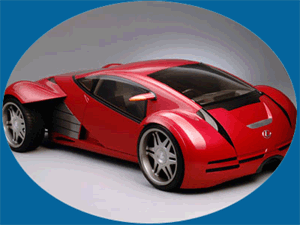
- Electric cars do have a reputation for slowness and poor acceleration, which may explain this: apparently the nifty sportscar from Minorty Report, the Lexus 2054, is completely electric. It does 0-60 in 4.5 secs and has a 90 mph top speed, plus looking REALLY cool, but for the most part people are silent about its status as an electric vehicle. It was developed in conjunction with Planet Electric (also known as Pleiades Enterprises), and is not yet available for sale by Lexus.
http://www.electrifyingtimes.com/minority_report_lexus.html
http://www.pleiades-enterprises.com/pages/251335/index.htm
and here are a couple of electric car/vehicle websites, that I will explore in more detail shortly.
Posted at Jun 13/2005 03:12PM:
David Platt: Excellent -- thanks Rebecca!
Posted at Jun 13/2005 05:32PM:
David Platt: Once again, you've pulled together some great material here. I can think of two (and only two) things that you might consider adding to the main body of your text.
The first, and perhaps less directly relevant for our project, is Michael Schiffer's Taking charge : the electric automobile in America published in 1994. It's a history of the electric car from 1890 to 1920. I'm not sure if you're more of an anthropologist than an archaeologist so I'll add that Schiffer is an archaeologist more famous for his work on archaeological formation processes than social history. A good book with some surprising conclusions about the reasons for the electric car's early failure.
Second, our colleagues at RTNA have their own page dedicated to their Fuel cell project. I'm sure that we can ask them about it at a later date.
