- Videogaming becomes a more likely group activity within the family car
- Requires multiple consoles/ controllers within
- Systems prove too expensive to install in cars.
- Gaming industry too conservative -- much as Hollywood prefers to focus on the male teen - mid-twenties demographic.
- Lack of innovation in gaming industry stymies market expansion. Old gamers give up gaming for something else, see this vitriolic online commentary by David Wong (caution: contains gamer-friendly terms of abuse).
The videogaming industry seems to keep trying to expand its consumer base beyond the traditional male demographic: teen - mid-twenties, although the end of this seems to be getting older in recent years. Traditionally this has been less than successful, for various reasons ("What do girls like?" "My kid loves her Barbie!" "Great! Let's make a Barbie game." "And we'll put everything in PINK."). But, more recently, there have been games that are popular with audiences outside the traditional demographic.
Face-to-Face Videogaming
David Platt: I recently saw an interview with Nolan Bushnell (Newsweek, June 6th, p. 52-53); he's opening a new type of restaurant in LA, called the Media Bistro. This may seem like an unlikely link for a project on car culture, but I was struck by something he said about video games. Traditionally, he argued, games have brought people together in face-to-face environments (think about Hasbro's Family Game Night advertising campaign). Video games, on the other hand, are actually isolating. Bushnell's big idea is to reintroduce the more social aspects of gaming through a restaurant with communal video gaming tables -- sort of like a family LAN party with dinner.
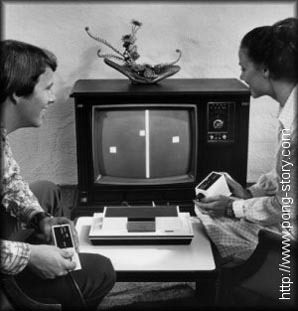
Oh, and this guy invented Pong and founded Atari -- so he may know a thing or two. ;)
Anyway, if there is a move to this kind of gaming, might it not have a natural place as a form of in-car entertainment?
From the New York Times:
At This Restaurant, the Video Games Come With the Meal
By MATT RICHTEL
Published: May 30, 2005
Nolan K. Bushnell, the creator of the Pong video game and founder of the Chuck E. Cheese restaurant chain, is innovating again. He is about to open a restaurant where the servers will have novel attributes: triple redundancy and backup batteries.
In this case, the servers will not be human waiters but powerful central computers that will record food orders and display video games that customers can play while they eat.
Mr. Bushnell calls the concept the Media Bistro, and he plans to open the first one in West Los Angeles this fall. The point, he said, is to get gamers out of the house.
Video games today "are about social isolation," Mr. Bushnell said. "There needs to be a place that brings a little more balance and brings people together."
In an interview last week, he described how the 300-seat restaurant and bar would combine food and drink with ubiquitous interactive media. Touch-screen monitors, installed at every table, booth and barstool, will allow diners to place food orders, play some 70 different video and trivia games, and even take instant pop culture polls.
The monitors at the tables will be two-sided, so that two people, or two couples, will be able to play video games against each other. The restaurant will be divided into two sections, one with more casual gaming at the tables and another where games can be organized for large groups, as in bingo halls.
Projected onto the walls of the restaurant will be digital images ranging from movie previews to changing scenes, like snowfall in winter and clover fields on St. Patrick's Day.
"There will be media everywhere, interactivity everywhere," said Mr. Bushnell, who is 62. "This is not going to be candlelight dinner."
Some game industry analysts, however, find it hard to imagine that consumers will want to combine a night out with playing video games, which they can do at home.
"Do I need to marry those two things?" said Michael Pachter, an analyst with Wedbush Morgan Securities. "It's like saying you're going to combine a restaurant and a barbershop."
Others, like P. J. McNealy, a video game industry analyst with American Technology Research, said the mass-market appeal of video games had led to an intersection with other forms of entertainment, like movies. Combining food and video games, Mr. McNealy said, "continues the trend of business model experimentation."
Given Mr. Bushnell's successes as a serial entrepreneur and his experience with video games and restaurants, industry analysts said they were generally cautious about second-guessing his concept.
Even Mr. Pachter was quick to add that he would not have predicted the success of Pong, an arcade game introduced in 1972 that helped usher in the video game revolution. Nor, he said, would he have guessed the popularity of Chuck E. Cheese Pizza Time Theaters, a chain of 498 family restaurants that feature a variety of arcade games. Mr. Bushnell began the business in 1976; today the parent company of Chuck E. Cheese is CEC Entertainment.
Mr. Bushnell has also had a hand in developing or founding nearly two dozen companies, including Atari in 1972; Etak, a maker of in-car navigation systems, which he started in 1982 and sold to Rupert Murdoch in 1989; and Axlon, a toy company, in 1985.
Mr. Bushnell now runs a small public company called uWink, based in Los Angeles, which develops short-form video games, like poker and trivia games. He said the company had invested about $12 million in developing software for Media Bistro. He said he hoped the restaurant would attract 21- to 35-year-olds.
He said he expected the restaurant to turn a profit by holding down costs. Instead of waiters who take orders, it will have food runners who deliver orders to the tables.
The restaurant will also have "tour directors" who will help diners choose video games and use the screens, Mr. Bushnell said.
He also plans to generate revenue by using the touch-screens to test commercials and conduct consumer surveys on behalf of corporations. Could this be intrusive while people are relaxing?
"Beats me," Mr. Bushnell said. "If they don't like it, we'll stop it."
If the first restaurant succeeds, he said, he will add others, possibly in states like Minnesota and Michigan, where cold weather increases demand for indoor entertainment.
Below: A little homage to Mr. Bushnell.

Posted at Jun 11/2005 09:12AM:
David Platt: Please feel free to add to this/ re-write etc. It is a wiki-entry, after all!
