by Cristina L. Archer (carcher@UDel.Edu)
and Mark Z. Jacobson (jacobson@stanford.edu)
The paper summarizing the results presented below was published in the Journal
of Geophysical Research - Atmospheres in 2005. A copy of the manuscript can be
downloaded here (MS Word, ~4 MB)
or here (PDF, ~17 MB).
Abstract
The goal of this study is to quantify the world?s wind power potential for
the first time. Wind speeds are calculated at 80 m, the hub height of modern,
77-m diameter, 1500 kW turbines. Since relatively few observations are available
at 80 m, the Least Square extrapolation technique is utilized and revised
here to obtain estimates of wind speeds at 80 m given observed wind speeds
at 10 m (widely available) and a network of sounding stations. Tower data
from the Kennedy Space Center (Florida) were used to validate the results.
Globally, ~13% of all reporting stations experience annual mean wind speeds
≥ 6.9 m/s at 80 m (i.e., wind power class 3 or greater) and can therefore
be considered suitable for low-cost wind power generation. This estimate is
believed to be conservative. Of all continents, North America has the largest
number of stations in class ≥ 3 (453) and Antarctica has the largest percent
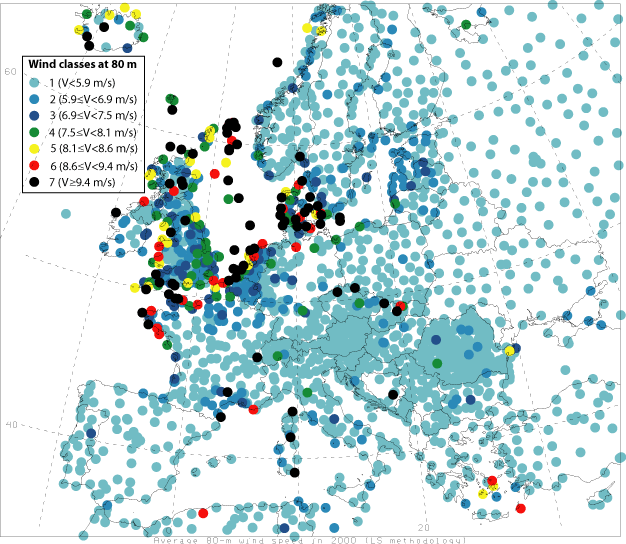
(60%). Areas with great potential are found in Northern Europe along the
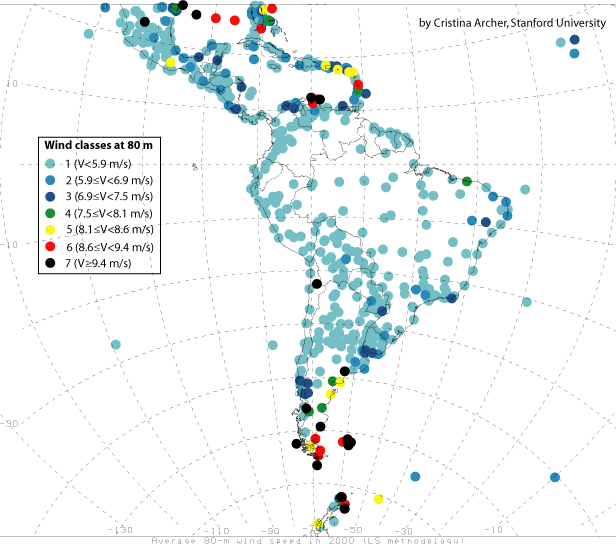
North Sea, the southern tip of the South American continent, the island of
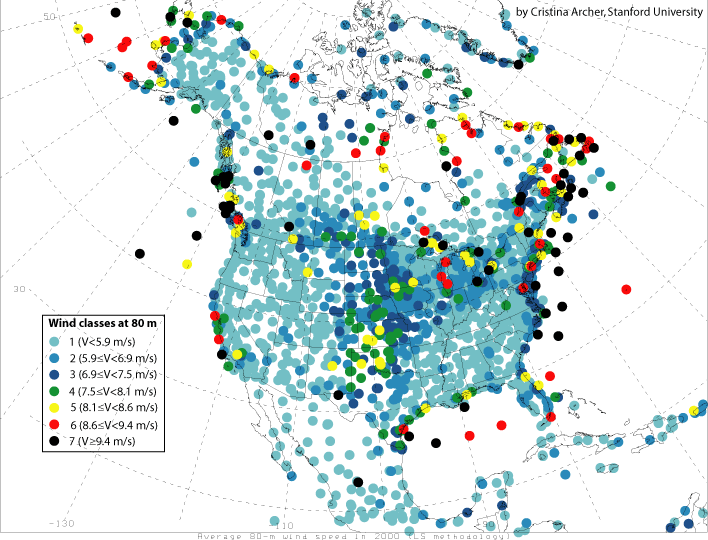
Tasmania in Australia, the Great Lakes region, and the northeastern and
northwestern coasts of North America. The global average 10-m wind speed over
the ocean from measurements is 6.64 m/s (class 6); that over land was 3.28
m/s (class 1). The calculated 80-m values are 8.60 m/s (class 6) and 4.54 m/s
(class 1) over ocean and land, respectively. Over land, daytime wind speed
averages obtained from soundings (4.96 m/s) are slightly larger than
nighttime ones (4.85 m/s); nighttime wind speeds increase, on average,
above daytime speeds above 120 m. Assuming that statistics generated from
all stations analyzed here are representative of the global distribution of
winds, global wind power generated at locations with mean annual wind speeds
≥ 6.9 m/s at 80 m is found to be ~72 TW (~54,000 Mtoe) for the year 2000.
Even if only ~20% of this power could be captured, it could satisfy 100% of
the world?s energy demand for all purposes (6995-10177 Mtoe) and over seven
times the world?s electricity needs (1.6-1.8 TW). Several practical barriers
need to be overcome to fully realize this potential.
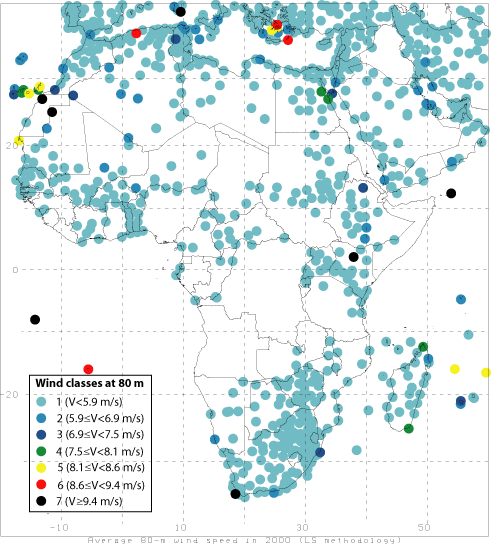
Maps of mean 80-m wind speeds for year 2000
Europe
North America
South America
Australia
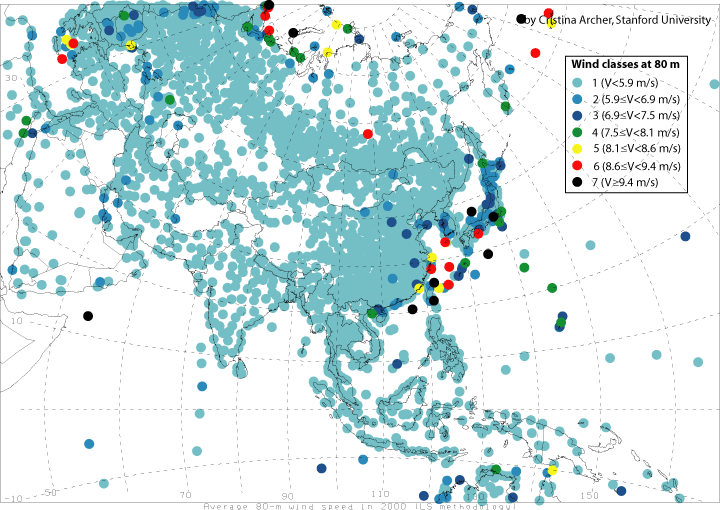
Asia
Africa
Tables
Table 4
Mean 80-m and 10-m wind speeds from all classes or from only
classes ≥ 3 at
different station types (year 2000, only stations with at least 20 valid
measurements).
Station type
Mean V80
Mean V10
Mean V80 for class ≥ 3 stations
Mean V10 for class ≥ 3 stations
(m/s)
(m/s)
(m/s)
(m/s)
Surface over land
4.54
3.28
8.40
6.50
Buoys
8.60
6.64
9.34
7.26
Soundings
4.84
3.31
8.02
6.26
All
4.59
3.31
8.44
6.53
Conclusions
Approximately 13% of all stations worldwide belong to class 3 or
greater (i.e., annual mean wind speed ≥ 6.9 m/s at 80 m) and are
therefore suitable for wind power generation. This estimate is
conservative, since the application of the LS methodology to tower
data from the Kennedy Space Center exhibited an average underestimate
of -3.0 and -19.8% for sounding and surface stations respectively.
In addition, wind power potential in all areas for which previous
studies had been published was underestimated in this study.
The average calculated 80-m wind speed was 4.59 m/s (class 1)
when all stations are included; if only stations in class 3 or higher
are counted, the average was 8.44 m/s (class 5). For comparison, the
average observed 10-m wind speed from all stations was 3.31 m/s (class
1) and from class ge 3 stations was 6.53 m/s (class 6).
Europe and North America have the greatest number of stations in
class = 3 (307 and 453, respectively), whereas Oceania and Antarctica
have the greatest percentage (21 and 60%, respectively). Areas with
strong wind power potential were found in Northern Europe along the
North Sea, the southern tip of the South American continent, the
island of Tasmania in Australia, the Great Lakes region, and the
northeastern and western coasts of Canada and the United States.
Offshore stations experience mean wind speeds at 80 m that are
~90% greater than over land on average.
The Least Square methodology generally performed better against
sounding data than did the log- and the power-laws with constant
coefficients (a=1/7 and z0=0.01 m). Wind speed values predicted with
the Least Square methodology were generally greater than those
predicted with the constant-coefficients curves (with the exception
of the linear profile, which by design predicts lower values than
the constant-coefficient curves).
The globally-averaged values of the friction coefficient a and
the roughness length z0 are 0.23-0.26 and 0.63-0.81 m, respectively.
Both ranges are larger than what is generally used (i.e., a=0.14 and
z0=0.01 m) and are more representative of urbanized/rough surfaces
than they are of grassy/smooth ones.
The globally-averaged 80-m wind speed from the sounding stations
was higher during the day (4.96 m/s) than night (4.85 m/s). Only above
~120 m the average nocturnal wind speed was higher than the diurnal
average.
Global wind power potential for the year 2000 was estimated to be
~72 TW (or ~54,000 Mtoe). As such, sufficient wind exists to supply
all the world?s energy needs (i.e., 6995-10177 Mtoe), although many
practical barriers need to be overcome to realize this potential.
ACKNOWLEDGMENTS. We would like to thank Mark W. Govett (NOAA) and Jonathan
Case (Ensco Inc.) for providing us with sounding data and Kennedy Space Center
data respectively. We are grateful to Andrew Oliver (RES-USA Inc.) and Allen
Weber (Savannah River National Laboratory) for their comments and exchanges.
Funding for this project came from NASA and from the Stanford University?s
Global Climate and Energy Project (GCEP).
Last updated: 3 February 2005