-
-
- The Computational Grid
-
-
- Before the Navier-Stokes equations can be applied
to something, such as an aircraft, computer specialists must represent the
aircraft's surface and the space around it in a form usable by the computer.
So they represent the airplane and its surroundings as a series of regularly
spaced points, known as a computational grid. They then supply the coordinates
and related parameters of the grid to the software that applies the
Navier-Stokes equaitions to the data. The computer calculates a value for the
parameters of interest - air velocity and pressure - for each of the grid
points.
-
- In effect, the computational grid breaks up (the
technical term is "descretizes") the computational problem in space; the
calculations are carried out at regular intervals to simulate the passage of
time, so the simulation is temporally discrete as well. The closer together -
and therefore more numerous - the points are in the computational grid, and
the more often they are computed (the shorter time interval), the more
accurate and realistic the simulation is. In fact, for objects with complex
shapes, even defining the surface and generating a computational grid can be a
challenge.
-
- Since the usual methods of discretization, finite
differences, finite volumes and finite elements, use neighboring points to
calculate derivatives, the nature of the mesh or grid on which the computation
is performed is important. There exist two mesh types, structured and
unstructured, characterized by the connectivity of the points. Below is a
two-dimensional example of each type of grid.
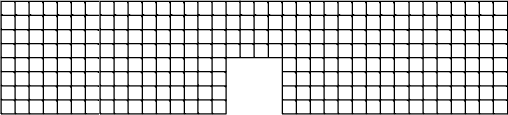
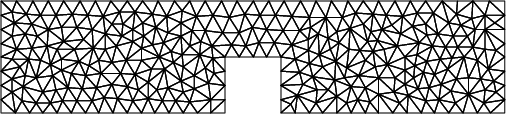
Two-dimensional example of a structured (top)
and unstructured (bottom) mesh for airflow over a step in a
channel.
Structured meshes have a regular connectivity,
meaning each point has the same number of neighbors (for some grids a small
number of points will have a different number of neighbors).
Unstructured meshes have irregular connectivity:
each point can have a different number of neighbors. In some cases part of the
grid is structured and part unstructured (e.g., in viscous flows where the
boundary layer could be structured and the rest of the flow
unstructured).