Symphony Simulation Suite#
The Symphony simulation suite is a publicly-accessible collection of 262 simulated dark matter halos, the massive dark matter structures that all galaxies grow within. These halos span a wide range of sizes: the smallest would be home to dwarf galaxies similar to the Large Magellanic Cloud, while the largest would be host massive galaxy clusters, containing hundreds of Milky Way-like galaxies.
About the Simulations#
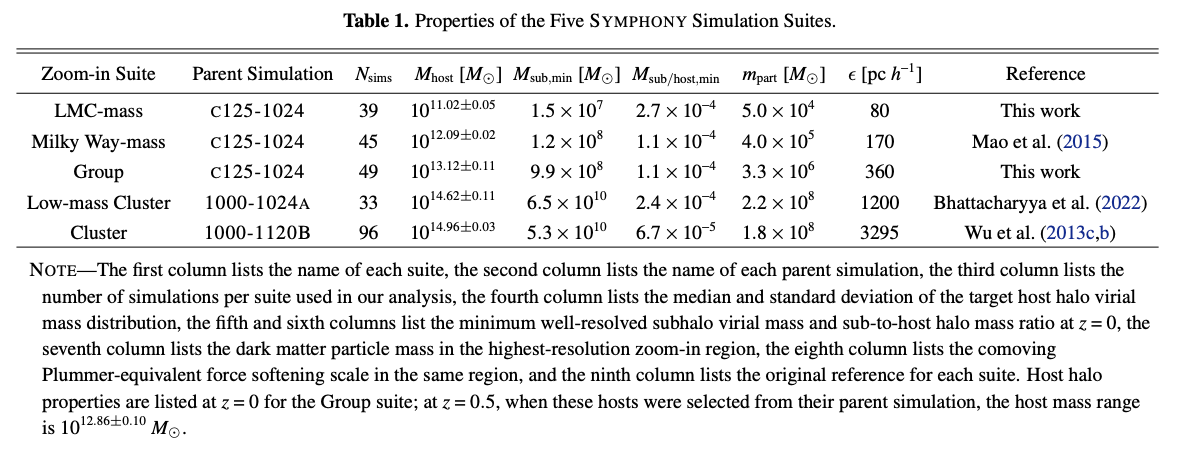
Symphony is a compilation of 262 cosmological, cold dark matter-only zoom-in simulations spanning four decades of host halo mass, from \(10^{11}\,M_\odot\) to \(10^{15}\,M_\odot\). In particular, Symphony includes zoom-in simulations of 39 Large Magellanic Cloud-mass host halos (\(10^{11}\,M_\odot\)), 45 Milky Way-mass host halos (\(10^{12}\,M_\odot\)), 49 strong lens-analog Group host halos (\(10^{13}\,M_\odot\)), 33 Low-mass Cluster host halos (\(4\times 10^{14}\,M_\odot\)), and 96 Cluster host halos (\(10^{15}\,M_\odot\)).
Each simulation is run at high resolution relative to the corresponding host halo mass scale, such that hosts are typically composed of several million dark matter particles [particle sizes range from \(5\times 10^{4}\,M_\odot\) to \(1.8\times 10^{8}\,M_\odot\)]. Symphony’s large statistical host halo sample— spanning several orders of magnitude in host halo mass—combined with its high resolution, enables measurements of host halo and subhalo population properties over a wide dynamic range. Furthermore, a unified set of analysis tools was used to process these simulations, and the documentation provided in this library allows simulation data to be accessed with ease across the suites.
EDEN and Symfind#
In the Symfind library, the Symphony suites are named SymphonyLMC, SymphonyMilkyWay, SymphonyGroup, SymphonyLCluster, and SymphonyCluster. Currently ony the first four have Symfind subhalo catalogs.
SymphonyMilkyWayHR contains high-resolution resimulations of five SymphonyMilkyWay halos. These halos have eight times as many particles with \(R_{\rm vir}\). The five high-resolution simulations were selected based on simulation runtime, meaning that that they are not an unbiased sample of Milky Way-mass halos. The high-res halos have same names as their low-res couterparts to allow for analysis which matches halos across resolution levels. As a convenience factor, generating a simulation directory with sim_dir = symlib.get_host_directory(base_dir, "SymphonyMilkyWayLR", i_halo) will select the fiducial-resolution SymphonyMilkyWay halo that corresponds to the SymphonyMilkyWayHR halo at index i_halo so that you don’t need to manually keep track fo simulation names.
Symlib’s match.py file contains utility functions for matching individual subhalos against one another. Note that cosmological simulations are chaotic, and even small changes in the trajectory of the host halo through its evironment can substantially change its subhalo population, so please visually inspect the results of any matching that you perform. Our tests on Halo530 have made us very wary of any cross-matching involving this specifc host, regardless of matching algorithm.
Technical Details#
Please refer to E. O. Nadler et al. (2023) for complete technical details regarding the five Symphony simulation suites, including the simulations’ numerical and cosmological parameters, convergence properties, host and subhalo population properties, and so on. The table below summarizes the relevant properties of each simulation suite. Note that the Milky Way, L-Cluster, and Cluster suites were originally presented in Mao et al 2015, Bhattacharyya et al 2022, and Wu et al 2013a, 2013b, respectively. In addition to citing E. O. Nadler et al. (2023), studies that use any of these suites should also cite these original papers.
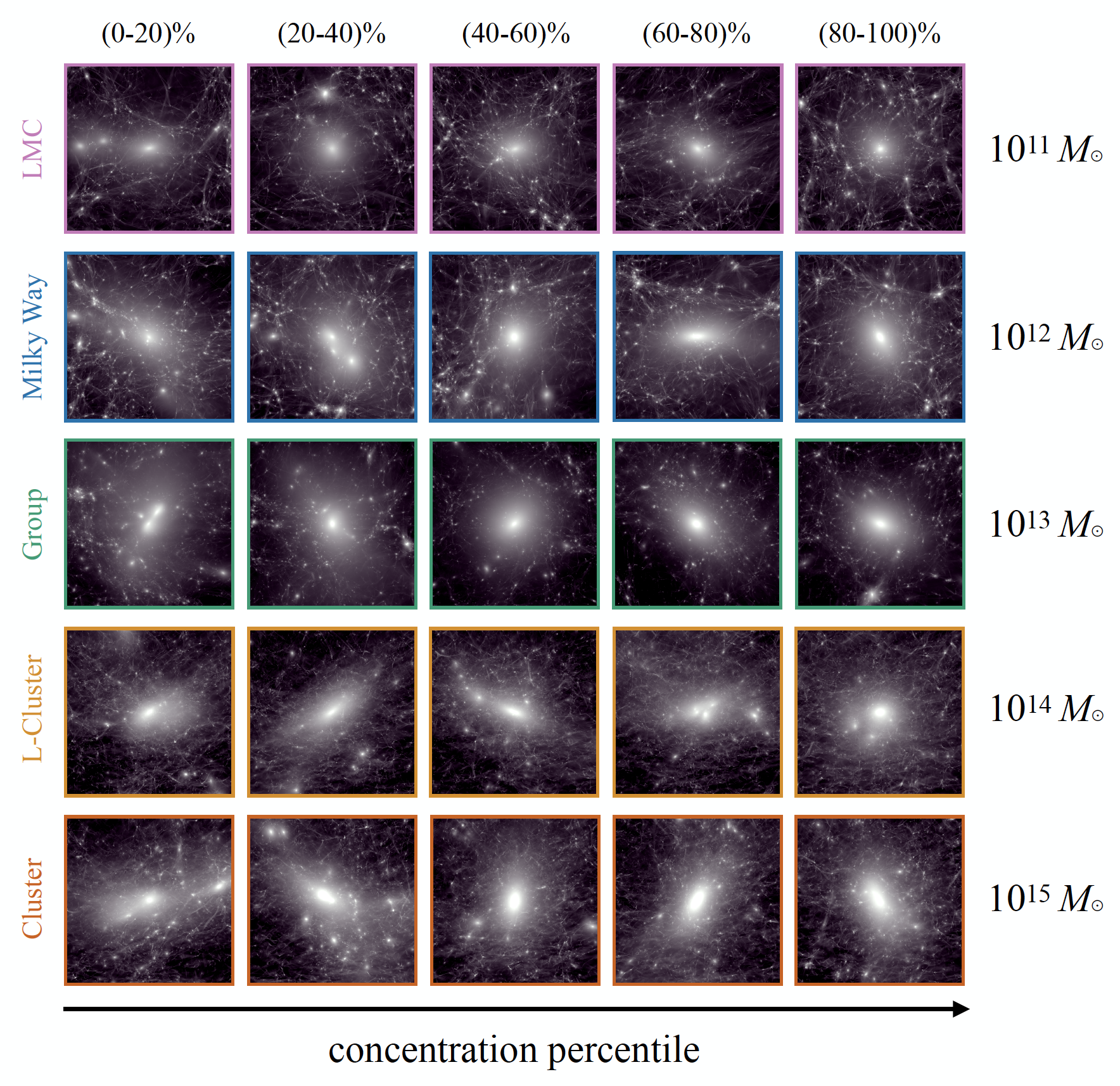
The image below shows five host halos from each Symphony suite. Each row corresponds to a different suite, from the lowest-mass (LMC) hosts at the top to the highest-mass (Cluster) hosts at the bottom. Host halo concentration—a number which increases as more of its mass is concentrated in the halo center—increases in quintiles from left to right, such that hosts with the more centrally concentrated dark matter distributions within each suite are shown towards the right. Visualizations were created using the phase-space tessellation method described in Kaehler et al 2017, 2018.
Publications#
SYMPHONY: Cosmological Zoom-in Simulation Suites over Four Decades of Host Halo Mass — E. O. Nadler et al. (2023) — This paper presents the Symphony compilation and studies the corresponding host and subhalo population properties, comparisons between Symphony simulations and semi-analytic structure formation predictions, galaxy–halo connection modeling using Symphony, and Symphony simulations’ convergence properties.
Symfind: Addressing the Fragility of Subhalo Finders and Revealing the Durability of Subhalos — Mansfield et al. (2024) — This paper describes the Symfind subhalo finder, which is used heavily in the data hosted on this website. It also makes the case that Symfind does a better job tracking subhalos than subhalo finders like Rockstar and lays out a new, comprehensive system for quantifying subhalo finder errors.