|
Nuclear submarines may run silent and deep, but they also radiate wispy
elementary particles known as neutrinos. And those stray particles
could pollute future experiments on how neutrinos behave, physicists
report. On the other hand, the researchers say, a less furtive nuclear
ship might make the ideal neutrino supply for such studies.
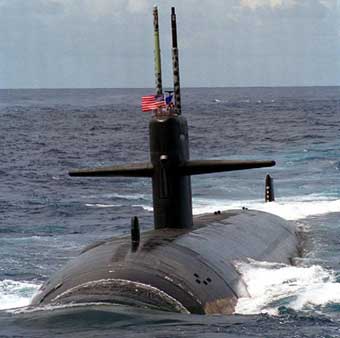 |
Trouble for neutrino hunters? Researchers say nuclear subs could interfere with the next generation of neutrino detectors.
CREDIT: JAMES W. OLIVE/U.S. NAVY |
Born of
radioactive decay and nuclear reactions, neutrinos swarm throughout the
universe, yet they almost never interact with ordinary matter. They
also come in three types--electron, mu, and tau--and in recent years
physicists have proved that the different types can turn into one
another (ScienceNOW, 18 June, 2001).
Researchers hope to study this "mixing" as neutrinos travel from
intense sources such as nuclear reactors to enormous detectors hundreds
of kilometers away.
But
neutrinos from nuclear-powered submarines could contaminate
reactor-based experiments if the detectors lie too close to the coast,
report Giorgio Gratta and colleagues at Stanford University in
California. They estimated how many neutrinos from subs could show up
in the detector of the KamLAND experiment, currently running in a mine
in Kamioka, Japan. A sub parked permanently in nearby Toyama Bay would
increase the number of particles detected by roughly 10%, the
researchers will report in an upcoming issue of Physical Review Letters.
Physicists
working with the Borexino detector in Gran Sasso, Italy, could also be
affected. Although that project's main focus is detecting neutrinos
from the sun, if researchers there decide to track neutrinos from
European nuclear power plants as well, they could see 50% more
neutrinos if a sub happened to loiter around Giulianova on the Adriatic
coast. Of course, no sub is likely to linger in one place for long,
Gratta and colleagues note, so the vessels probably won't cause
problems for current experiments. But even a small amount of
contamination might render Kamioka and Gran Sasso unsuitable for future
high-precision experiments--especially as the movements of the subs
remain secret.
"If you
think about the next generation of detectors, then maybe you want to
worry about this," says Frank Calaprice, a physicist at Princeton
University in New Jersey and a member of the Borexino team. But
Calaprice says that he's more intrigued by the Stanford groupÕs idea of
using a nuclear ship as a neutrino source that can be moved toward or
away from a very large detector. A tricky part, he says, would be
convincing the ship's owner to anchor it in one place and blast its
reactors for months or years at a time.
--ADRIAN CHO
Related sites
The KamLAND home page
The Borexino home page
The Neutrino Oscillation Industry
|