
Single cell analysis by isotachophoresis
Crystal Mijung Han and Juan G. Santiago
Collaborations with:
The Joint Initiative for Metrology in Biology (JIMB) at Stanford
Michael Snyder's group at Stanford Med school
We have developed a precise method and microfluidic chip to handle and then automatically fractionate the nucleus versus cytoplasmic
nucleic acids (cyt-NA) from single cells. The chip uses on-chip cell traps; selective electric field lysing of a single cell's outer membrane
(leaving nucleus intact); extraction and purification of the cytosol nucleic acids (cyt-NA) away from its trapped nucleus using ITP; and fractionation
and high-efficiency (>95%) individual recovery of the intact nucleus and the focused cyt-NA in two separate outputs for off-chip genetic analyses.
Figure 1a shows a schematic of this concept. Figure 1b shows preliminary next-generation sequencing (NGS) data obtained for cytosol versus nuclear
fractions of RNA transcripts from two single cells (we have completed 24 sequencings for 12 single cells comparing cyt-RNA to nuclear RNA transcripts).
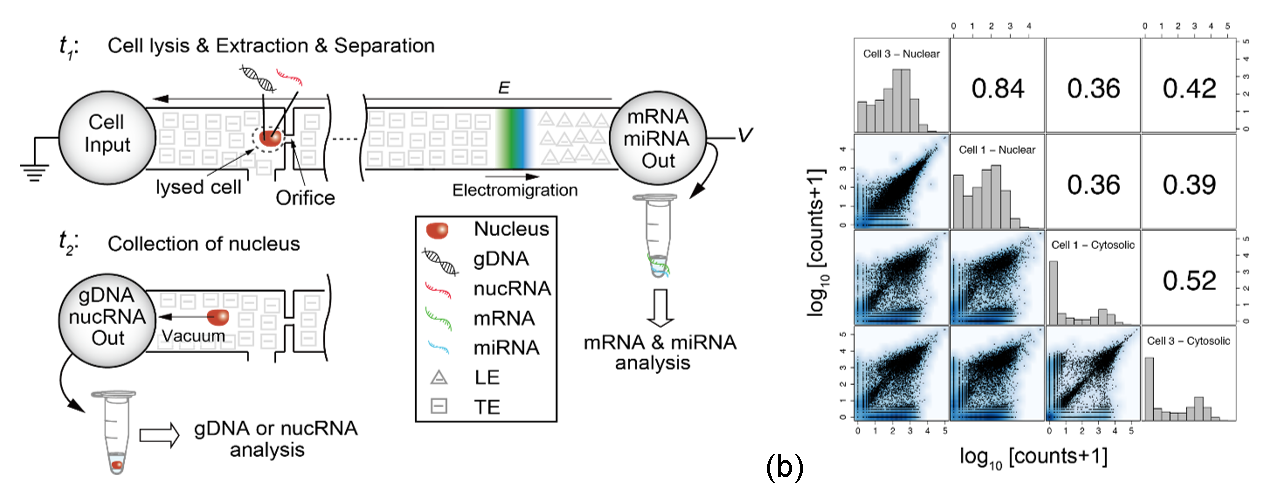
Figure 1: Preliminary work to fractionate and perform NGS analysis of nucleus versus cytosol multi-omics from single cells.
(a) Schematic of our demonstrated system showing cell automatically loaded onto trap via electric field. A locally focused electric
field at the trap selectively lyses cell's outer membrane; releasing cytosol nucleic acids (cyt-NA) to the downstream channel while
leaving intact nucleus in trap. A change in applied electric field within 0.05 s starts cyt-NA extraction, and the ITP zone focuses
and carries cyt-NA to output reservoir on right. Nucleus is recovered from left reservoir via vacuum (Shintaku et al. 2014; Kuriyama et al. 2015).
(b) Preliminary sequencing data obtained for K562 cells in collaboration with Michael Snyder (Stanford) comparing RNA transcripts from nucleus vs.
cytosol (NGS analyses of two single cells, unpublished).
This research aims to provide new quantitative insights into gene expression at the single cell level. Leveraging microfluidic
technology and highly versatile ITP purification methods, the approach holds great potential for many biological studies including
neuron development, stem cell differentiation, and identification of tumor origin.
Reference
Kuriyama, K., H. Shintaku, and Santiago, J.G. "Isotachophoresis for fractionation and recovery of cytoplasmic RNA and nucleus from single cells." Electrophoresis , 2015
Shintaku, H., Nishikii, H., Marshall, L.A., Kotera, H. and Santiago, J.G., "On-chip separation and analysis of RNA and DNA from single cells." Analytical Chemistry,2014 (click here for pdf)