During the early development of DPN, the first type of “ink” used patterned self-assembled monolayers (SAMs) onto a gold surface. Currently, several “ink-substrate” combinations have been developed for patterning. DPN mainly utilizes inks that are made of small organic molecules, organic and biological polymers, colloidal particles(1) , or metals ions. This technology is able to use many different types of ink to create patterns on a variety of surfaces ranging from metals to insulators and even “to pattern on top of functional monolayers absorbed on a variety of surfaces.”(2)
High-resolution patterning has mostly been witnessed to be in the range of 100 nm; however, in a few instances (such as with alkanethiol inks on single-crystal gold surfaces(3)) the resolution has been improved to around 15 nm, which is roughly the size of a single biological macromolecule. Because of this possibility, scientists are eager to develop more extremely high-resolution techniques so that more research can be done on biological processes from the molecular to cellular level. In order to develop even higher-resolution inking, researchers suspect that DPN will require the use of high aspect ratio atomic force microscope (AFM) tips like carbon nanotubes. Another possibility is to combine DPN with another scanning-probe lithography technique so that the benefits of both can be utilized.
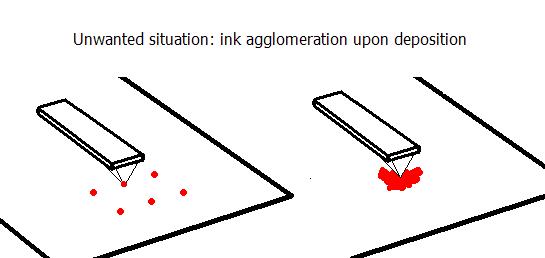
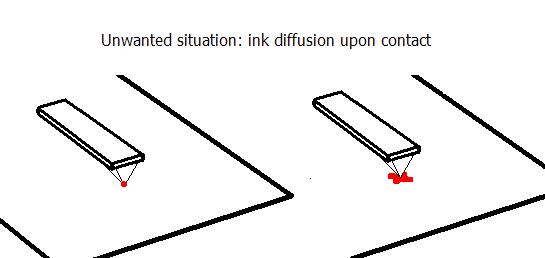
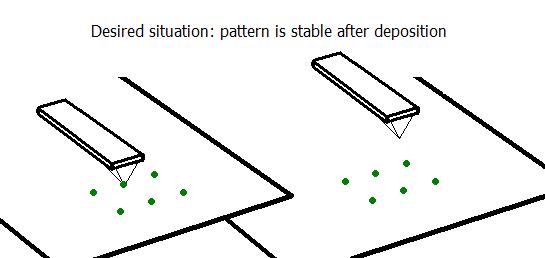
Understanding the process by which the ink is transferred from the tip of the AFM to the surface allows for further development and improvement of DPN. Technically named “tip-substrate molecular transport,” this process has many parameters that influence it. Just a few include the chemical makeup and purity of the ink and surface, the shape of the tip, the distribution of ink on the tip, and the temperature at which the experiment is performed. Two other important factors that greatly affect the quality with which the DPN is able to transfer ink to a surface are the humidity of the surroundings and the water solubility of the ink. Moisture will gather on the tip of the AFM (called the “water meniscus"), which is essential to the DPN process. In order to keep a constant layer of water, which is especially important for scientific experiments, the experiment must be carried out within a humidity-controlled box so that a change in the concentration of water will not affect the results. However, it is also important to note that the effect that temperature and humidity has on DPN molecular transfer depends on the specific chemical properties of the ink used.
(1) Colloids are particles that are larger than molecules but are too small in size to be directly viewed using a microscope.
(2) C. A. Mirkin et al, Angew. Chem. Int. Ed. 2004, 32.
(3) S.H. Hong, J. Zhu, C. A. Mirkin, Science 1999, 286, 523.