Smart Gels
What is a Smart Gel
and how do they work?
Smart gels
contain fluids (usually water) in a matrix of large, complex polymers. These polymers are special in that they
respond to stimuli in an advanced way.
Types of stimuli that affect smart gels are physical and chemical factors. Temperature, light, electric forces, magnetic
forces, and mechanical forces (shaking) are types of physical interactions on
the gel that will precipitate a reaction.
Chemical stimuli are usually pH changes or solvent exchanges (Hirai). The reaction of the smart gel is always an
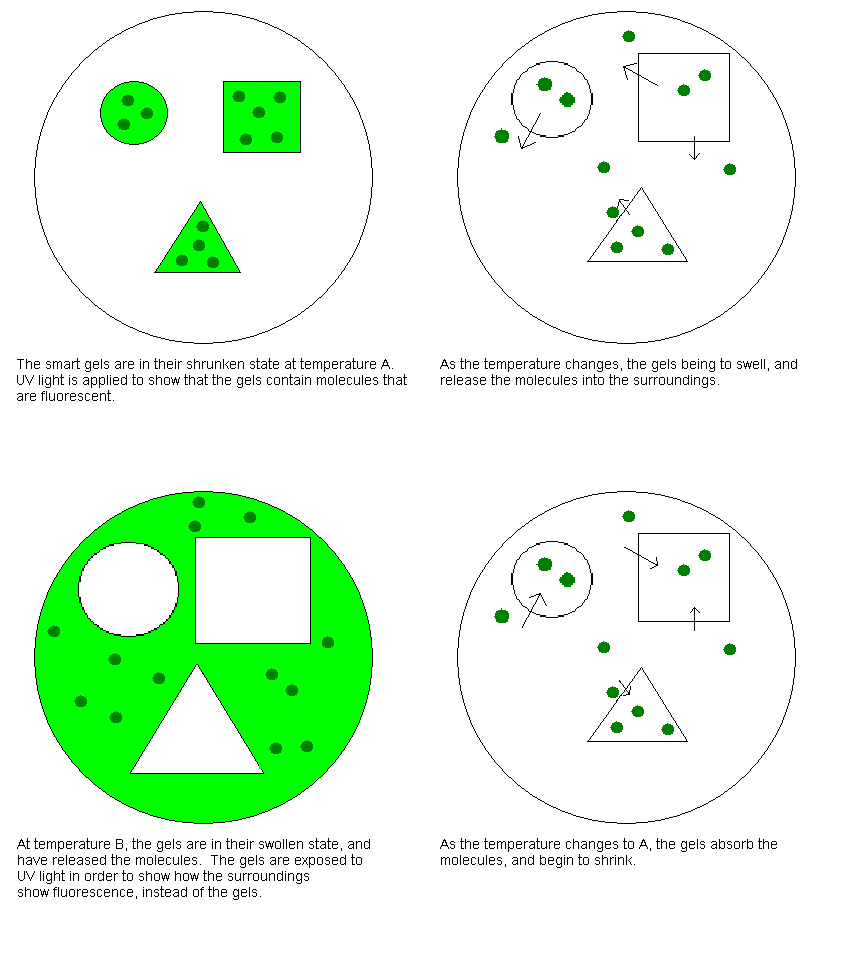
expansion or contraction within milliseconds upon stimulation. Essentially, when a gel swells, it absorbs additional
fluid into it. Likewise, when it
deflates, it expels this fluid out of its membrane. The expansion and
contraction are usually caused by a change in the polymer; the stimulus alters
the polymer by making it more or less hydrophilic. For example a significant pH decrease will
neutralize ions in the gel, precipitating the polymers to be less hydrophilic
and causing the gel to contract (University
of Sheffield).
While smart
gels do not depend on nanotechnology, in many cases their effects are greatly
aided by using nanoparticles. While microparticles usually allow the gel to function properly,
smaller particles at the nanoscale increase intended effects dramatically. A great example of this is in the use of ferromagnetic
particles. Ferromagnets
are tiny particles that act as little bar magnets. In this example, scientists apply a magnetic
field on a smart gel to induce the ferromagnets to
move. This movement raises the
temperature of the gel and consequently causes the gel to expand. While microparticles
of iron still allow the gel to expand, nanoparticles make the gel more responsive
to the magnetic field (Dagani).
How can smart gels be
applied?
Applications of smart gels permeate
into many various fields including both medical and industrial. While smart gels are in their infancy in the
medical field, there is great promise for the technology. The two main applications for smart gels are
in artificial muscle fabrication and drug release. In drug release, a smart gel containing the
desired water soluble drug is injected into the patient. After receiving a certain stimulus (usually
temperature or pH), a hydrogel (a type of smart gel)
will expand by allowing the water and salt in the blood to enter the gel. Consequently, the drug will be released from
the gel in the desired environment. This
concept can be used to release drugs to attack tumors or aid specific areas of
the body (i.e. eye drops for the eye).
This concept is beneficial because the area, duration, and speed of the
release can be better controlled with a smart gel. Eventually hydrogels
could mimic the behavior of the pancreas by releasing chemicals to achieve the optimal
glucose concentration. This could
tremendously help the medical industry by aiding patients with defective
pancreases (i.e. diabetes). Nanoparticles well help this medical technology
by increasing the effectiveness of the gel by increase the surface area of its
constituents (Dagani).
Development in smart gels’ electrical
properties could result in the future production of artificial muscles. When an electric field is applied on certain
types of gels, there is an asymmetric charge distribution within the gel. This asymmetry yields different rates of
expansion throughout the gel. In fact,
in some cases, one end might contract while the other expands. Asymmetry can also be created by producing
heterogeneous gels with different rates of expansion throughout the gel. As a result of the electric field and
asymmetry, the gel bends. This bending
is significant because it mimics the role of muscles in the body which respond
to electrical signals sent from the brain by creating mechanical energy. With
more development, these gels could become replacement muscles for
patients. While this technology is only
in its infancy, the manifestation would aid many who are in need of artificial
muscles (Dagani and Hirai).
One example
of how smart gels could help industry is in the utilization of shake gels. Shake gels respond to forces applied on them
by becoming firm. Shake gels could
tremendously aid shock absorbers. When
driving over a pothole, the shake gel would firm up based on the size of hole
and the weight of the car. This
adjustment would optimize the absorber’s response to the shock (“Recipe…”) .
Note: Citations can be found indexed in the links page.

