| |
002. |
|
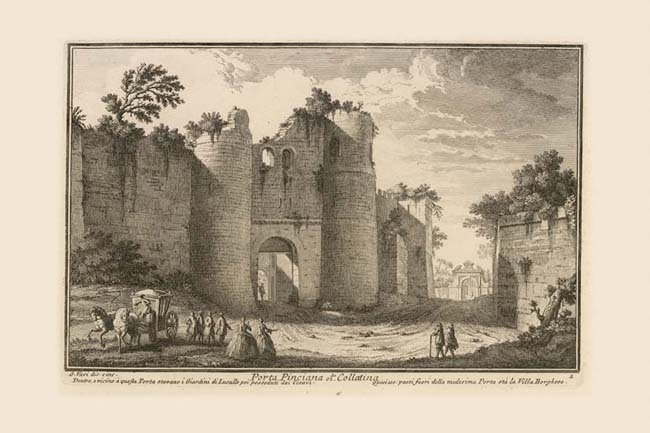
Porta Pinciana ol. Collatina |
|
 |
|
 |
|
 |
|
| |
|
Porta Pinciana |
| |
2. |
Porta sta la Villa Borghese |
Vasi shows the second gate in the Aurelian walls, Porta Pinciana, as still retaining the now vanished vantage court (the walled enclosure behind the main gate with a smaller gate giving access to the city). The gate spanned the Via Salaria Vetus (old Via Salaria: the ancient salt way). Its odd angle with the alignment of the walls reveals the adaptation of the latter to this very ancient path. The round towers flanking the gate are typical of most Roman city gates. The Christian cross on the keystone of the arch reveals this to be an early 5th century reworking of the old gate under the emperor Honorius (395-423 AD). By the early 19th century, the gate was walled up, as indicated by Nibby in his book on the walls (Le Mura di Roma, 1820). It was reopened after 1887 after Rome became the capital of unified Italy, when this quarter of the city began to be redeveloped on the grounds of the former Villa Lodovisi. In the distance Vasi shows the entrance gate (a) to a property which Nolli labels Vigna Ascani gia Ceva. The wall at far right bounds Villa Borghese.
|
