| |
023. |
|
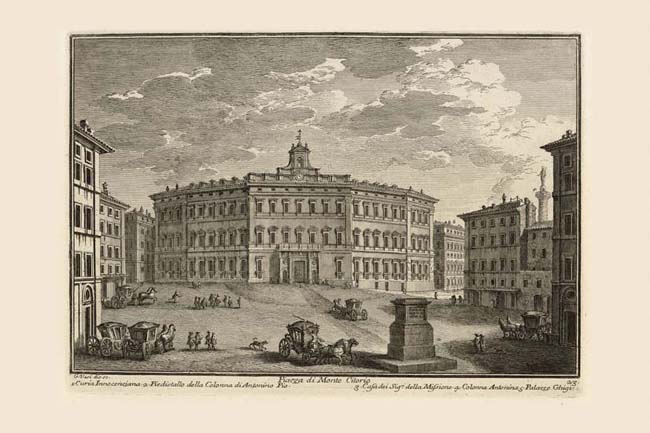
Piazza di Monte Citorio |
|
 |
|
 |
|
 |
|
| |
|
Piazza di Monte Citorio |
| |
1. |
Curia Innocenziana |
| |
2. |
Obelisco Solare d'Augusto, di granito d'Egitto |
| |
3. |
Casa dei Sig. della Missione |
| |
4. |
Colonna Antonina |
| |
5. |
Palazzo Ghigi |
| |
-. |
Palazzo della Casa degli Orfani |
| |
-. |
Palaz. dell’Ospiz. Apostolico Abitazione di Mons. Vicegerente |
The five facets of the Curia Innocenziana (1) followed the curvature of a street which existed before the great piazza in front of it was carved out of the urban fabric. The 1676 map by Falda shows the incomplete palazzo and the street, but no piazza, which dates from the end of the 17th century. Originally begun by Bernini in the 1750s for the Ludovisi family, the palace was completed by his successor, Carlo Fontana under Pope Innocent XII (1691-1700), who turned it into Rome's palace of justice. It is now called Palazzo Montecitorio, (the name which refers to the small hill upon which it located) and houses the Chamber of Deputies, the lower house of the Italian Parliament. The piazza, which is not as wide as the palazzo, as Vasi would have us believe, was extended to the south in 1733 with the space between the two buildings seen in the foreground at the edges of the print (see the Nolli map). To the immediate left of Palazzo Montecitorio, Vasi shows a corner of the Casa dei Sig. ri della Missione (3) while on the right side shows a portion of the much larger Palazzo Chigi (5) which alighns with the Curia and dominates the nearby Piazza Colonna, Plate 22. The Antonine Column (4), which is the focus of that space, peeks above the roof tops of the right foreground buildings. The pedestal in the foreground (2) belongs to the column of Antoninus Pius (138-161 AD) and was placed here in 1745 with the intention of erecting the column on it. Nolli featured that pedestal on the large version of his map where he uses it as the title block. At that time the column itself was stored temporarily in a shed in a recess on the left side of the Palazzo Montecitorio (NN 340). However a fire destroyed both shed and column. Eventually under Pope Pius VI (1775-99) the obelisk from the Augustan Horologium replaced the Antonine pedestal, which was transferred to the Cortile del Belvedere in the Vatican complex. Today the obelisk is still used as the gnomon of a sun dial in front of the Palazzo di Montecitorio.
|
