| |
026. |
|
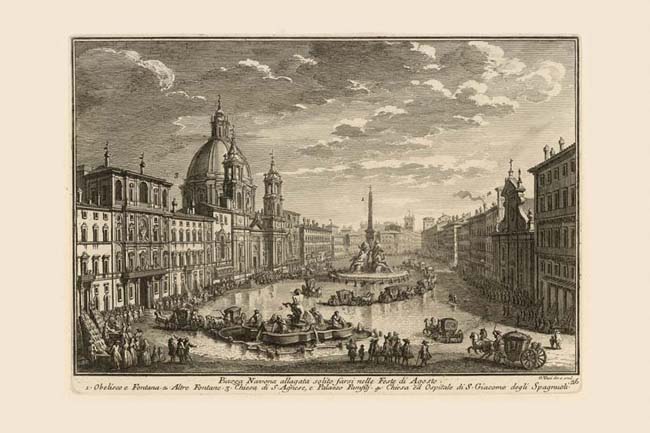
Piazza Navona allagata solito farsi nelle Feste di Agosto |
|
 |
|
 |
|
 |
|
| |
|
Piazza Navona |
| |
1. |
Obelisco e Fontana (Fontana dei Fiumi) |
| |
2. |
Altre Fontana (Fontana del Moro) |
| |
3a. |
Chiese di S. Agnese |
| |
3b. |
Palazzo Pamfili |
| |
4. |
Chiesa ed Ospitale di S. Giacomo degli Spagnuoli |
| |
-. |
Palazzo Ornani |
Since the buildings surrounding this piazza were built founded directly on the stands of the stadium of Domitian (81-96 A.D.) the shape of the piazza is that of a elongated rectangle with one rounded end. The Nolli map shows the outline of the stadium plan and the narrowness of the blocks surrounding the piazza. Vasi emphasizes the more monumental left side with the block containing the sunlit Palazzo Pamphilj (3), the church of S. Agnese (3a) and its three fountains (2) which are suggestive of the central spine or spina of the ancient stadium. These buildings, erected under Innocent X (1644-1655) who also had Bernini build the central Fountain of the Four Rivers (1) represent the climax of the development of the piazza which did not become important until the high Renaissance. Until then, both churches faced away from piazza Navona. The less imposing national church of the Spaniards, S. Giacomo degli Spagnoli (4) on the right, initially faced the Sapienza, see Plate 161. In the early 16th century the orientation of this church was reversed with a new facade built on Piazza Navona. This facade was elevated by one storey in 1879 when the church was renamed Nostra Signora del Sacro Cuore (Our Lady of the Sacred Heart). The early Christian church of S. Agnese (3) formerly faced on to Via dell'Anima until it was totally rebuilt by Rainaldi and Borromini in the present form with its curved facade opening onto the piazza. The narrowness of the block in which it is located makes the width of this church greater than its length, with the great dome being tangent to the facade. Vasi pictures a summer tradition of allowing the fountains to overflow and partially flood the piazza so that noblemen's carriages could parade through the shallow water providing "refrigerio" against the Roman heat in August, while the populace watched. A few of the latter are shown splashing in the water themselves.
|
