|
| |
|
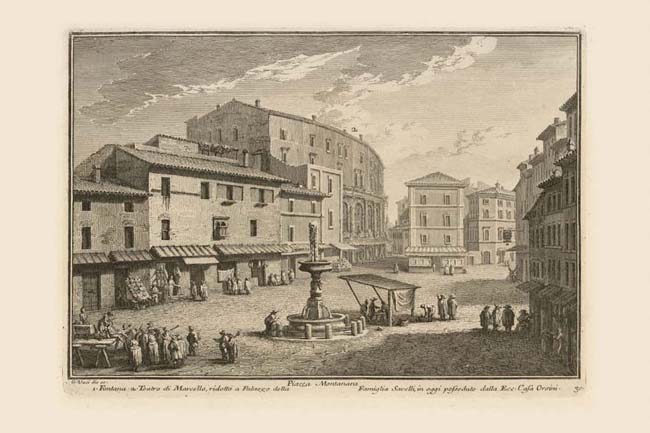
Piazza Montanara |
| |
1. |
Fontana |
| |
2. |
Teatro di Marcello |
Except for the curved Theater of Marcellus (2), nothing is left today of the modest buildings surrounding this once lively piazza. Until the 1920s it served as a sort of open air union hall, where laborers looking for work would gather awaiting to be hired by construction foremen and others. Its demolition between 1926 and 1933 was part of the Fascist plan for a wide new street (Via del Teatro Marcello) and the clearing of the slopes of the nearby Capitoline hill. The same scheme included the isolation and excavation of the lower level of the ancient theater. Completed by Augustus in 11 BC, the great structure became a baronial stronghold belonging to the Savelli family in the medieval period. In the 16th century Baldassare Peruzzi built the palazzo following the curve of the theater, constituting the top two levels visible in the print. The shops in the arches of the lower level, and the apartments filling the arches of the second level were cleared out during the 1920s demolitions, but the palazzo remains. The fountain (2) was moved to a park on the Aventine hill, then relocated in the 1970s in the tiny Piazzetta S. Simeone off the Via dei Coronari. The street following the curve of the theater was called Via dei Sugherari, and led to Piazza di Pescaria, Plate 29A. The dome in the distance to the left of the theater is of S. Maria in Campitelli (NN 989).
|


