| |
032. |
|
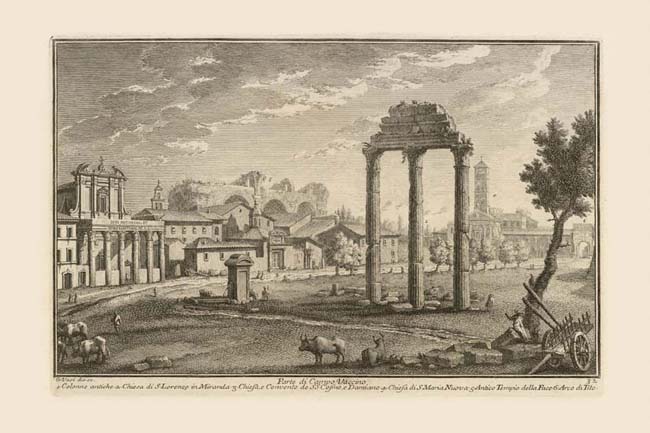
Parte di Campo Vaccino |
|
 |
|
 |
|
 |
|
| |
1. |
Colonne antiche |
| |
2. |
Chiesa di S. Lorenzo in Miranda |
| |
3. |
Chiesa, e Convento de SS. Cosmo, e Damiano |
| |
4. |
Chiesa di S Maria Nuova |
| |
5. |
Antico Tempio della Pace |
| |
6. |
Arco di Tito |
| |
-. |
Fontana |
The second of three Vasi prints of the Roman Forum exhibits even more of its "cow field" character at the time, with numerous bovines and a dedicated drinking trough in the left middle ground (NN 927). At the same time it is worth noting that Nolli's index entry reads "Piazza di Campo Vaccino," which is an indication of its serving as the only piazza for the nearby neighborhood of Pantano, whose edge we see on the left side of this print. Pantano was an expansion area of the city planned and developed in the 1560s on the site of a former quagmire (pantano) caused by the medieval blockage of an ancient storm drain which gathered the runoff from the Quirinal hill. The whole neighborhood was demolished in the 1930s to make way for Mussolini's Via del Impero (now called Via dei Fori Imperiali). Few Roman piazze fail to include a church facing into it, but this piazza had no less than eight, three of which appear in this view. On the left we see S. Lorenzo in Miranda (2), a Baroque church built into the remains of the mid 2nd century Temple of Antoninus and Faustina, utilizing its hexastyle temple front as a kind of entrance porch. The tree-lined path passing in front of this church links the Arch of Septimius Severus, Plate 31, to the Arch of Titus (6), and is part of the Via Papale, the papal processional route linking St. Peter's to the Lateran. Moving to the right on this path we encounter the circular entrance hall to SS. Cosma e Damiano (3) built into another ancient structure, the so-called Temple of Romulus. The body of this church utilized yet another ancient structure, visible behind the circular entrance structure, which was originally a library building facing into the Forum of Vespasian, next to the massive Basilica of Maxentius (5), mistakenly named the Temple of Peace. Vasi depicts the only remaining third of this, the largest forum basilica, on which the highest elements mark the spring points of the giant cross vaults of its central hall. The partly buried columns of the Temple of Castor and Pollux (1) dominate the right half of the image. Beyond this famous icon of the Roman Forum we see the Baroque church of S. Maria Nova (4). Nolli gives it its other name of S. Francesca Romana, still used today.
|
