| |
034. |
|
Piazza di S. Giovanni in Laterano |
|
 |
|
 |
|
 |
|
| |
|
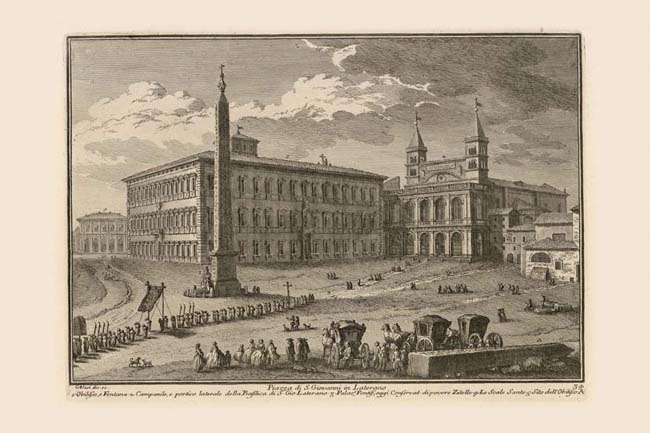
Piazza di S. Giovanni in Laterano |
| |
1. |
Obelisco, e Fontana |
| |
2. |
Basilica di S Giovanni in Laterano |
| |
3. |
Palazzo Pontificio |
| |
4. |
Scale Sante |
| |
5. |
Sito dell'Obelisco |
Vasi presents the view that one gets upon entering the piazza from the Via di S. Giovanni in Laterano, along which the papal processions approached the Lateran. S. Giovanni has always been the seat of the Bishop of Rome. As such it was the goal of the elaborate Possesso procession performed by each newly crowned Pope (except the current Benedict XVI), moving in state from St. Peter's to take possession (hence the name Possesso) of the Lateran, which is "mother and head of all churches of the city and of the world" as an inscription of its main facade relates:
SACROS•LATERAN•ECCLES•OMNIVM VRBIS ET ORBIS ECCLESIARVM MATER ET CAPVT
The transept entrance and facade (2) was the one most in use from the late middle ages on, because it faced the approach from the main part of the city. Sixtus V (1585-90) added the two-level, arched benedictional loggia to this facade, replacing the former one which stood at the corner of the Patriarchium (3), the original papal palace, which the same Pope had demolished and rebuilt by Domenico Fontana in the form we see here. The same architect is responsible for the rebuilding of the Sancta Sanctorum (4), left background, as well as for erecting Rome's tallest obelisk (1) in the piazza, having brought it here from the Circus Maximus where it once stood. The fallen obelisk in the foreground was discovered in the 1580s in the Horti Sallustiani next to Villa Ludovisi. In 1733 Clement XII Corsini (1730-1740) had it brought to Piazza S. Giovanni with the intention of erecting it in front of the main façade of the Lateran basilica, which was then receiving a new form at the hands of Alessandro Galilei. But 20 years later, in Vasi's day, it was still lying unused in the piazza. To better illustrate this obelisk, Vasi depicts it at an exaggerated scale (note the people standing next to it) removed from its actual location, as if it were resting near the point from which this view was taken. He informs us in the caption that its true location was at the point marked 5 at extreme left. Nolli accurately indicates its precise position next to the number 14 on his map: "Obelisco Lodovisio giacente" (prone). In 1788 Pius VI decided to place it at the top of the Spanish steps in front of Trinità dei Monti. There it was sited on axis with Via Condotti, and erected on a very high base so as to make it visible from Piazza di Spagna between the two towers of Trinità dei Monti, Plate 128.
|
