|
| |
-. |
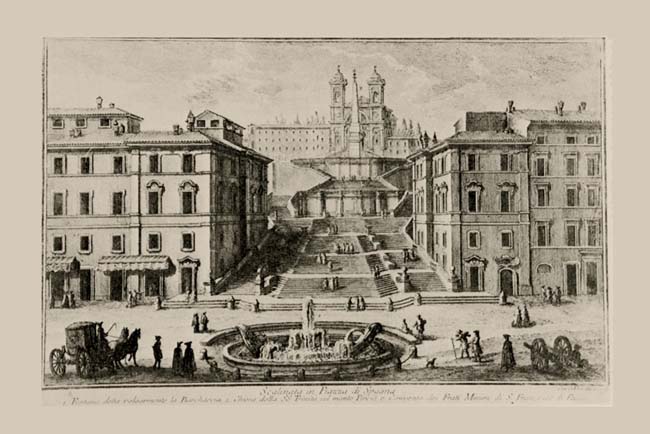
Scalinata della Chiesa della SS. Trinità |
| |
|
Chiesa della SS. Trinta sul monte Pincio, e Convento dei Frati Minimi di S Francesco di Paola |
| |
1. |
Fontana detta voloarmente la Barcaccia |
| |
-. |
Obelisk |
This view of the Spanish Steps is one of two contiguous views which focus on the Piazza di Spagna, Plate 40. Its vantage point was probably taken from a fourth floor window of a building across the piazza from the steps. The high viewpoint enabled Vasi to illustrate the upper ramps of stairs and to elevate the church of Trinità dei Monti (2) (NN 391) above the other buildings for dramatic effect. The off-axis view masks the asymmetry of the great stairway whose subtle deviation is discernible on the Nolli map. The stairs were designed by designed by Francesco De Sanctis largely following an earlier scheme by Alessandro Specchi. They were completed under Benedict XIII Orsini (1724-1730), and partly funded by the French, as noted in the inscription on the second landing. The steps are the culmination of an urban axis begun by Paul III Farnese (1534-1549) who had Via Trinitatis (Via Fontanella Borghese/ Via dei Condotti) cut through from Piazza Nicosia and aimed at Trinità dei Monti. The next element to mark this axis was the 1629 fountain of the old boat or Barcaccia (1) by Bernini. Then came the Spanish steps, whose official name is Scalinata della Trinità dei Monti. Finally, several decades after the initial Vasi print was made, the obelisk was placed at the top of the steps in 1789 on the axis of Via Condotti under Pius VI Braschi (1775-1799).
|


