| |
059. |
|
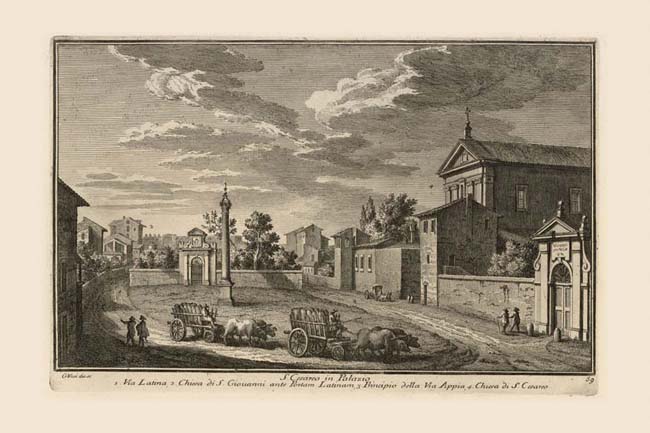
S. Cesareo in Palazio |
|
 |
|
 |
|
 |
|
| |
1. |
Via Latina |
| |
2. |
Chiesa di S Giovanni ante Portam Latinam |
| |
3. |
Principio della Via Appia |
| |
4. |
Chiesa di S Cesareo |
Here Vasi seems to be more interested in the intersection of two major ancient roads than he is in the church which gives the title to this print. Both roads led from Rome to the Latin volcano (or Alban hills) around which were located the towns of the Latin League. The prehistoric Via Latina is on the left (1), and the 4th century BC Via Appia is on the right (3). Between the two roads is the entrance gate to the wedge-shaped Orto Passarini. S. Cesareo (4) is a medieval church built into a 2nd century AD roman structure with elaborate mosaic floors, hence its "in Palazio" appellation. The facade of the church, partly hidden in the print, dates from restoration of the church in the year 1600. The Nolli map indicates that the church owned a small area to the left of the building, but was bordered on the other sides by land belonging to other religious orders. At the right edge of the print we see the gate to the Vigna de PP. della Minerva (a farm belonging to the priests officiating the church of S. Maria sopra Minerva). What Vasi calls the church of S. Giovanni ante Portam Latinam (2) (in front of the Latin gate) is actually the Franciscan monastery building attached to that church, which is not visible in this view. Immediately to the right of this building is the crenellated top of Porta Latina in the Aurelian walls (see Plate 9). Directly below this appears the dome of the early 16th century circular church of S. Giovanni in Oleo (NN 947), restored by Borromini in 1658.
|
