| |
094. |
|
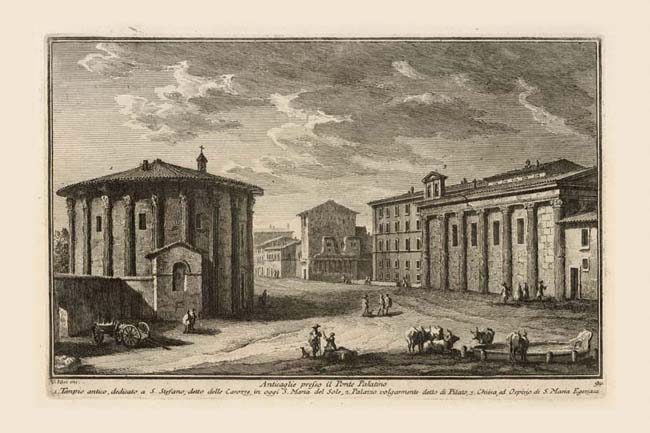
Anticaglie presso il Ponte Palatino |
|
 |
|
 |
|
 |
|
| |
1. |
Tempio antico, dedicato a S Stefano, detto delle Carozze in oggi S Maria del Sole |
| |
2. |
Palazzo volgarmente detto di PIlato |
| |
3. |
Chiesa, ed Ospizio di S Maria Egeziaca |
Topographically in sequence with the previous view, but not strictly related to Volume V's theme of the river, is this print of the northern half of Piazza della Bocca della Verità (NN 1087). The only link to the river is in the title where Vasi refers to Ponte Rotto as the "Ponte Palatino", a reference to the nearby Palatine hill. Also in that title, "Anticaglie" is a rather pejorative reference to the two "antiques" in the right and left thirds of the image, both of them ancient temples transformed into churches during the middle ages. Until the 20th century, the round temple (1) on the left was referred to as that of Vesta, goddess of fire. It is now thought to have been dedicated to Hercules Victor. In the 12th century the temple was dedicated to S. Stefano "delle Carozze", which refers to the name of the street alongside it in this image (now absorbed into the wide Via L. Petroselli). In the mid 16th century the church was renamed S. Maria del Sole. In the 1930s the temple was restored by the removal of the walls between the columns. The rectanglular temple (3), formerly referred to as Fortuna Virilis, is now thought to have been dedicated to Portunus. It was transformed into the church of S. Maria Egiziaca in the 9th century. It was returned to its temple form in the 1930s when this area was cleared of all buildings except the two temples and the "so-called house of Pilate" (2). The latter is now known to be a house built in the mid 11th century by Nicolas, a member of the powerful Crescenzi family. An elaborate inscription over its doorway tells us that the owner built it in an effort to restore the glory of ancient Rome. This is borne out by the fact that he built the house largely out of ancient spolia.
|
