| |
109. |
|
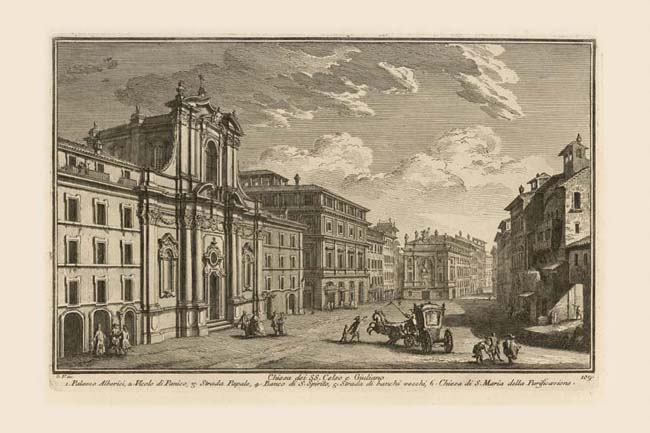
Chiesa dei SS. Celso e Giuliano |
|
 |
|
 |
|
 |
|
| |
|
Chiesa dei SS. Celso e Giuliano |
| |
1. |
Palazzo Alberici |
| |
2. |
Vicolo di Panico |
| |
3. |
Strada Papale |
| |
4. |
Banco di S. Spirito |
| |
5. |
Strada di banchi vecchi |
| |
6. |
Chiesa di S. Maria della Purificazione |
The late Baroque church of SS. Celso e Giuliano, designed and built in the 1730s by De Dominicis, replaced an early Christian church which once faced onto Piazza di Ponte from which this view was taken. The real subject of this print is actually a fairly narrow street named, at that time, Strada de'Banchi (NN573) which is enlarged to look like a piazza. Vasi widened this important street graphically in order to better reveal its sides and perhaps to underscore its stature as the major link between the Vatican and the rest of the city. This short street, which extends the axis of the bridge leading to Castel S. Angelo, was known as Canale di Ponte a reference to both the bridge "ponte" and the fact that it was the first street in this area to flood when the Tiber overflowed its banks. Significantly Ponte is also the name given to the entire rione which contains this view. In the Renaissance, Strada de'Banchi was Rome's Wall Street, lined with banking establishments, which were supervised by the Zecca (4) (mint) at the head of the street. Antonio da Sangallo the Younger designed the concave facade of this building during the reign of Leo X Medici (1513-1521) making it the first curved facade of the Renaissance. Vasi's title for the old Zecca indicates that by then it had become the Banco di S. Spirito, founded by the hospital of that name, Plate 171, in Borgo. The street is still called Via del Banco di S. Spirito even though that bank was absorbed by the Banca di Roma in the late 1990s. Strada de' Banchi was part of the Via Papale, the papal processional route linking the Vatican to the Lateran. The Possesso procession (when each newly elected Pope would take possession of the Lateran) passed through here and continued on the Via dei Banchi Nuovi, Vasi's Strada Papale (3) on its way to S. Giovanni in Laterano. In the evening, the procession would return along Via dei Banchi Vecchi (5) on its way back to the Vatican passing the small church of S. Maria dell Purificazione (6) barely visible in Vasi’s print. The beginning of a third major street intersecting Strada de' Banchi is the ancient Via Recta, Vasi's Vicolo di Panico (2) exiting on the left between the church block and the early 16th century Palazzo Alberini (1) misnamed Alberici by Vasi.
|
