| |
150a. |
|
[Ruine del Foro di Nerva] |
|
 |
|
 |
|
 |
|
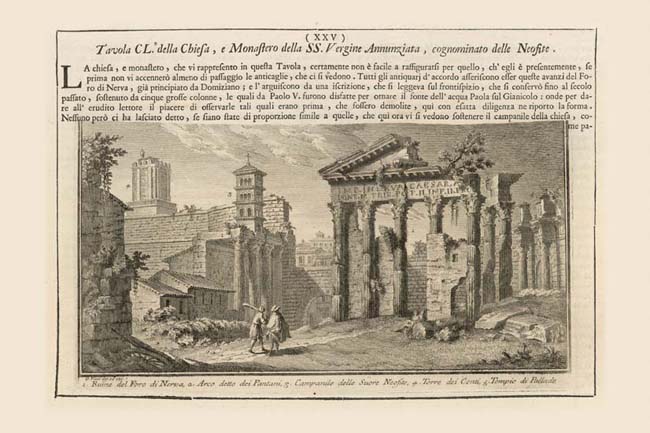
| |
1. |
Ruine del Foro di Nerva |
| |
2. |
Arco dei Pantani |
| |
3. |
Campanile delle Suore Neofite |
| |
4. |
Torre dei Conti |
| |
5. |
Tempio di Pallade |
This is a rare excursion into reconstruction of ancient ruins by Vasi, who, like Nolli, concentrated most of his efforts on the contemporary city. The justification for the view is that it depicts the convent and campanile of the Dominican Neophyte nuns (3) from a different angle than in the closely related print of both it and S. Maria Annunziata, Plate 150. The medieval church and monastery of the Annunziata were built into the late 1st century BC Temple of Mars Ultor which backed onto the great perimeter wall of the Forum of Augustus which Vasi mistakenly refers to as part of the Forum of Nerva. It is no coincidence that the only surviving columns of that temple correspond to the edge of the medieval building where their static properties provided a convenient structural reinforcement. The bell tower was demolished in 1823, while the church and convent were destroyed during the excavations of the Forum of Augustus in the 1930s. Part of that forum is the Arco del Pantano (2) which gave access to the ancient Suburra neighborhood. Dominating the right half of the print is the Temple of Minerva in the Forum of Nerva. This no longer existed in Vasi's day, having been demolished by Paul V Borghese (1605-1621). In his text Vasi notes that he is presenting a reconstruction of the vanished temple which he calls the Tempio di Pallade, probably based on an earlier image such as the 1577 Duperac print. Vasi imagines the site cleared to the right so as to view the only surviving columns which lined both sides of Nerva's forum the two columns, known as the colonnacce (5) are featured in the related Vasi view, Plate 53A. Another Vasi error of nomenclature is the medieval tower rising on the left: he calls it the Torre dei Conti (4) but it is actually the Torre delle Milizie, built on the Markets of Trajan.
|
