| |
181. |
|
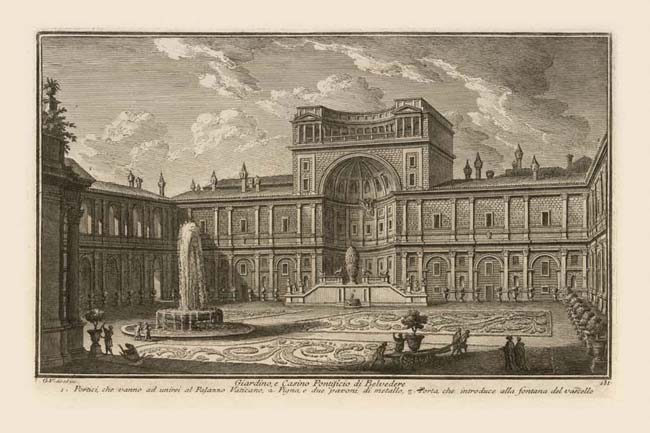
Giardino, e Casino Pontificio di Belvedere |
|
 |
|
 |
|
 |
|
| |
|
Casino Pontificio di Belvedere |
| |
|
Giardino Pontificio di Belvedere |
| |
1. |
Portici che vanno ad unirsi al Pal. Vaticano |
| |
2. |
Pigna e due pavoni di metallo |
| |
3. |
Porta che introduce alla fontana del vascello |
The Casino di Belvedere is a 15th century building located at a high point of the Vatican hill about 300 meters (about 1000 feet) from the papal palace, overlooking the plain of Prati di Castello from which lower vantage point Vasi provideds a second view of the Belvidere which can be seen in his print of the Porta Angelica, Plate 19 silhouetted against the sky with an impressive sunset. As an isolated building with a "good view" (Belvedere), it probably served the function of a suburban villa for the pope in the same way as a number of the other sites in this volume did for the noble families to which they belonged. Under Julius II Della Rovere (1503-1513), Bramante built two long wings (1) linking the Belvedere to the main papal palace, thus forming a rectangular garden court on three levels. In this print Vasi depicts the top level of that court and its gardens, which Nolli labels Giardino della Pigna on his map. Pigna refers to the ancient bronze pine cone (2) standing in front of the Nicchione (great niche). The Nicchione, built by Ligorio in 1560, is at the center of the short north wing of the Bramante court, which masks the Belvedere building itself. The pine cone, found in the Baths of Agrippa, was used in the medieval period to decorate the courtyard in front of old St. Peter's, and then moved here in the early 17th century. The columned structure at the extreme left edge of the print appears to be an entrance to one of the two cross wings added to the Bramante court, dividing it into three distinct spaces.
|
