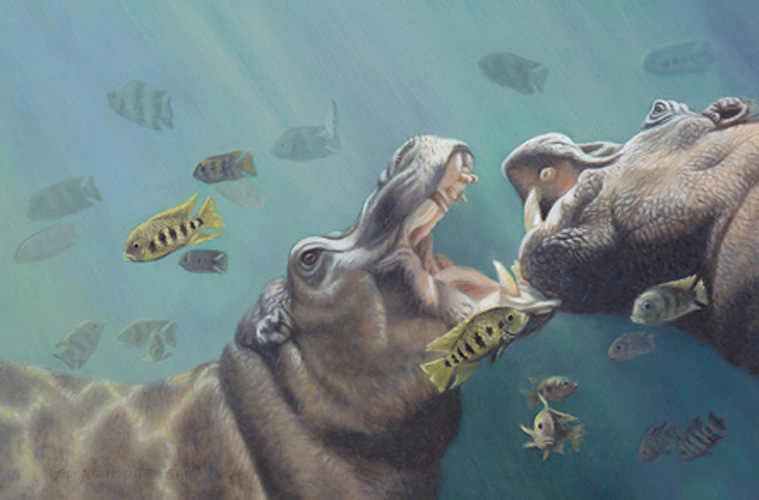
Hippos were thought to be related to pigs until recent DNA analysis suggested that they're more closely allied to cetaceans than to other artiodactyls. Their common ancestor is thought to have split from other even-toed ungulates about 60 million years ago, with the two groups diverging about five million years later. The peculiar artiodactyl fossil Indohyus, from Eocene India, is placed by some within the hippo/whale clade. The earliest known hippo fossils (Kenyapotamus) date to around 16 million years ago, and are from east Africa. Hippos can hear well underwater, although they lack the thickened auditory bullae typical of whales.
keywords: evolutionary lineage, divergence, adaptation, taxonomy, mammals, hippopotamuses, cetaceans, paleontology, DNA
Original Caption: Hippopotamus (Hippopotamus amphibius) The Indohyus was a fox-sized semi-aquatic herbivore, from the kasmir region of India, living about 48 million years ago and an early ancestor of hippopotamus. Recent DNA analysis found that among artiodactyls, cetaceans are hippo’s closest living relations. The common ancestor of whales and hippos split from other even-toes ungulates about 60 million years ago. They diverged 55 million years ago. The earliest known hippo fossils date to around 16 million years ago (Kenyapotamus) from east Africa. Hippos can hear above and below the water, through ear bones traditionally associated with whales, and communicates with the same sounds underwater as whales and porpoises.
|