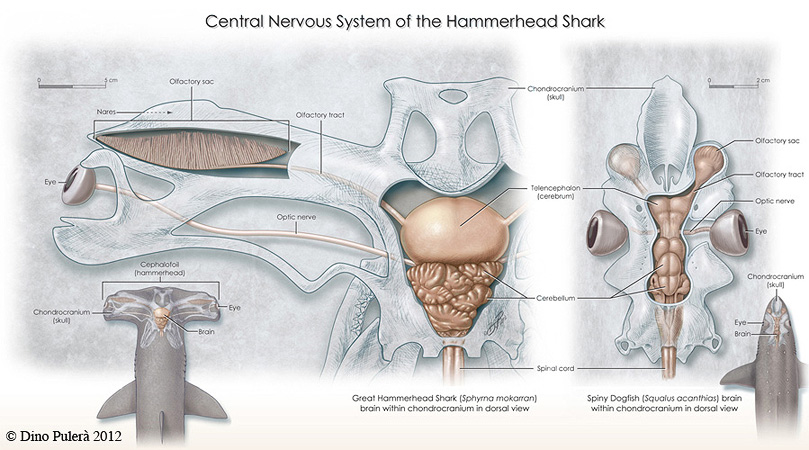
When comparing the brain of a typical shark like the Spiny Dogfish and a highly derived one like the Great Hammerhead, the differences are obvious. The Great Hammerhead has an enlarged telencephalon (embryonic forebrain) and a highly foliated cerebellum reminiscent of a mammal, whereas the dogfish has a smaller telencephalon and a smooth undifferentiated cerebellum. Hammerheads also have a unique head among sharks in that the olfactory and optic regions are expanded laterally. Research suggests that these differences most likely evolved as a result of a combination of locomotor abilities, complex social behaviours, sensory-motor integration and prey capture.
keywords: adaptation brain evolution, fishes, sharks, nervous system, brain, embryology
Original Caption: When comparing the brain of a typical shark like the spiny dogfish and a highly derived one like the great hammerhead, the differences are obvious. The great hammerhead has an enlarged telencephalon and a highly foliated cerebellum reminiscent of a mammal, whereas the dogfish has a smaller telencephalon and a smooth undifferentiated cerebellum. Hammerheads also have a unique head among sharks in that the olfactory and optic regions are expanded laterally. Research suggests that these differences most likely evolved as a result of a combination of locomotor abilities, complex social behaviours, sensory-motor integration and prey capture.
|