| |
|
| |
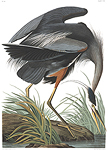
Great Blue Heron (Ardea herodias) |
| |
|
| |
Narrative and Science Lens |
| |
|
What brings this denizen of marshes to campus lawns and the median along Campus Drive? Is it spreading beyond marshy habitats? Are premiere marshy areas shrinking or degraded making grassy area increasingly acceptable alternatives? The low water levels at Lake Lagunita probably limit foraging opportunities, while the lawns and grassy areas probably encourage foraging for voles and pocket gophers.
|
When stalking these small mammals, a Great Blue Heron will patiently wait for a vole or gopher to emerge from a burrow. The heron will very slowly lower its head, often swaying back and forth a bit (some say to calibrate the location of the strike, or even to resemble vegetation blowing in the breeze) before jabbing at the mammal with its dagger-like bill. (See Art: Wheye, below)
Still, this bird is typically a fish-eater. Some of its feathers have evolved to help clean off fish slime. They constantly grow, fray, and break into bits of “powder down,” which the bird harvests. Using its bill and toes, it combs the greasy, powdery keratin through its feathers during preening. The powdery “cleaning agent” clumps the fish slime and other oils that stick to the bird while wading, and the preening bird brushes them away. Powder down would probably clean off vole and pocket gopher slime, too, but these prey are usually swallowed hole and the wet grasslands where they are hunted are probably relatively clean.
|
|
| |
 Campus Locations Campus Locations
Uncommon visitor throughout the year: colony in Portola Valley, individuals often seen commuting between there and campus during breeding season. Occasionally forages at Lagunita, and for voles and pocket gophers in grassy areas throughout campus including the Arboretum and the median along Campus Drive.
|
| |
Campus sustainability |
| |
Water depth at Lake Lagunita may limit foraging there, but wherever there are gophers in relatively open areas these birds will hunt. (They won’t hunt where vegetation is dense enough to block their view of potential predators.) Using poison to control gophers should be avoided; places herons at risk of secondary poisoning. |
| |
What you can do |
| |
1. Share sightings of any successful foraging efforts, noting what prey was taken, and whether the area was dry or damp. |
| |
2. Share sightings of the birds flying overhead, noting flight direction and time-of-day, and sightings of the birds at Lagunita, noting the water depth |
| |
3. Visit Audubon Canyon Ranch or Elkhorn Slough (See Regional Studies, below) |
| |
Science |
| |
Essays from The Birder’s Handbook: |
| |
Piracy; Variation in Clutch Sizes; Coloniality |
| |
References:
Gibbs et al., 1987; Hancock and Kushlan, 1984; Pratt and Winkler, 1985.
Regional Studies:
Audubon Canyon Ranch, which acts as guardian of five main nature preserves in Marin and Sonoma counties
Elkhorn Slough Research and Information for Researchers Art
|
| |
Art |
| |
Photos: |
| |
Rohan Kamath: Great Blue Heron
|
| |
Videos: Breeding season video clips/live footage provided by the Washington Dept. of Fish and Wildlife
|
| |
Drawings and Paintings: |
| |
Darryl Wheye: Great Blue Heron Hunting a Vole
|
| |
|
| |
To add to the Science or Art links, submit bird sightings, comment on the exhibit or the web presentation, or ask questions, please use the web forms on the Art at Exits home page.
|