 |
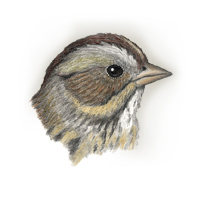
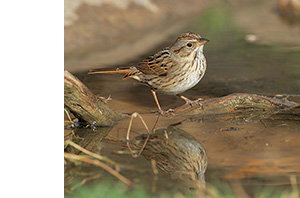
Lincoln's Sparrow
Melospiza lincolnii |
|
|
STANFORD LOCATIONS: Uncommon migrant and winter resident in weedy habitats, tall grassland, and brushy vegetation in relatively open areas. Most common in weedy areas near water, as at the edge of Lagunita. |
 |
Location |
Type |
Mating System |
Parental Care |
2ndary Diet |
Strategy |
 |
 |
 |
I: 12-14 DAYS ALTRICIAL |
 |
 |
|
|
(3-6) MONOG ? |
MF |
|
| BREEDING: | Bogs, wet meadows, riparian thickets mostly in n and montane areas. 1 brood, possibly 2. |
| DISPLAYS: | ? |
| NEST: | In grass tussock or sunk in shallow depression on sphagnum or moss; of grass or sedge, lined with fine grass, hair. |
| EGGS: | Pale green to greenish-white, marked with reddish-browns. 0.8" (19 mm). |
| DIET: | Includes few spiders, millipedes; grass and forb seeds. Nestlings likely fed 100% insects. |
| CONSERVATION: | Winters s to Honduras and El Salvador. Rare cowbird host. |
| NOTES: | Dominated by and may compete with Song Sparrows where breeding territories overlap. Male sings very little during incubation. Female leaves nest by mouse-running along ground when disturbed. Female performs broken-wing distraction display when flushed from nest containing young. Very unobtrusive in migration. |
| ESSAYS: | Bird Guilds; Distraction Displays; Territoriality; Vocal Functions. |
| REFERENCES: | Bent, 1968. |
| Help | Abbreviations | Species-Alphabetical | Species-Taxonomic | Essays-Alphabetical | |
| Except for Stanford Locations, the material in this species treatment is taken, with permission, from The Birder's Handbook (Paul Ehrlich, David Dobkin, & Darryl Wheye, Simon & Schuster, NY. 1988). | |||||