Object Name:
Doll
Object ID:
71.51
Case:
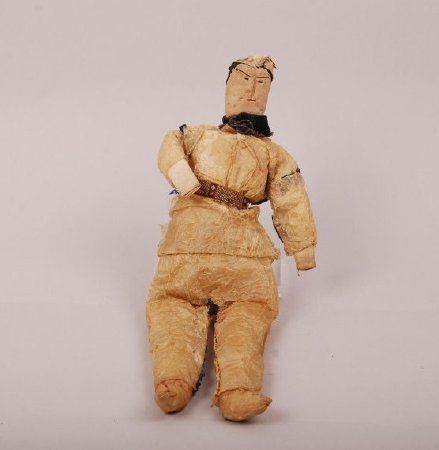
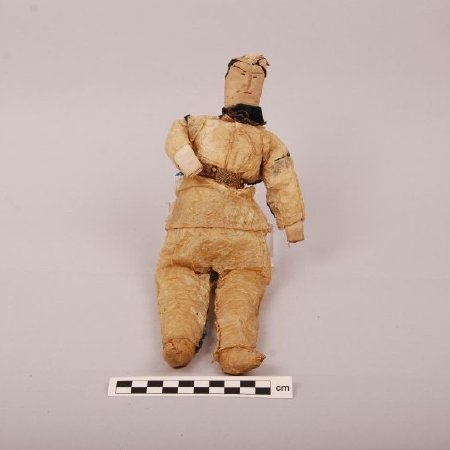
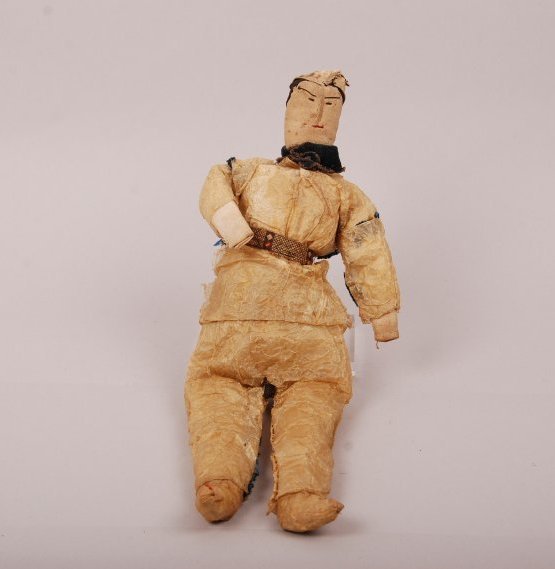
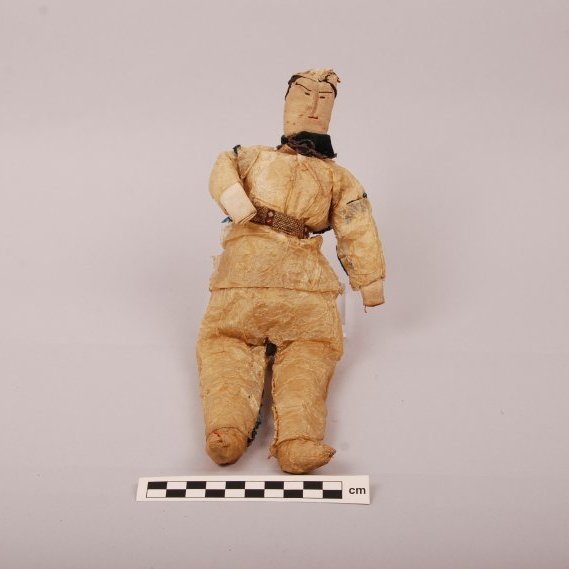
This is the tale of an inventory reunion that wasn't. First: a miniature hand–sewn gut skin parka with finely crafted details like a drawstring hood and borders on the sleeves and hem (54.223). Second: a hand–sewn soft doll of hide stuffed with cotton batting (71.51). His focused expression is wrought in colored cotton thread, and he wears gut skin pants, tunic, and hat with colored seam detailing. A blue cotton neckerchief and finely woven belt complete the ensemble. We were very excited when we discovered an old inventory photo of the doll wearing the parka–a seemingly perfect fit! Seeing this image, we–like whoever took the photo–believed the two items must have been separated at some point after 1954 and that the doll received a "found in collection" number in 1971. Except we were wrong. Museum records are clear that these two great items, that go great together, are not related. The tiny parka was made by an Inupiaq or Yup'ik woman in Golovin, Alaska. Mrs. George Bunker collected it, and her daughter, Mrs. Henry Boos, donated it to Stanford in 1954 as part of a larger collection. The doll has a different provenance. It was made ca. 1898. And it wasn't found in collections in 1971. It was donated by Mrs. Albert Feldhym. Like the parka, it is from the American Arctic, but that region stretches beyond Golovin Bay and across the continent. Is there any way they are related after all? We'd need a lot more information to be sure. These objects remind us that we need to review all the evidence we can before jumping to museological conclusions.
Dimensions:
W–17 L–30.5 cm
Material(s):
Animal intestine/Cloth/Cotton/Thread/Hide
Place of origin:
North America
Date:
1898
Provenance:
Donated by Mrs. Albert Feldheym.
Collection:
Anthropology; North America; Arctic/Subarctic
Click to Enlarge