Object Name:
Ceramic sherd
Object ID:
94.1020
Case:
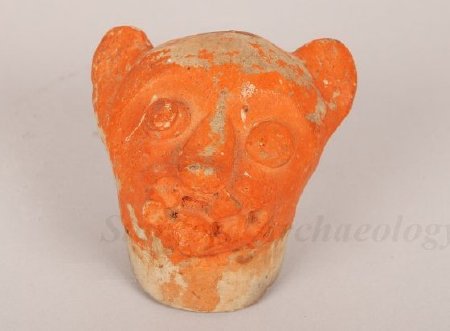
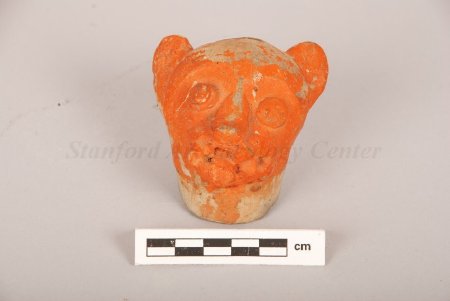
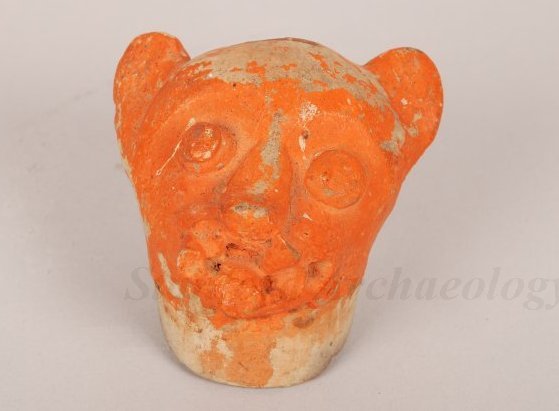
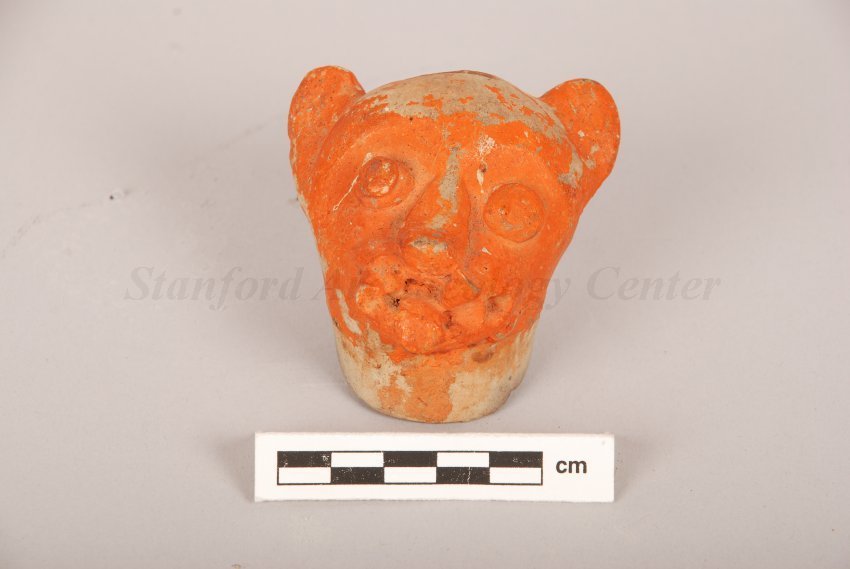
This small, lively feline figurine head caught our attention during inventory this week because of the bright orange coloring. Further research revealed a collections conundrum. Somehow, according to museum records, it is simultaneously "Pre Columbian" (prehistoric) and from a "cultura moderna" (modern culture). Its object biography may explain how.
First, it was made by an artisan in Ecuador. Despite its small size, he or she clearly modeled a cat's pinned back, alert ears; rounded, staring eyes; and an aggressive expression with bared, pointy canines. Then, it was damaged. This head became separated from its body, while the left eye and teeth suffered minor chips. Next, somebody painted its surface bright orange, including over some of the chipped areas; others were left or rubbed bare. Mrs. Clayton Stafford then purchased the piece, probably in Ecuador, and donated it to Stanford University in 1965.
Our hypothesis is that this cat is BOTH prehistoric and modern! And in one of two ways: 1) it was an ancient piece that an enterprising antiquities dealer "spruced up" to make more appealing for tourists like Mrs. Stafford. The bright paint may have been intended to mimic the striking red achieved in ancient times by rubbing pigment into a ceramic surface, as in this cat effigy bottle from the Metropolitan Museum (1988.117.5). Or, 2) it is an entirely modern piece–either forgery or reproduction–that is based on an ancient model. Either way, it illustrates what can happen when the lines between heritage and souvenir are blurred, as they have been for hundreds of years.
First, it was made by an artisan in Ecuador. Despite its small size, he or she clearly modeled a cat's pinned back, alert ears; rounded, staring eyes; and an aggressive expression with bared, pointy canines. Then, it was damaged. This head became separated from its body, while the left eye and teeth suffered minor chips. Next, somebody painted its surface bright orange, including over some of the chipped areas; others were left or rubbed bare. Mrs. Clayton Stafford then purchased the piece, probably in Ecuador, and donated it to Stanford University in 1965.
Our hypothesis is that this cat is BOTH prehistoric and modern! And in one of two ways: 1) it was an ancient piece that an enterprising antiquities dealer "spruced up" to make more appealing for tourists like Mrs. Stafford. The bright paint may have been intended to mimic the striking red achieved in ancient times by rubbing pigment into a ceramic surface, as in this cat effigy bottle from the Metropolitan Museum (1988.117.5). Or, 2) it is an entirely modern piece–either forgery or reproduction–that is based on an ancient model. Either way, it illustrates what can happen when the lines between heritage and souvenir are blurred, as they have been for hundreds of years.
Dimensions:
H–7 L–6.4 D–4.7 cm
Material(s):
Ceramic
Place of origin:
Unknown
Date:
AD 500–1532
Provenance:
Stafford Collection. Original archaeological provenience is unknown. Collector is Mrs. Clayton Stafford. Donated by Mrs. Clayton Stafford to the Stanford University Collections in 1965.
Collection:
Archaeology; South America
Click to Enlarge