Bornavirus enters the host cell via endocytosis. Entry of an
enveloped virus into animal cells usually requires membrane-fusing
activity of viral surface glycoproteins. BDV's glycoproteins are GP-84
and GP-43. Since GP-43 is present at the surface of BDV-infected cells,
it is probably responsible for triggering fusion events. GP-84 is
postulated to be involved in the attachment of to the cell surface
receptor whereas GP-43 is involved in the pH-dependent fusion after
internalization of the virion by endocytosis. After internalization, the
virus is delivered to endosomes.
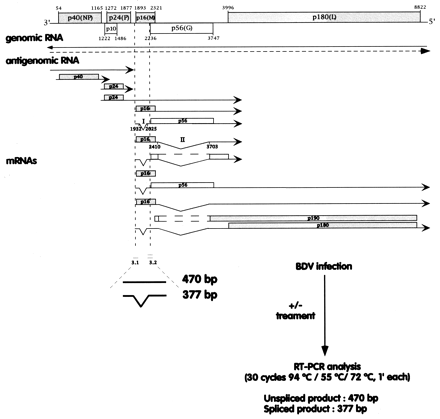
Genomic map of
Borna Virus, illustrating early replication and transcription:
*taken from
http://jvi.asm.org/cgi/content/full/72/1/783/F1
Viral Replication
Only known animal/human RNA virus with a nonsegmented genome of negative
polarity which replicates in the nucleus of host cell. In situ
hybridization of infected rat brain showed that positive- and
negative-stranded RNAs were differentially located within the nucleus.
Sense-strand RNA was preferentially localized to nucleolar regions while
genomic-sensed RNAs were found in both nuclolar and nonnucleolar regions,
suggesting a role for the nucleolus in BDV replication. It is also known
that BDV's RNA has an overlap of open reading frames and transcriptional
units. Two antigens specific for borna were isolated: one
class corresponds to a 40 kDa protein, open reading frame (ORF)
p40, the other to a 24 kDa protein, ORF p24. Replication also includes
posttranscriptional modification of subgenomic RNAs by RNA splicing.
Specifics on replication and splicing mechanisms are still unknown.