Author: Rebecca Hammon
HumBio 115A: Humans and Viruses,
March 2004
Stanford University
Dr. Robert Siegel,
instructor
Hepatitis
D virus
(also known as Delta agent)
 Family: unclassified
Genus: Deltavirus
-ssRNA, circular genome
requires coinfection with Hepatitis B in order
to replicate
associated with severe liver disease including
an increased risk of liver cancer

Introduction
Hepatitis D virus (HDV) is a small, single-stranded, negative sense RNA virus. It is unique because it is a satellite virus for Hepatitis B virus (HBV): co-infection with HBV is required for virion assembly and propogation. HDV infection along with HBV leads to liver disease more serious than that seen with HBV infection alone.
There are two types of HDV infection: coinfection with HBV and superinfection. During coinfection, the patient acquires HBV and HDV at the same time. Superinfection occurs when a patient with chronic HBV becomes infected with HDV. HDV infection should be suspected when a patient with chronic hepatitis suddenly worsens or the patient experiences a particularly aggressive acute hepatitis B infection.
HDV is transmitted the same way that HBV is transmitted: by blood and blood products. This can include sexual transmission. The people most at risk for infection are intravenous drug users.

http://www.cdc.gov/ncidod/diseases/hepatitis/d/index.htm
 Recent research has shown that approximately 70% of
characterized African sequences form highly divergent groups. Researchers claim that this suggests an
ancient African radiation. They also
increased the number of clades (or genotypes) from three to seven. This brings the genetic variability of HDV
closer to that of HBV.
Recent research has shown that approximately 70% of
characterized African sequences form highly divergent groups. Researchers claim that this suggests an
ancient African radiation. They also
increased the number of clades (or genotypes) from three to seven. This brings the genetic variability of HDV
closer to that of HBV.
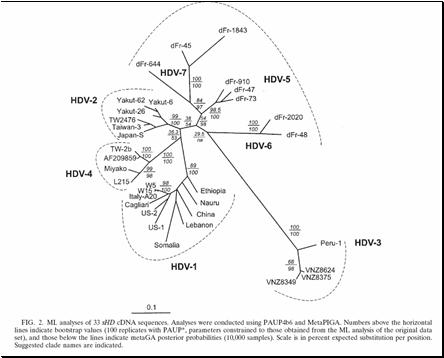
Radjef et al. “Molecular Phylogenetic Analyses Indicate a Wide and Ancient Radiation of African Hepatitis Delta Virus, Suggesting a Deltavirus Genus of at Least Seven Major Clades.” Journal of Virology, Mar. 2004, Vol. 78, No. 5. Pages 2537-2544. Pubmed.
Scientists
have determined that a subclass of the IIb genotype, IIb-M, is correlated with
progressive liver disease. A study of 40
patients with chronic HBV and HDV superinfection was performed in Japan, and
genetic sequences of the infection viruses were determined for 33 of the 40
patients. Among the patients with HDV
IIb, the clinical background and viral levels of HBV in the patients were
similar. However, genetic analysis of
the HDV variants among the IIb patients showed the presence of two subclasses:
the classic IIb subclass from Taiwan and a new subclass designated
IIb-Miyako. The patients with genotype
IIb-M showed greater progression to chronic hepatitis and cirrhosis. Researchers propose that these clinical
differences may point to genetic variations in the functional part of the HDV
genome between the IIb and the IIb-M subclasses.

Watanabe et al. “Chronic hepatitis delta virus infection with genotype IIb variant is correlated with progressive liver disease.” Journal of General Virology, 2003, Volume 84. Pages 3275-3289. Pubmed.
 New
experimental data suggests that the rate of RNA replication in infection with
genotype II is much lower than that of genotype I. The authors of the paper hypothesize that
their results might show another mechanism by which genotype II HDV is
responsible for milder clinical outcomes.
In the course of their research, the scientists also developed a method
for growing the Taiwan-3 HDV clone in cultured cells, allowing the study of
replication levels of the virus.
New
experimental data suggests that the rate of RNA replication in infection with
genotype II is much lower than that of genotype I. The authors of the paper hypothesize that
their results might show another mechanism by which genotype II HDV is
responsible for milder clinical outcomes.
In the course of their research, the scientists also developed a method
for growing the Taiwan-3 HDV clone in cultured cells, allowing the study of
replication levels of the virus.
Lin, Feng-Ming et al. “Initiation of RNA replication of cloned Taiwan-3 isolate of hepatitis delta virus genotype II in cultured cells.” Biochemical and Biophysical Research Communications, 2003. Volume 306. Pages 966-972. Pubmed.
 A
study in mice was done to determine the efficacy of a DNA vaccine in the
induction of a protective immune response.
Researchers created three plasmids: large δAg, small δAg, and
a mutant large δAg. Mice were
injected with the plasmids, and their various immune responses were
analyzed. The small δAg induced a
strong anti-HDV response, while the large δAg developed much lower
antibody titers. All of the plasmids
induced a strong Th-1 and HDV-specific CTL response. These findings will be important in choosing
HDV vaccine candidates in the future.
A
study in mice was done to determine the efficacy of a DNA vaccine in the
induction of a protective immune response.
Researchers created three plasmids: large δAg, small δAg, and
a mutant large δAg. Mice were
injected with the plasmids, and their various immune responses were
analyzed. The small δAg induced a
strong anti-HDV response, while the large δAg developed much lower
antibody titers. All of the plasmids
induced a strong Th-1 and HDV-specific CTL response. These findings will be important in choosing
HDV vaccine candidates in the future.
Huang, Yi-Hsiang et al. “Varied Immunity Generated in Mice by DNA Vaccines with Large and Small Hepatitis Delta Antigens.” Journal of Virology. December 2003. Pages 12980-12985. Pubmed.

 HDV
assembly relies on prenylation (prenyl lipid modification) of the large δAg. Scientists have developed prenylation
inhibitors as a potential antiviral therapy for HDV. Preclinical data in a mouse model is
promising. HDV-viremic mice where able
to inhibit viremia (as measured by HDV RNA) when treated with the prenylation
inhibitors. The study is a promising
prototype for an antiviral strategy which might appy to other medically
important viruses.
HDV
assembly relies on prenylation (prenyl lipid modification) of the large δAg. Scientists have developed prenylation
inhibitors as a potential antiviral therapy for HDV. Preclinical data in a mouse model is
promising. HDV-viremic mice where able
to inhibit viremia (as measured by HDV RNA) when treated with the prenylation
inhibitors. The study is a promising
prototype for an antiviral strategy which might appy to other medically
important viruses.
Bordier, Bruno B. et al. “In vivo antiviral efficacy of prenylation inhibitors against hepatitis delta virus.” Journal of Clinical Investigation. August 2003, Vol. 112, No. 3. Pages 407-414. Pubmed.

 An
epidemiologic study in Taipei, China has shown that the seroprevalence of HDV
is decreasing among drug users and prostitutes.
However, the virus has a new potential reservoir among the populations
of male and immigrant prostitutes which are moving into the area. The researchers call for increased
surveillance of these high-risk groups in an effort to curb the spread of HDV.
An
epidemiologic study in Taipei, China has shown that the seroprevalence of HDV
is decreasing among drug users and prostitutes.
However, the virus has a new potential reservoir among the populations
of male and immigrant prostitutes which are moving into the area. The researchers call for increased
surveillance of these high-risk groups in an effort to curb the spread of HDV.