Understanding Localization
Huh...
The initial (naive) goal:
I want to know if localizations can be thought of as adding inverses or not. Initially, I thought that adding inverses should enlarge a set, but I came to see that in some cases, localization shrinks our sets (possibly due to identification with 1)?
Two Years Later…
When I was taking a second course in commutative algebra at UC Berkeley, I was deeply confused by the following exercise: prove that module localizations commute with finite products. Specifically, we were instructed to use a categorical proof style rather than a constructive one, but I simply could not get the universal properties to work together. At the time, I also found the homework problems very non-intuitive and often struggled to solve them without hints from the internet. In part, I thought that I hadn’t spent enough time working with localizations hands-on, and proceded to squeeze in computation after computation whenever I found a moment. I reached no clarity that semester, instead fell behind, and late dropped the class.
For a while afterwards, I decided algebra was not for me, perhaps my brain wasn’t built for it. Instead I classified myself as an “analysis person” and decided to spend the rest of my time at Berkeley mastering analysis.
Two years later, while reading Ravi Vakhil’s The Rising Sea and stumbling on the same exercises, I remembered to come back to finish this post with newfound mathematical maturity and clarity.
Looking back, I still don’t know what took me so long to get these concepts. It seems that the angle with which I was viewing the math was itself flawed, so maybe time was really what I needed. I guess that’s just how math is sometimes.
Date Started: March 7, 2024
Date Finished: June 12, 2026
How Does Localization Impact Size of Underlying Set
It seems I was sort of dancing around this point with my line of computations below, but the following theorems elucidate what’s going on:
I leave the proof of the first part as an exercise, since I have written it down myself as a one-liner. Hint: find an annihilator, and multiply both the numerator and denominator of things by it.
The second part one can show inductively.
I also will leave the following as a conjecture (simply because I have not proved it myself as it is 3AM and I would like to wrap up this sketch) which I may one day discuss again, or make corrective edits to.
Let us first gather some intuition (in addition to the examples below). In a sense, inverting a zero divisor $s$ means that for any $r$ with $rs = 0$, $r$ should become zero in the localization (units cannot be zero divisors). This motivates quotienting by the collection of elements which are killed by elements in $S$.
Together, these two ideas roughly answer my original question.
Localization Commutes with Finite Products
Categorical Proof.
This is the big theorem which stumped me two years ago. In hindsight, I was stumped for good reason: the categorical proof still requires a property of module direct sums which at the time I didn’t see as “categorical”. The Stack Exchange posts on this problem seem to me to also be unclear, because they sometimes indicated that a fully categorical/diagram chasing proof exists after one assumes that coproducts and products are the same. Clearly, however, it is the property of direct sum modules that $i_1\pi_1 + i_2\pi_2$ is identity which drives the proof.
It suffices (for both the theorem and lemma) to restrict our attention to two modules. We claim that the direct sum of two modules is both a product and coproduct, which via universal properties shows the desired isomorphism.
The key property is that for modules $M_1$ and $M_2$ with direct sum $M_1 \oplus M_2$ and associated projections and inclusions $\pi_1, i_1$ and $\pi_2, i_2$ onto the first and second coordinates, $i_1 \pi_1 + i_2\pi_2$ is the identity on $M_1 \oplus M_2$.
Indeed, the direct sum $M_1 \oplus M_2$ is a product since for any module $N$ with $N\xrightarrow{\phi} M_1$ and $N\xrightarrow{\psi} M_2$, the maps factor uniquely through $M_1 \oplus M_2$ via the map $i_1\phi + i_2\psi$ (it can be easily checked that the diagram commutes). This map is unique because for any other map, $f = i_1\pi_1 f + i_2 \pi_2 f = i_1\phi + i_2\psi$.
It is also a coproduct, since for any module $N$ with $M_1 \xrightarrow{\phi} N$ and $M_2 \xrightarrow{\psi} N$, the maps factor uniquely through $M_1 \oplus M_2$ via $\phi\pi_1 + \psi\pi_2$. The map is again unique because for any other map, $f = fi_1\pi_1 + fi_2\pi_2 = \phi\pi_1 + \psi\pi_2$.
🔲
Let us try to see what kinds of diagrams we can draw.
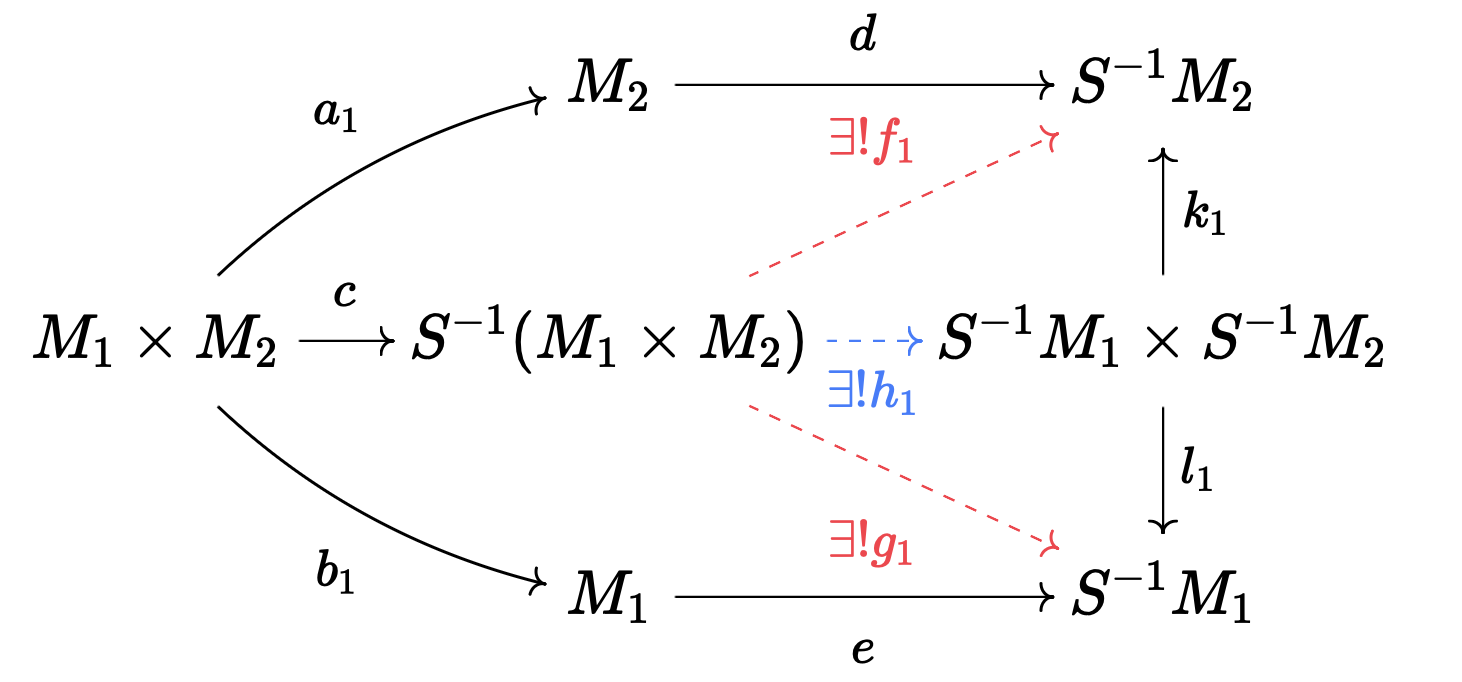
The other direction seems notoriously harder without the lemma, but with the lemma, we can actually just flip many of the arrows!
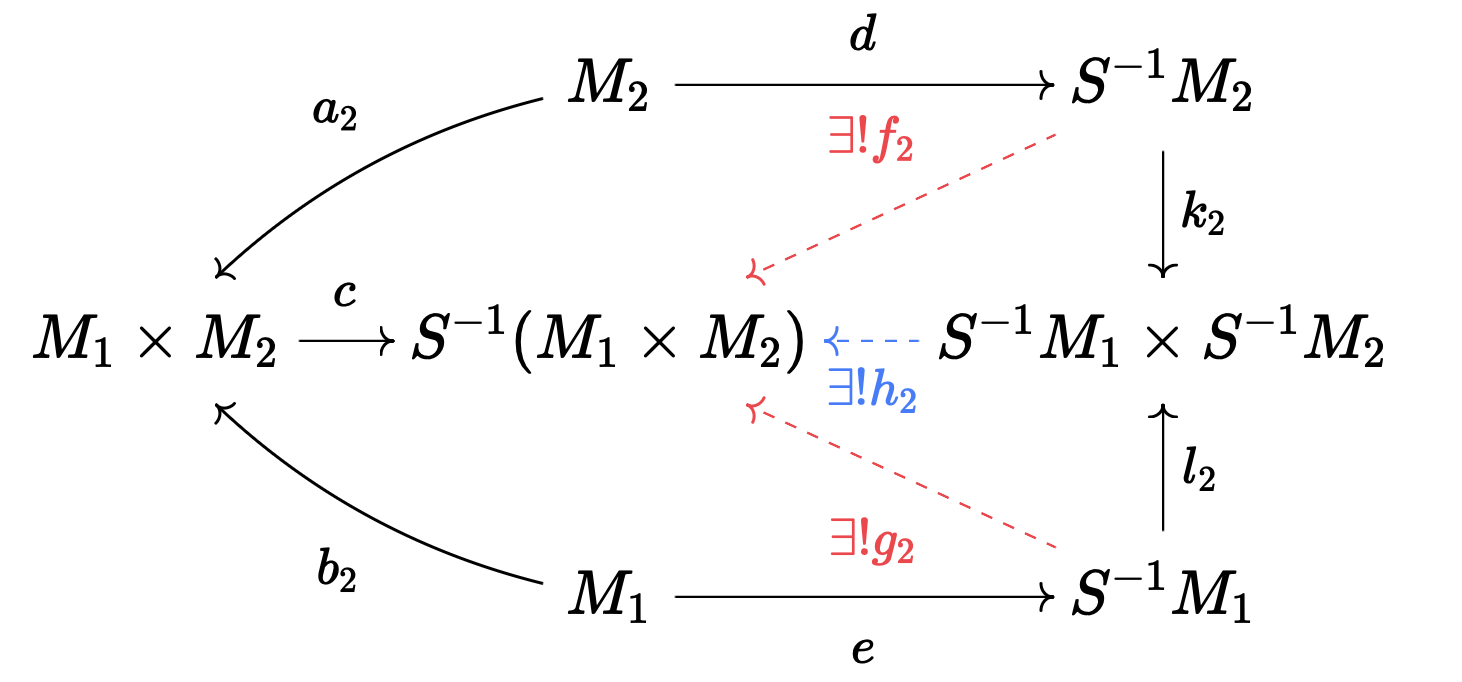
Note the following properties which are not contained in the diagram:
- $l_2l_1 + k_2k_1 = id_{S^{-1}M_1 \times S^{-1}M_2}$ CRUCIAL!
- $a_2a_1 + b_2b_1 = id_{M_1 \times M_2}$ CRUCIAL!
- $k_1l_2 = 0$ CRUCIAL!
- $l_1k_2 = 0$ CRUCIAL!
- The canonical map $\phi : X \rightarrow S^{-1}X$ satisfies a cancelation law for maps $a, b$ from $S^{-1}X$ to a module where elements of $S$ are invertible: $a\phi = b\phi$ implies $a = b$ CRUCIAL! (this is really a restatement of the universal property)
- This implies that $c$, $d$, and $e$ are epi in this diagram (noting that all the maps out of the $S^{-1}$ modules only go to modules where elements of $S$ are invertible).
Finally, we must show the blue maps compose to identity. This is actually notoriously difficult to see naively, but it actually works, the crucial property being the structure of direct sums for modules: 😭 $$h_2h_1c = h_2(l_2l_1h_1c + k_2k_1h_1c)$$ $$ = h_2(l_2eb_1 + k_2da_1)$$ $$ = g_2eb_1 + f_2da_1$$ $$ = cb_2b_1 + ca_2a_1$$ $$ = c(b_2b_1 + a_2a_1)$$ $$ = c$$ but now using the fact that $c$ is epi, $h_2h_1$ is identity.
For the other direction, first note that $$g_1g_2e = g_1cb_2 = eb_1b_2 = e$$ $$f_1f_2d = f_1ca_2 = da_1a_2 = d$$ $$g_1f_2d = g_1ca_2 = eb_1a_2 = 0 = 0d$$ $$f_1g_2e = f_1cb_2 = da_1b_2 = 0 = 0e$$ and since $d$ and $e$ are epi, $g_1g_2$ and $f_1f_2$ are identity and $g_1f_2 = f_1g_2 = 0$. Then, $$h_1h_2 = h_1h_2(l_2l_1 + k_2k_1)$$ $$= h_1(g_2l_1 + f_2k_1)$$ $$= (l_2l_1 + k_2k_1)h_1(g_2l_1 + f_2k_1)$$ $$= (l_2g_1 + k_2f_1)(g_2l_1 + f_2k_1)$$ $$= l_2l_1 + 0 + 0 + k_2k_1$$ $$= id_{S^{-1}M_1 \times S^{-1}M_2}$$
⬛
Previous Case Studies
All Localizations of $\Z/6\Z$, $\Z/8\Z$, and $\Z/12\Z$
To study all the localizations of $\Z/6\Z$, we should look at all multiplicative subsets of $\Z/6\Z$. Here they are:
Erm... this is embarrasing, I never got to do this yet...
I have drawn the in this lattice to show inclusions. Now in localizing with respect to all of these multiplicative sets, we can notice some patterns. It so happens that all prime ideals of
Localizing $\Z/6\Z$ at $\{1\}$, $\{1, 5\}$
Intuitively, we should have $\boxed{(\Z/6\Z)_{\{1\}} = \Z/6\Z}$, since $1$ is already invertible. We can look at this in two ways. Firstly, we can see via the construction. If we now consider elements $s^{-1} m$ where $s \in \{1\}$ and $m \in \Z/6\Z$, we have a bijection mapping $1^{-1} m$ in the localization to $m$ in $\Z/6\Z$ and vice versa. The result is also clear via the universal property: for any morphism from $\Z/6\Z$ to an object (ring or module) $M$ which sends 1 to an invertible element, it commutes obviously with the identity map $id : \Z/6\Z \rightarrow \Z/6\Z$. Since 5 is already invertible mod 6, we can also see pretty immediately that $\boxed{(\Z/6\Z)_{\{1,5\}} = \Z/6\Z}$.
Localizing $\Z/6\Z$ at $\{2,4\}$, $\{1,2,4\}$, or $\{1,2,4,5\}$
We start with $\{2,4\}$, I will claim that $\boxed{(\Z/6\Z)_{\{2,4\}} = \Z/3\Z}$ together with the natural quotient map. We can indeed see this via the universal property. For any map $\varphi$ mapping $\Z/6\Z$ to an object $M$ where $\varphi(2)$ and $\varphi(4)$ are units, we have a map from $\Z/3\Z$ to $M$ mapping $0$ to $0$, $1$ to $\varphi(2)$, and $2$ to $\varphi(4)$ which is clearly a valid homomorphism making the diagram commute. Now making the conjecture that iterated localization works (I'll show this later but have also shown it on my MATH 250 problem set), we must have that $\boxed{(\Z/6\Z)_{\{2,4\}} = (\Z/6\Z)_{\{1,2,4\}} = (\Z/6\Z)_{\{1,2,4,5\}} = \Z/3\Z}$.
Localizing $\Z/6\Z$ at $\{3\}$, $\{1,3\}$, or $\{1,3,5\}$
We start with $\{3\}$, I will claim that $\boxed{(\Z/6\Z)_{\{3\}} = \Z/2\Z}$ together with the natural quotient map. We can indeed see this via the universal property. For any map $\varphi$ mapping $\Z/6\Z$ to an object $M$ where $\varphi(3)$ is a unit, we have a map from $\Z/3\Z$ to $M$ mapping $0$ to $0$, $1$ to $\varphi(3)$ which is clearly a valid homomorphism making the diagram commute. Now via the conjecture that iterated localization works, we must have that $\boxed{(\Z/6\Z)_{\{3\}} = (\Z/6\Z)_{\{1,3\}} = (\Z/6\Z)_{\{1,3,5\}} = \Z/2\Z}$.
Localizing $\Z/6\Z$ at $\{0, 1,2,3,4,5\}$
In this case, we can again localize iteratively and find that this is just $\boxed{0}$. Alternatively, notice that in any map, if $3$ goes to a unit, then 2 must go to zero (or else the unit is a zerodivisor, which is not possible) but then zero must be a unit, which is only possible if we consider the zero ring.
Commentary
We must first acknowledge some properties of $\Z/6\Z$: all nonzero prime ideals and maximal, and it turned out in this case that all localizations ended up also being localizations at prime ideals except for the one at $\{1,2,3,4,5\}$. Somewhat surprisingly to me (at least when I realized this), our ring actually shrinks here when we localize. This is unlike the case below with $\Z$ where we will see that we can localize $\Z$ to get $\Q$. Notice also that many of our localizations gave fields because we ended up quotienting by a maximal ideal. There is this idea that if we localize some element $x$, all elements in $y \in \text{Ann}(x)$ must go to zero (for example in our construction we can simply multiply $y = y \cdot 1 = y \cdot \frac{x}{x}$ to get 0), so we essentially quotient by $\text{Ann}(x)$. In all cases, we can see how localization precisely leaves what we want. When localizing at $\{2,4\}$, it just leaves the set $\{0,2,4\}$, and kills 3, and when localizing at $\{3\}$, it just leaves $\{0, 3\}$ and kills $2$ and $4$.
In the future, I'll also only consider multiplicative subsets which do not contain units. This is because adding in units does not change anything by iterated localization, and no two non-units can ever multiply to a unit, so any time we have units in a multiplicative subset, we can just take out all units and what we are left with should still be a multiplicative subset.
Now to study localization in $\Z/8\Z$, notice the scarcity of multiplicative subsets. Nilpotents can't be in multiplicative subsets, so we're just left localizing things which are already units, since all nonunits are nilpotent in $\Z/8\Z$. In fact, this is what happens in any object of the form $\Z/p^k\Z$.
Localizing $\Z/8\Z$ at a subset of $\{1,3,5,7\}$
This is now obviously just $\boxed{\Z/8\Z}$.