Pauline Brutlag
pbrutlag@cmgm.stanford.edu
Technologist
Educational Strategies
400 Market Avenue
San Jose, CA 94045
Mrs. Josephine Gruberman
931 Olive Street
Menlo Park, CA 94025
|
CS147 technology evaluation
by: Pauline Brutlag
email: pbrutlag@cmgm.stanford.edu
for: Henry's Mr. Prince Fleaswallow Section
this page is at: http://www.stanford.edu/~anagit/techeval
|
Dear Mrs. Gruberman,
We have conducted an analysis of your daugher Julia's situation and have found a series of products which may be of help. According to the consultation report, Julia is three years of age, has laryngial paralysis, resulting in complete loss of speech ability. At the moment she retains all other motor control, but her disease may progress if her drug treatment fails. This may leave her quadraplegic, with little voluntary muscle control.
For such a case, we recommend Prentke Romich Company's line of speech output devices. More information about these products can be found at http://www.prentrom.com/speech/speech.html . More information about Prentke Romich Company (PRC) can be found at http://www.prentrom.com. PRC is dedicated to serving people with disabilities by facilitating communication and computer access. Below, you will find our standard format analysis of the PRC line of speech output devices, and why they are appropriate for Julia's case. If you have any further questions, feel free to contact me at the address above.
For what class of users and uses is this technology likely to be most appropriate and effective?
|
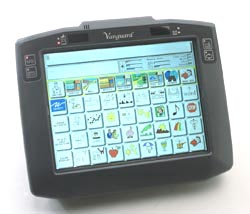
Here is Vanguard, one of PRC's most recent speech output devices. Vanguard uses a dynamic digital icon display which facilitates learning.
Julia's young age puts her at a great educational advantage. She retains the ability to learn quickly and easily. With any solution, for her to be able to "speak," she will have to learn a new mode of communication. PRC has developed a system called Minspeak, which uses semantic compaction. Semantic compaction allows the use of picture based representations of words, but reduces the necessary symbol set by assigning multiple meanings to each picture or icon. The meaning of an icon in a particular instance is determined by the icons it is used in conjunction with. Reducing the number of icons necessary allows for only one icon overlay in the speech output interface (a sort of icon keyboard). Since only one overlay is needed, becoming fluent in Minspeak is fast and easy. And since Minspeak uses icons instead of text to represent words, even young children (or developmentally retarded individuals) can learn the system.
PRC's products are built with an eye to ease and flexibility of use. Minspeak "requires no literacy skills but enhances communication for people who can spell and read, it can help teach language but will never be outgrown, and it permits people to be the most effective communicators that they can be." Minspeak maximizes the learnability of PRC's products. Julia would have very little trouble adjusting to this new mode of communication. As a young, speech impaired, pre-literate but not developmentally retarded individual, Julia is an ideal candidate for this enabling technology.
What new or improved affordances are offered by this technology?
First and foremost, PRC's tools will allow Julia to actively and independently participate in a speaking/hearing world. Without any speech output devices, she would be constrained to communication through gesture, as in American Sign Language. This would severly limit who she could speak with. PRC's speech output tools are flexible enough to help Julia to be adequately fluent in any context.
A variety of models and style of PRC Minspeak speech output devices are available for those with a variety of needs. As Julia grows, there will exist Minspeak devices to accomodate her growing vocabulary and changing requirements in everyday life, school and work. With all models come tutorials/games to enhance learning. Different overlays on certain models allow for different vocabularies, to allow for activity-based learning. New words can be programmed into most models to personalize vocabulary for Julia's needs. Julia can pick a speaking voice approriate to her sex and age. Through PRC's products, Julia will be able to speak a variety of languages, as well as access TV's, VCR's, computers, environmental contols, and any device that uses infrared command. One model even contains simple word processor, calculator and multiple alarm functions.
If Julia does lose voluntary movement, she will not be relegated to yet other means of communication. PRC products can be accessed not only through their Minspeak icon keyboards, but also through infrared head pointers or switch activated scans. One can use these speech output devices with minimal movement. If Julia becomes visually impaired with age, auditory scanning/feedback can be activated to cue her as to what location is being activated.
Despite the range of circumstances under which PRC's devices can be used, there is a limit to their flexibility. Their lightest devices are hand held and have limited vocabularies. Those which can be accessed through head pointers seem large and clunky, and are pictured as trays attached to wheel chairs. Though allowing powerful communication, their size does limit their mobility. Were Julia to remain mobile into her later years, where she needed constant access to a large vocabulary, it may be a hassle to drag around a large and heavy speech output device, and have to find somewhere to put it down every time she wished to talk to someone.
What new interaction styles and metaphors seem especially well suited to this technology?
As was stated above, interaction via head pointer or switch activated scans are new and innovative ways of providing access to these devices to people with limited movement. An excellent example of putting familiar technologies to good use in completely new contexts.
|
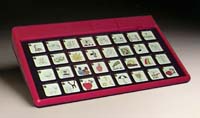
The AlphaTalker II demonstrates the mechanical keyboard metaphor.
The interaction designers used the metaphor of the computer keyboard in coming up with the interface for PRC speech output products. In the case of the limited icons that Minspeak requires, this was an appropriate choice, since all necessary vocabulary could be placed on one overlay of a resonable size. Earlier versions have mechanical interfaces (like keys on actual keyboards). More recent versions, like Vanguard pictured above, have a touch screen interface (like a virtual keyboard, or touch screen at a public kiosk).
The metaphor of the rebus would best describe the use of Minspeak. Creating a sentence in Minspeak would be much like constructing a both pictographic and semantic rebus. Non-picture producing words (like hard, fun or healthy) can be represented using combinations of icons. PRC prides itself in Minspeak's ability to form most words out of two or less icons. For example, the color red could be represented by combining the icon rainbow with the icon apple, while a house with the apple could mean grocery.
 + + 
|  + +
|
| RED | GROCERY |
How different meanings can be created from the same icon in different symbol combinations. An icon's meaning is context dependent in Minspeak.
What is the current commercial availability and success of this technology?
This particular line of products (using Minspeak) are exclusively available through PRC. Information on how to contact PRC is located below:
Prentke Romich Company
1022 Heyl Road
Wooster, OH 44691
fax (330) 263-4829
Since I have just been introduced to these sorts of products for the purposes of this report, I cannot speak to the commercial availability of speech output devices in general. I can say that other companies do produce speech output devices using other methods of picture-based word representation. PRC claims Minspeak to be the most successful of these methods, but I have no objective means of assesing this claim.
Commercial success is severly limited to the demand for speech output devices, which in the large scheme of things will always be relatively low. There will only be so many people with the particular disabilities that call for such devices. PRC will (hopefully) never have a booming business, but they will always have a strongly needed one.
What key technical constraints currently limit development and deployment of this technology?
This technology is currently being deployed, and used successfully. There are no technical constraints limiting production as the product stands. The only constraint I can fathom is price. PRC does not publicly list the price of their products. I would gather that they are expensive, and this limits access to them for many. As these technologies become more familar and more widely used, prices will no-doubt drop, enabling those with less means to have access to them.
Despite the fact that there are no technical constraints limiting the production of PRCs speech output devices, there are many ways in which the product could be improved. The interface need not be as bulky (though the icon keys should remain large to facilitate access). I would imagine the digitized speaking voice of the devices could be made to sound more human. It would also be a nice addition for every user to be able to manipulate a few of the tonal aspects of the outputted speech in order to personalize their "voice."
Though PRC claims their products can access computers and infra red controlled devices, I'm sure this access is not universal, and should as much as possible be made so. Perhaps peripheral features could be designed, such as speech or infra red controlled light switches, elevator call buttons, or door openers, to further facilitate access to one restricted to a wheelchair.
What broader social and economic implications are likely to create either benefits or problems from the new technology?
These technologies allow those formerly unable, to express themselves and communicate with the world. With more and more of the disabled speaking out through such devices, perhaps the public will begin to treat them more like humans and less like babies, meant to be coddled and taken care of, or less like freaks, meant to be covertly stared at and avoided.
Perhaps eventually devices like these will eliminate the term "disabled" from our vocabulary. Cetainly, at the very least, they will help facilitate the dissemination of the stigma with which people with disbilities are perceived. The formerly speechless will be increasingly enabled to become valued and valuable members of society. People will realize the asset people with disabilities can be to society, and help join the effort to design a world accessible to all.
More salient to you than any societal implications of speech output devices, Mrs. Gruberman, is the fact that PRC has created a technology that will allow Julia to operate with a greater degree of normality in the world at large. Please contact me if you have any questions, or wish to place an order through us.
Best wishes,
Pauline Brutlag
Educational Strategies