Automating
Scoliosis Measurements in Radiographic Studies with Machine Learning:
Comparing
Artificial Intelligence and Clinical Reports
Audrey Y. Ha1, Bao H. Do1, Adam
L. Bartret1, Charles X. Fang1, Albert Hsiao2,
Amelie M. Lutz1, Imon Banerjee3,
Geoffrey M. Riley1,
Daniel L. Rubin1, Kathryn J. Stevens1,
Erin Wang1, Shannon Wang1, Christopher F. Beaulieu1,
Brian Hurt2
LINK to
publication
Scoliosis affects 3.1% of children globally,
impacting females at 4.06% versus 2.58% in males. Most cases involve mild
curvatures of 10 to 19 degrees, with severe curves over 40 degrees in ~0.05%
of the population. ~3.8% of diagnosed patients required surgery, with 97%
utilizing fusion [1],[2].
Try the updated app at http://xrayhead.com/scoliosis/
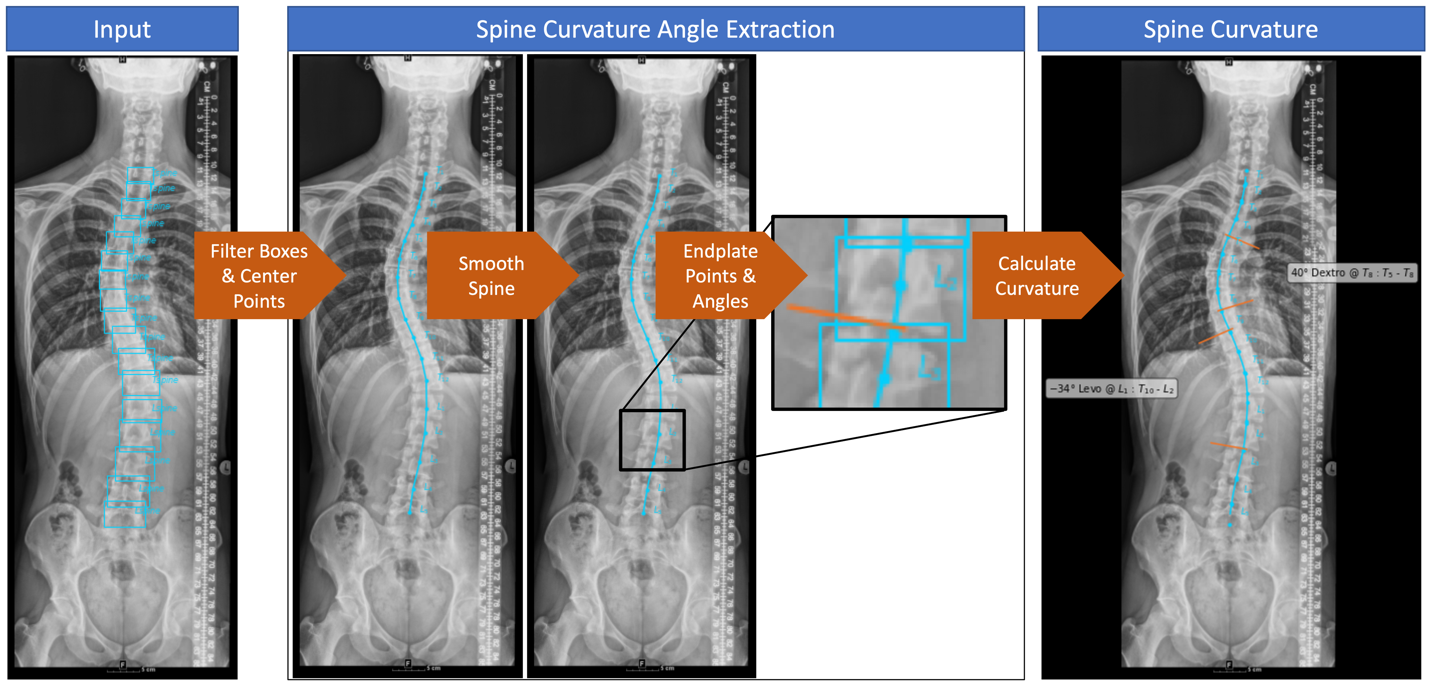
1 Department of Radiology, Stanford University, 300 Pasteur Drive, Stanford,
CA, USA 94305
2 Department of Radiology, University of California San Diego, 9300 Campus
Point Drive, La Jolla, CA, USA 92037
3 Department of Radiology, Mayo Clinic, 5779 E Mayo Blvd, Phoenix, AZ 85054