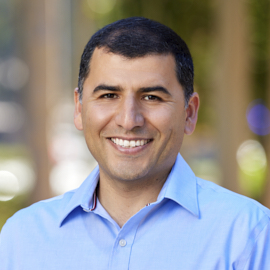
Mohsen Bayati
Courtesy appointments in Electrical Engineering and Radiation Oncology; faculty affiliate of Stanford HAI
Visiting faculty researcher at Google; previously at Microsoft Research, Amazon, and Turing
I work on the mathematics of using AI systems in high-stakes decisions. Two questions take up most of my time. One is how to give a deployed model the properties its users actually need. A model learns from data that carries gaps and anomalies, and its architecture brings assumptions of its own, so the properties a clinician or an operator depends on are not guaranteed to be there. The other is how to learn efficiently from experiments and from the decisions themselves, which is where multi-armed bandits, adaptive design, panel data methods, and estimation under interference all come in.
The health care work began at Microsoft Research and has continued with clinicians at Washington Hospital Center, Stanford, San Mateo Medical Center, and Amazon Pharmacy. More recently I have worked with industry teams on experimentation, on adapting language models for online retail, and on the evaluation of agentic systems.
Research
AI alignment and oversight
Giving a deployed model the properties its users need, and working out how a human and an AI agent should divide authority when the agent is usually right and occasionally badly wrong.
Language models and agentic systems
Agent pipelines for tasks a domain expert would otherwise do by hand, paired with measurement designs that say how often the system is right and where it fails.
Experimentation and causal inference
Estimating treatment effects when units interfere with each other and the interference network is unknown, plus design tools for staggered rollouts and panel data.
Bandits and online decision-making
Learning while deciding. Regret theory for linear and Thompson sampling policies, personalization when the covariates are high-dimensional, and the conditions under which a simple greedy rule is already near optimal.
AI and analytics in health care
Work with clinicians since 2009 on readmission risk, cancer recurrence, emergency department flow, drug safety, and the burden electronic health records place on physicians.
Message passing and high-dimensional statistics
The methodological base underneath the rest: rigorous analysis of belief propagation and approximate message passing, estimation and inference in high dimensions, and random graph algorithms.
News
- Two papers accepted at NeurIPS 2026: “A Few Teacher Steps Go a Long Way” with Junze Ye and coauthors, and “Causal Effects with Unobserved Unit Types in Interacting Human-AI Systems” with Will Overman and Sadegh Shirani.
- GSB Insights wrote about the two oversight papers with Will Overman: A Blueprint for Keeping Humans in Control of AI.
- “Annealed Softmax Greedy in Many-Armed Bayesian Bandits” with Will Overman appeared at the Reinforcement Learning Conference.
- Sadegh Shirani joined MIT Sloan as Assistant Professor of Operations Management.
- Junze Ye's paper on stewarding an LLM-assisted clinical benchmark was a finalist in the INFORMS Health Applications Society Student Paper Competition.
- Two papers with Will Overman at ICML 2026: “The Oversight Game” and “Calibrating Conservatism for Scalable Oversight”.
- New preprint with Junze Ye and coauthors on where to spend a limited teacher budget when post-training agents: “A Few Teacher Steps Go a Long Way”.
- “Speed Up the Cold-Start Learning in Two-Sided Bandits with Many Arms” with Junyu Cao and Wanning Chen published in Management Science.
- “Text-to-Distribution Prediction with Quantile Tokens and Neighbor Context” accepted at ACL 2026.
- Will Overman defended his dissertation and is on the academic job market.
- Gave a SNAPP seminar, “Estimating Interference Effects via Distributional Dynamics”.
- Stanford GSB published a Class Takeaways video from the MBA course.
- GSB Insights covered the LLM-agent simulation work with Sadegh Shirani: Researchers Build a Virtual World to Run Experiments Over and Over.
- Delivered the INFORMS Applied Probability Society Distinguished Lecture, on AI alignment challenges and progress.
- First offering of OIT 612, Management Science in the Age of AI, a new PhD course.
Code and data
Most of the methods papers ship with a public implementation.
- CausalMP Causal message passing for experiments under unknown network interference.
- MCPanel R package for matrix completion estimators in causal panel data models, with Susan Athey and coauthors.
- staggered_rollout_design Optimal and adaptive designs for staggered rollout experiments.
- many-armed-bandit Greedy and subsampled-greedy policies for bandits with many arms.
- LLM-SocioPol A simulated society of language model agents for testing experimental designs.
- validate-medcalc-labels Physician-in-the-loop auditing of an LLM-assisted clinical benchmark.
- Readmission risk models The heart failure readmission methodology, released through Microsoft Azure.
Teaching
- OIT 612, Management Science in the Age of AI
PhD, Autumn. A new course on designing research and decision systems around what current AI systems can and cannot do. - OIT 367, Business Intelligence from Big Data and AI
MBA, Winter. The advanced track of Data and Decisions, taught since 2013.
Service
Associate editor at Management Science (Data Science and Healthcare Management) and Stochastic Systems. Member of the Stanford AI Advisory Committee and of the faculty leadership committee of the Stanford Leadership Institute, where I organize the faculty AI flash talk series. Area coordinator for the OIT group at the GSB.
Contact
Office
Knight Management Center655 Knight Way, E363
Stanford, CA 94305
bayati [at] stanford.edu
(650) 725-2285
Assistant
Sandra Davis655 Knight Way, E324
Stanford, CA 94305
srdavis [at] stanford.edu
(650) 736-0939