 WRITING NATURE:
DISCOURSES OF ECOLOGY
WRITING NATURE:
DISCOURSES OF ECOLOGY
On a winter's day in New York, I decided to experiment with our rugged 2-ton Jeep SUV's handling ability in snow by taking it through unplowed parking lots. I justified my actions at the time by thinking of the importance of being able to handle the car in all sorts of weather conditions. After doing a few figure "8"s, hard accelerations and hard, controlled brakings along with a few lateral slides, I decided that I'd had enough fun.
On the way home, I passed by a paved auxiliary road with the foundations of new houses on both sides of it. Tempted by the fresh, unmarked snow and bumpy construction site, I eagerly aimed the car towards it. My heart raced. I pumped the gas a couple of times and felt the car pin me in the driver's seat. This beast was powerful: at my fingertips&emdash;and toe-tips&emdash;I had a 3600-pound, 285-horsepower, 5.9 liter, gas-guzzling monstrosity. I accelerated down the road and climbed over mounds and mounds of dirt covered by snow. I could only imagine the adrenaline rush of real off-roading. My knuckles turned white on the steering wheel, I started shivering nervously, and I felt a trickle of sweat come down my arm.
As the terrain got more difficult, I slowed down and all too soon my fun was cut short. The front left wheel had gotten stuck in a sewer hole. My eyes opened wide, I started biting my lips, and my mind raced as I imagined what my parents would say when they found out what had happened. After some jerking the car back and forth, I realized that I was just settling the other three wheels deeper into the snow and dirt piles. The whole experience was an adrenaline rush, gave me a feeling of power, and made me feel bigger than I actually was.
Psychology plays a major role in the desire to go off-roading. Many people want a status symbol, the feeling of strength and power while driving, and to be above everybody else, literally! "SUVs are higher off the ground, have great visibility, are rugged and you can run over anybody smaller than you. They give you a feeling of personal power and there is a projection about off-roading&emdash;I can if I want to," said Martin Goldfarb, a Ford employee (qtd. in Rollover).
This type of attitude stems from the history of the SUV/4X4&emdash;one of the many wartime creations of society in the twentieth century. Its production arose from the need for a vehicle that was capable of climbing over any terrain, especially in battlefields and unpaved areas. After World War II, the Jeeps and 4X4s that were produced for military use had little practical use, so companies tried combining them with different passenger compartments to produce a new car market. When a match was made, the SUV was born.
Due to this type of car breeding, SUV users feel like they are driving tanks on the road. It gives the feel of being impenetrable and invincible. That is one of the reasons for why BMW X5s, Chevy Suburbans, Yukon Denalis, and Jeep Grand Cherokees now run rampant along city streets and highways. But, by the same token, these gas guzzlers have become a societal symbol of extravagance, wastefulness, and a rapidly growing population with little concern for the environment.
The gas mileage that SUVs get is shocking. These trucks do not only spew out massive quantities of emissions, with chemicals that cause acid rain, thick and dirty air, global warming, and damage to forest flora and fauna, but they also account for a rapidly rising number of deaths per year in rollover accidents: in 1990, 700 people died because of unstable vehicles, and a decade later, 2000 people were dying per year. (Rollover) The Hummer H1, for example, is an overweight SUV, weighing around 7150 pounds but shares the average SUV fuel economy&emdash;13 miles per gallon in the city and 17 miles per gallon on the highway. (Edmunds) Compared to a normal passenger car&emdash;which easily gets twice that&emdash;the SUV is a huge polluter.

|
The Hummer's cool, reflective body of complexly molded medal with four rubber tires can dominate any hill, crawl up the terrain, and tear rocks out of their natural places. Its spinning wheels chew up weeds and vegetation, and the tail pipe spews out liters and liters of an invisible smoke consisting of carbon dioxide, carbon monoxide, sulfurous combustion products that harm the wildlife of the area, which is nowhere to be found. The car's macho appearance, enhanced by the slits on its rear window, its boxy shape, wide wheels, stiff shocks, rugged suspension, gives this behemoth a look of aggressiveness toward its surroundings. The car's structure is so rugged and tough that it looks as if a falling tree would bounce off with a mere "ping." The reflection from the glass windows on the car makes the cabin appear to be distinct from the outside environment, emphasizing the separation between man's creation and nature.
Clearly, the Hummer, and in general, the SUV is a manifestation of our arrogant, assumed superiority over nature. One can now sit inside his or her car, with an interior appointed with wood and leather designed to make one feel as if one were in one's living room, and venture out into the wilderness at the flick of the wrist on the gear shifter and tap of the foot on the accelerator. The Hummer portrays the belief that we are the center of life on Earth, occupying nature and moving civilization outwards. This type of anthropocentric attitude is sure to lead society into problems with the ecosystems from which we derive our basic life necessities such as food, air, water. At the current rate of environmental usage and lagging interest in conservation of energy and resources, we will run out of the essentials for survival very soon.
We are very wasteful in manufacturing such a good; in the making of the monster, factories need metals ranging from copper to iron, wood, plastic, glass, rubber, synthetic and natural oils, paints. These raw materials are eventually used in a huge factory, built solely for the purpose of producing these trucks. During the energy-guzzling building process, many toxic chemicals formed are byproducts of production. So in a sense, the environment is reaped and pillaged for the SUV's construction.
The finished sport utility vehicle rolls off the assembly line and into the hands of one in four eager vehicle consumers that have been brainwashed to buy SUVs. (Rollover) These consumers then use their enormous vehicles for daily routines&emdash;commuting to work, shopping, taking children to their various extracurricular activities. For these tasks, the SUV is an inefficient use of transport. A midsize car would suffice in the garage where the SUV has now scraped the roof.
The main intrinsic problems with SUVs are their poor gas mileage and tendency to have rollover accidents because of their high center of gravity. Both of these affect the environment since more gas consumed per mile means more pollutants coming out of the tailpipe per distance traveled. The latter of the two means that more resource harvesting has to take place in order to supply the SUV owner with replacement parts.
|
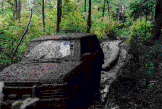
Truck and SUV owners also go out into the wilderness to recreationally enjoy their 4X4 capability. SUV owners trample plants, scare away wildlife, drive through mud, up slanted slopes, and through rivers to get an adrenaline rush and see the great outdoors. (Surely this type of abuse on a vehicle takes its toll in the form of a shortened lifespan.) The marks that off-roading leaves are permanent: nobody is there to get rid of the tread marks, pave over the ruts, and negate the effects of the exhaust. We need some sort of governmental regulation to be established for these reasons.
Recently, Congress has taken several steps along the lines of slowing down pollution in all vehicles. In 1990, a proposal was made by Representative Bryan of Nevada in Congress to cut fuel emissions 40% by 2001, but this deadline was postponed. (Rollover) Now, as the twenty-first century gets under way, we should have stricter environmental goals; the protection of nature should be very important to us as the population burgeons. The problem has been, as Noel Perrin says, "...the sense is that nature is so bounteous that we could never possibly run short of anything" (Ross 375). Nature is something that we must preserve for our children, our children's children and their grandchildren. There is a finite amount of pristine land in the world, and the more we let it be trampled, the less there will be in the future.
Therefore, regulation must be imposed on SUV buying in the form of adequate taxation due to poor gas usage and safety concerns or size regulation. By implementing a gas-guzzler tax in addition to the fees when buying a car or imposing an annual tax, we can reduce consumption of inefficient vehicles. This way, some of the spillover costs on society of having an SUV would be accounted for in the form of monetary compensation. Perhaps another tax on consumers would suffice for getting the point across that SUVs are harmful to others and the environment. A safety accommodations penalty could be passed, stipulating that since SUVs cause an unnecessary hazard to others on the road, owners will be assessed an additional fee payable to the insurance or the government. Governmental size regulation is another option. SUVs like the Ford Excursion, which has a sturdy bar under its front bumper so smaller cars do not get run over in a frontal collision, should be banned. There is no need for other highway users to be at risk when one of these vehicle owners loses control in the case of a blowout.
While there are many other solutions to reducing our unnecessary dependence on SUVs and their abuse of the environment, the fact remains that legal action against SUV extravagance, inefficiency, and recreation must be taken. Instead of "treading lightly," we should not tread at all!
Edmunds. 2002 HUMMER H1 Specs, Auto Safety. 21 October 2002.
<http://www.edmunds.com/new/2002/hummer/h1/
10thanniveditionwagon4wd4drsuv65l8cylturbodiesel4a/specs.html?id=lin0018>.
Edmunds. 2003 HUMMER H2 pictures. 9 October 2002.
<http://www.edmunds.com/new/2003/hummer/h2/luxseries4wd4drsuv60l8cyl4a/
Rollover: The Hidden History of the SUV. Dir. Barak Goodman. PBS Video, 2002.
Ross, Carolyn C. Writing Nature: An Ecological Reader for Writers. New York: St.
Martin's Press, 1995.
Land Rover Line. "Rover Photo Gallery." 20 October 2002.
<http://www.landroverline.com/Features/Photos.asp>.