 WRITING NATURE:
DISCOURSES OF ECOLOGY
WRITING NATURE:
DISCOURSES OF ECOLOGY
|
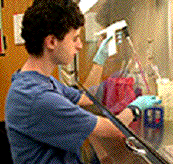
The mundaneness of a molecular biology laboratory would probably surprise the public, as would the ordinary nature of the people working in it. Last summer I was one of those people, working in a laboratory investigating gene regulation in reference to a rare form of congenital blindness called Leber Congenital Amaurosis Type 1. I very much enjoyed the challenging, and sometimes frustrating, work; my only regret was not being able to stay there longer, since we were quite close to making our blind chicken model see.
Critics of science would question the propriety of our actions, as we were changing nature. They would assert that science cannot properly respect nature because its fundamental purpose is to reduce life to "mere information," turning living things into "machine-like automata" (Rifkin 573). Because of this, scientists would act as if they were building Legos, not working with living things: they would not approach their work with the serious and responsibility necessary. This, of course, could cause big problems, such as unethical treatment of humans and animals, creation of new fatal diseases, etc.
The point that these critics miss is that, although in some sense science reduces life to information (i.e. the genetic code), it does so to understand it, not to belittle it. In other words, science recognizes that life is infinitely more complex than the information contained in its genetic code. A researcher will reduce a physical phenomenon to a simple representation so that he can understand it and appreciate its beauty. A better understanding and appreciation of life allows scientists to be more responsible in their work; of course, there are always a few scientists who act immorally and irresponsibly, but they are the minority.
The question of propriety being settled, other critics, especially environmentalists, question science's usefulness. For example, an environmentalist would take issue with the production of genetically modified corn because it would destroy the balance of nature (among other things). This is a very real and important complaint, and scientists often dismiss it, saying that theirs is the way of progress. In many cases, it is very difficult to decide whether or not they are right; a prime example of this difficulty can be found in the search for cures to diseases.
|
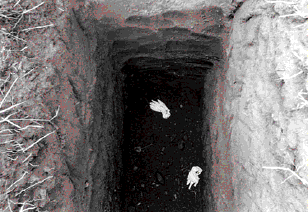
Ebola is one of the most feared of all viruses because, in the words of Richard Preston, it "does in ten days what it takes HIV ten years to accomplish" (Preston 46). The picture above speaks of this fear and horror to North Americans innocent of Ebola's curse. Viruses cannot be seen, touched, fought&emdash;they can only be contained. Unlike the virus, however, fear is not confinable; it spreads through newspapers, photographs, and conversations to all parts of the world. And this fear is well warranted. Ebola can spread easily through contact of bodily fluid; were this not bad enough, the virus actually causes the body to leak fluids from every possible opening. Consequently, the dead and ill are extremely contagious, and friends and relatives must be forced away for their own safety. In fact, one of the primary functions of international relief organizations is to educate the locals regarding safe practices.
Despite all of their efforts, fear still remains, for one mistake can cost tens or hundreds of lives&emdash;or worse. Air travel has made it very easy and convenient for people to move about the world, including people infected with Ebola. If an unknowingly infected person were to fly to the United States, the effects could be devastating, both in terms of lives lost and worldwide panic caused. We in the United States are really not so far away from those in Africa; their plight can just as easily become ours. As great as humanity may be, as large and magnificent as our cities are, just tens of these microscopic particles could bring our entire world crashing down.
Science provides the hope of curing Ebola, of freeing our minds from this fear, just as it did for bacteria with the discovery of penicillin. Of course, a cure would disrupt the balance of nature, as it selects for resistant strains (if there are any) and destroys a very real part of the ecosystem. From the example of penicillin, we know that bacteria have compensated, and now there are a significant number of resistant organisms. It seems that nature is quite resilient, returning to a stable equilibrium in relatively short order.
We must then ask ourselves, how resilient is nature? On the one hand, humans have killed off a number of species of animals; on the other hand, bacteria seem to be thriving. Environmentalist Aldo Leopold says that "the less violent the manmade changes, the greater probability of successful readjustment" (Leopold 444), but obviously our effects upon bacteria have been the equivalent of nuclear bombs compared to the harpoons we use against whales. And what about the potential effects of something as deadly as Ebola upon us?
Leopold bases his theory of "violence" upon the assertion that nature, acting as a network, will not be able to compensate for quick, drastic changes and would universally fail should one happen. Obviously, this suggests that science should not create new technologies but work very hard to preserve the current status quo.
Thus science is presented with a dilemma: it can either save human lives or save the balance of nature. In fact, this same dilemma is present in virtually everything science does, from nuclear power to bioengineered corn. Perhaps the answer lies in the question brought up earlier: does not nature itself, such as the Ebola virus, create huge catastrophes? We see then that humanity is really part of nature&emdash;this is the root of our contradiction. Viewing ourselves as outside it, we run into insurmountable moral dilemma; we must realize that we are in fact the equals of viruses.
If we recognize the virus as an equal, there is a very important lesson it can teach us. Viruses are persistent mechanistic killers, nomadic conquerors that use each plunder as a point of leverage for the next. However, they never go too far; they will never destroy their target species, for that would destroy their species. In other words, they cannot afford to be greedy. By analogy, we must realize that, as inhabitants of this biosphere, we are permitted&emdash;required, even&emdash;to use its living and nonliving resources. In fact, taking the example of what we suspect AIDS did to the chimpanzee population two million years ago ("Study"), we see that we may even use up large parts of nature. However, if we go too far, we may cause death to our species or at least make Earth uninhabitable.
Science can help us stay away from disaster, both by helping us to understand more fully the way nature works and by helping us to live in harmony with it. Ecology is an obvious example of the former, but molecular biology can also help us understand nature by helping us understand its individual components. In the latter task, many engineering disciplines help us design more efficient and less obtrusive buildings, and molecular biology can help all species survive better. Of course, another very important role for science is the improvement of the human condition (such as a cure for cancer); the problem with this is that it causes population increase. However, science then offers, for example, the hope of expansion to other planets. In sum, science will not only help us work better with our surroundings: it will allow us to move forward as a species with a minimum of negative consequences.
Maybe science is what separates us from the rest of nature. We have the ability not only to improve our own condition but also to improve the conditions of other species. This ability will allow us to survive and progress far into the future.
Leopold, Aldus. "The Land Ethic." In Writing Nature. Ed. Carolyn Ross. New York:
St. Martin's Press, 1995.
Murphy, Seamus. "Outbreak&emdash;Ebola." Adventure @ nationalgeographic.com. May/June 2001.
Accessed 20 October, 2002. <http://www.nationalgeographic.com/adventure/0105/seventh.html>.
Preston, Richard. The Hot Zone. New York: Anchor Books, 1995.
Rifkin, Jeremy. "A Heretic's View on the New Bioethics." In Writing Nature. Ed. Carolyn Ross.
New York: St. Martin's Press, 1995.
Semple-Rowland, Susan. "Mark Hammer." The Semple-Rowland Laboratory (University of Florida's
McKnight Brain Institute). August 2001. Accessed 20 October, 2002. <http://www.mbi.ufl.edu/~rowland/>.
"Study: Chimp disease clues to AIDS." CNN. 30 August, 2002. Accessed 27 October, 2002.
<http://www.cnn.com/2002/WORLD/europe/08/30/aids.chimp.dna/index.html>.