Ground Beetle
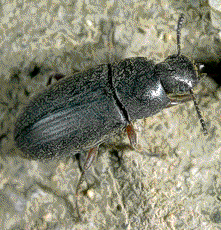
by Sara Auld
by Sara Auld
Ground beetles, sometimes called fiery hunters or caterpillar hunters, are one of the most common families of beetles. There over 20,000 known species of Ground beetles in the world and almost 2,500 in the United States alone. They are most common in temperate regions such as the San Francisco Bay area.
Ground beetles are usually between 6 to 14 millimeters, or 1/4 to 1 1/2 inches, long. They are usually blackish-brown, but some species of Ground beetles are quite colorful. Their bodies are round and slightly flattened. Their abdomens are divided into eleven different segments and they have one pair of antennae. Ground beetles have six long, reddish-brown legs that allow them to be very quick runners. Their legs are covered with tiny spines and brushes that help them clean themselves. Ground beetles use their hindlegs to clean their wing covers while they use their front legs to clean their heads. In most species of Ground beetles, their forewings are fused together making them a flightless species.
Ground beetles have extremely well developed mandibles, the mouthpart of insects, used for biting, but they have never been known to bite humans. Instead, since many types of Ground beetles are predators, they use these strong mandibles to devour other insects. Their prey includes insects such as caterpillars, fly grubs, snails, and small earthworms. Although most Ground beetles are predatory, some species are vegetarian.
After the male and female beetles mate, the female lays eggs in the soil. When the eggs hatch, the beetle is in an immature, worm-like larvae stage. The larvae live either in the soil or in the grass and also feed on other insects. Once the larvae mature into the adult beetle stage, they remain hidden during most of the day.
Ground beetles tend to be most active during the spring and summer. Some of the Ground beetles that live around Baylands can be found living in small holes while others can be found in ant nests. Wherever they live, Ground beetles are enemies of insects, snails, slugs, and other pests that live around the Bay area and therefore play a very important role in maintaining the balance of the insect population around Baylands.
For further information, explore the following web pages:
http://axp.ipm.ucdavis.edu/PMG/r261300711.html