 WRITING NATURE:
DISCOURSES OF ECOLOGY
WRITING NATURE:
DISCOURSES OF ECOLOGY
Like most, you have probably heard about the latest developments in genetics; you have seen the televised reports of the world's first mammalian clone: the sheep, Dolly. You have read that the future of mankind now rests in the hands of scientists in genetic laboratories across the world. During the past decade, the U.S. government and private organizations allocated research funding to the National Institute of Health in America and the Roslin Institute in the U.K. hoping that one day, we would have a genetic map of ourselves; that goal was achieved years ahead of schedule in the summer of 2000. However, whereas many supported the mapping of human DNA, not all applications arising from its use have been met with universal enthusiasm; rather, it has been the center of a controversy that has enormous ramifications: what is our future?
Some of the difficult questions it raises include those that center on our sense of identity and what it means to be unique. Today, we know that we are unique because each of our genetic code is different, but we cannot say this for sure if we allow human cloning. Human cloning raises the question of just how much we value a human life: human cloning changes our perception of whether death is really the end of our physical presence for we can create duplicates of our physical image. Its applications, such as human cloning for stem cell research or organ transplants, put us in a situation of knowing that while we may save another life through a transplant, we must kill the cloned embryo to harvest the stem cells. All of these questions ultimately move us toward the question of what will be become if we allow human cloning?
These questions are not ones easily answerable or justified, and so as temporary measure to curb human cloning in America so that more studies could be conducted to address its safety and ethical concerns, the U.S. House of Representatives passed a law banning on all forms of human cloning in the United States in 2001. Meanwhile, this legislation has met with some resistance in the Senate. The issue has largely centered on research cloning since most agree that human cloning for reproductive purposes should not be allowed, but research cloning could perhaps provide new insight into treating diseases.
A report released in July 2002 by the President's Council on Bioethics voiced similar concerns. The seventeen-member board unanimously agreed that reproductive cloning is unethical and should be permanently banned. However, the Board was split in regards to cloning for medical research purposes. Ten members voted to ban all research cloning while seven members argued to allow research cloning but under strict federal regulation. The ten-member majority thus recommended a four-year ban during which the Council would conduct a thorough federal review of current and anticipated practices of human cloning for research purposes (Dignity).
Meanwhile, the international community has also begun to take part in the human cloning debate. The United Nations created a committee to draft guidelines concerning human cloning, but as of November 19, 2002, no agreement could be reached. Whereas the United States and the Vatican proposed a ban on all forms of cloning, France and Germany were more open to the possibility of using human cloning for therapeutic purposes (Lederer par. 4-6).
At the end of November 2002, the human cloning issue was brought to our attention again amid news that there is now a real possibility that a human clone could be born as early as January 2003! In spite of the continuing debates, one doctor was bold enough to claim that there is a surrogate mother carrying a cloned baby about eight months pregnant and that the baby would be born sometime in January 2003. Dr. Severino Antinori, an Italian fertility doctor, would not reveal the identity of the woman, only saying that the birth would take place only in "countries where this is permitted" (qtd. in Mayer par. 6). While his claims are without evidence, his courage to suggest the birth of a human clone even amid debates concerning human cloning's safety and legality, not to mention ethical questions, shows that there are those who would be willing to pursue this technology while there is still no definite universal ban against its practice.
Clearly, as an issue that has been debated not only at the national but also the international level, human cloning is an issue that requires our immediate attention&emdash;if we turn away now, there is no telling how many other doctors in addition to Dr. Antinori (if his claims are indeed true) may choose to aid individuals with human cloning. In simplified form, human cloning is the fusing of a cell and an egg that lacks a nucleus (thus, no DNA) to form an embryo. The embryo only contains DNA from one source and develops into an exact physical replica of the original animal that donated the DNA-carrying cell.
There are two different uses of cloning, and both are under debate. On one hand, cloning could be used for reproductive purposes. In this case, geneticists would use a person's existing DNA to create a genetic duplicate. Whereas sexual reproduction involves genes from both an egg and sperm, a cloned individual would receive all of its genes from a single person.

Figure 1 illustrates a cloning method known as somatic cell nuclear transfer (SCNT). In this process, the nucleus from a body cell is inserted into an egg without a nucleus. If the embryo is placed into a women's uterus and carried to birth, the individual created would have only one set of genetic material, that of the donor's. The result is a genetic duplicate.
The second, and quite different use of human cloning would be for research purposes. Research cloning, also known as therapeutic cloning, uses the same SCNT process as reproductive cloning, but instead of implanting the embryo in a womb, the embryo would instead be used for research purposes such as stem cell research and organ transplants. Lin 4

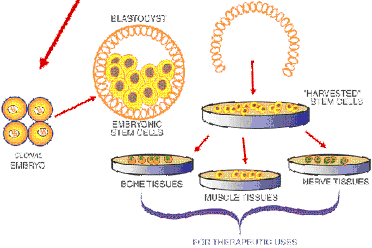
As illustrated by Figures 2 and 3, the clonal embryo could then be harvested as stem cells and then separated into various tissues for further research. In essence, research cloning could provide an endless supply of stem cells that could be used as replacement tissues for patients. Furthermore, whereas tissue transplants run the risk of being rejected by a recipient, tissue transferred via research cloning would presumably be accepted by the patient's immune system since the cells would essentially be from the same individual; this makes the prospect of using human cloning very attractive in medical applications.
However, research cloning opens the debate as to what exactly constitutes "research and therapeutic uses." Allowing the most acute form research cloning, namely, using the stem cells for disease research, would lead some to ask why not let those stem cells develop into tissues that could serve as transplants? The outcome is inevitably moving us then to organ harvesting and then quite possibly to cloning entire human beings. The danger is obviously that once we begin any kind of cloning, we will surely ask to expand the "acceptable" applications of cloning&emdash;but where do we stop this expansion and who should decide what is the defining line between acceptable and unacceptable cloning uses should be?
Moreover, even human cloning for therapeutic uses is not as safe or effective as proponents would like to claim. Some advocates may argue that by prohibiting cloning, we are refusing to save the lives of those dying from cancer or other terminal illnesses. Their reasoning is simple: human cloning would allow us to save those dying from kidney cancer by "manufacturing" a new kidney, and likewise, to save others dying from other illnesses as well. Yet we should be suspect when there appear no initial disadvantages. In this case, the dangers are in disguise: if we clone humans to save other humans, we are harvesting human organs&emdash;we are using human cloning as merely a manufacturing process for tissues and organs. To use embryonic stem cells, the cloned embryos must be destroyed; thus, saving one life requires that we kill another. This differs from current transplant procedures in which a person's organs are taken after they have died, but not because we killed them for the purpose of the transplant. As a result, the value of a human life may become nothing more than a specimen that can be discarded as easily as a used product.
Amid rising safety concerns, a recent BBC report on cloning labeled cloning as "an imprecise science" (Nelson). New research which found that not all new cloned stem cells were always accepted by the target's immune system prompted further questioning as to whether human cloning would indeed be promising for research and therapeutic measures. In an interview with one of the creators of Dolly&emdash;the first mammal to be cloned&emdash;Professor Ian Wilmut remarked that "we would have to ask, is it possible that their cells will be as variable and their function perhaps slightly unpredictable as has been shown in these last experiments" (qtd. In Nelson). Cloning Dolly took over 200 attempts to produce one successful clone so the cloning procedure cannot be accepted as entirely safe or 100% successful. Are we willing to accept the possibility that many clones will die before birth, or they will be born with severe deformities and deficiencies such that they perish soon after being born? Undertaking human cloning in light of this risk questions just exactly how far we will go to produce one success story amid the loss of hundreds of failures.
With even more uncertainty over using human cloning for therapeutic purposes, researchers may feel less publicly threatened to pursue human cloning for medical research. To this end, on December 10, 2002, Stanford University announced that it would develop human embryonic stem cells using the SCNT method. Many other researchers viewed this as an equivalent to cloning and thus marked the first higher education institution in the United States to formally support cloning (Elias par. 1); meanwhile, Stanford medical professor Irving Weissman, who will direct the research, argues that "creating human stem cell lines is not equivalent to cloningŠ. These cells can go on to form many types of tissue, but cannot on their own develop into a human" (qtd. in Elias par. 5). Thus, while we may not know it, we have already begun the slippery slope of moving the distinction between what is acceptable or not beyond the previous distinction of pursuing or not pursuing any form of human cloning.
Consequently, while advocates claim that the cloning would become one of our greatest tools&emdash; medical research and treatments, organ transplants, and even "regenerating" lost loved ones&emdash;we still must question whether human cloning is really worth it when weighed against the ethical dilemmas it raises. And, although each of its applications mentioned has a different degree of moving us toward creating entire human clones, they all represent a step on the path toward this end&emdash;once we start, where will we know to stop? For those who wish to be cloned, human cloning raises the socially-oriented issues of affordability for the middle-class citizen and the risk for misuse by the rich and powerful. For the cloned, it creates a sense of lost individuality&emdash;a sense that "I'm not exactly Lin 7 human." For society, human cloning changes our perception of what is the value of a human life: we change from having children to manufacturing children. Human cloning, for sure, carries the possibility of regenerating lost loved ones&emdash;but is it worth it? Would those loved ones even be replicated in a truly meaningful way?
For the typical citizen, human cloning looks unpromising simply because of the cost. When human growth hormone injections can cost an upwards of $30,000 per year, human cloning will inevitably be even more expensive (Gibbs 1). If we adopt what advocates propose and apply human cloning for research purposes that have an end goal of providing better treatments, then human cloning, like human growth hormone injections, are part of the same category which entails enormous an price to use. For the rich and powerful, human cloning is another stride towards protecting their wealth for generations to come. Since human cloning would initially be quite expensive, we can be sure that only the affluent will have access when cloning becomes public.
While we cannot judge the affordability issue in terms of an absolute right and wrong, it still poses definite social consequences. Just consider athletes, models, and other wealthy members of a "super-class" people who may want clones of themselves to perpetuate their legacy, thereby increasing the inequality between the average citizen and the wealthy and otherwise privileged. Moreover, clones of athletes, models, and other highly talented people may lead to a more narrow-minded society on the ideas of appearance, intelligence, and athletic ability. Today, we already have a gap between those possessing more desirable assets&emdash;be they, material, physical, or mental&emdash;and the average person; human cloning is another step toward this ugly trend of class separation.
But, if we work to make human cloning more affordable for the average citizen, this is not without problems of its own: misuse even by the average person. For example, just consider parents who would like to live through their children&emdash;human cloning might serve as another avenue to this end. Today, there are already enough problems with parents who try to live vicariously through their children. Parents who have had failed aspirations typically push their children to succeed where they have failed. Yet, most parents still only have hopes for their children; cloning might compel parents to have expectations for their children. To this end, Leon Kass, a teacher of bioethics at the University of Chicago and chairman for the President's Council on Bioethics, notes that "cloning isŠinherently despotic, for it seeks to make one's children one's own image (or an image of one's choosing) and their future according to one's will" ("Preventing a Brave New World" 2).
If cloning were affordable for all, the potentials for abuse are still there. In an interview with Lee Silver, a professor of Genetics at Princeton, on PBS Frontline, Silver comments that "the most disturbing part of this technology is not the cloning, where you just have a child born who happens to be related to one parent instead of two. The most disturbing part of this technology is when parents are going to try to use genes to provide their children with serious advantages" (Frontline par. 131). Whether cloning is or is not affordable, the unresolved risk is that there will be parents who may see human cloning and associated bioengineering techniques as a way to give their children an edge over the rest that ordinarily would not be possible if children are conceived naturally with two parents. In today's highly competitive society, most of us are all striving to be the best: the most intelligent, beautiful, successful, and famous. There is nothing wrong with parents wanting the best for their child, such as offering children greater educational opportunities, but human cloning allows us to clone those with the best assets and thereby give children advantages most directly at the genetic level.
But for those children, what kinds of lives will they lead? For the cloned, human cloning raises an issue of identity&emdash;a question of who am I or what am I? Every child has the right to feel unique. Human cloning may diminish the individual's sense of identity because a clone is the same in appearance and in genetic coding as the original. In addition, we, as once unique individuals, also lose our feeling of uniqueness because we may look across the room one day and see a look-alike&emdash;not created from chance during natural reproduction but because of our own choice. When a cloned child looks into the mirror, he will not see his own face, but someone else's&emdash;perhaps the face of his father or mother or even a deceased relative. He cannot say to himself, "I am one of a kind." He cannot forget that he is the image&emdash;an exact physical image&emdash;of another person.
Proponents may argue that after time, the clone may forget that he or she is a duplicate, but this does not erase the ingrained knowledge that he or she was conceived in a laboratory. However, what if a clone was never told that he or she was a clone? This creates the danger, like with any kind of decision to withhold information, that the clone will one day find out and the daily effort to conceal this information on the part of the clone's creator. As Leon Kass testified before the National Bioethics Advisory Committee, "Genetic distinctiveness symbolizes uniqueness of each human life and the independence of its parents that each human child rightfully attains" ("The Necessity of a Permanent Ban" 3). A child today comes into the world with a sense of not only spiritual and physical uniqueness, but also the knowledge that his genetic code is his very own, not some experimental duplicate. He knows that while some of his code comes from his parents, his DNA has never been sequenced before in its entirety.
At this point, proponents of human cloning like to remind us that identical twins fall into this same category. However, studies by Dr. Thomas Bouchard and his colleagues at the University of Minnesota's Center for Twin and Adoption showed that identical twins in different environments produced only slight differences in personality; consequently, this casts doubt on whether a clone personality's would actually be distinct. Twins separated at birth were found to have similar interests and experiences. In studies of over 100 twins over a period of twelve years, the researchers found that many of the similarities between twins cannot be explained by coincidence. For example, one pair of twins who were reunited at thirty found that they both had similar mustaches and hairstyles, big belt buckles and key rings, and both held jobs installing safety equipment. They both drank Budweiser and crushed empty cans. In his studies, Dr. Bouchard found that these similarities were more often the rule than the exception. Those who attempted to link these similarities to traits that run in families, such as high intelligence, baldness, and eye color, were unable to answer the same liking for Budweiser or other preferences that are usually associated with uniqueness. From these findings, Dr. Bouchard concluded that "the vast majority of psychological traits are influenced to some degree by genetic factors" (Bouchard 1567).
In another study conducted in 2001 in a collaborative effort between Dr. Julie Harris and her colleagues at the University of Western Ontario and Dr. Kerry Jang at the University of British Columbia, their results affirmed Dr. Bouchard's research in 1992. The researchers examined over 300 pairs of twins and compiled an analysis of thirty attitude preferences such as sociability, exercise, and stances on various political issues. Of these thirty attitude factors, they identified nine items of which six showed significant influences from heredity. From the results, they concluded that "attitudes are learned. But attitudes also depend on biological factors. In this research, we obtained evidence that variation across individuals on a wide variety of attitudes is partly attributable to genetic factors" (853). They noted that while "the environment is necessary for the development of attitudesŠthe hypothesis that attitudes are learned is not incompatible with the notion that biological and genetic factors also influence attitudes" (845).
Thus, one of the common claims that human cloning advocates assert may not be necessarily true. Because human clones will have the same genetic identity as the original, in many respects, the clones and the original are like identical twins, though separated by age. With these studies showing that identical twins may possess similar personalities because of genetic sameness, we can infer that clones may also have similar psychological attitudes; therefore, the clones not only have lost their genetic distinctiveness, but perhaps also their sense of unique personality.
Moreover, in a society that naturally ostracizes those different from us, what is there to guarantee that the cloned will not simply become a part of the outside circle? While today we distinguish human beings on the basis of race, color, religion, and gender, cloning may create a new separation between those conceived by nature, and those born by cloning. Even in vitro fertilization, which involves taking eggs from a woman and fertilizing them in a laboratory with her partner's sperm, still can be considered as being conceived by nature because how the child will turn out is uncertain. However, when we decide to clone a person, we already know how the child will turn out&emdash;a physical replica of the original, and moreover, perhaps with a strikingly similar personality as inferred from research involving personalities between identical twins separated at birth. We recognize that whether male or female, black or white, we are all human beings. With human cloning, however, we are breaking the boundary of what we define as human: to be given life by love or by experiment. As biotech critic Jeremy Rifkin warns us, "[Cloning] will create a new form of discrimination. How will we look at those who are not enhanced, the child with the low IQ?" (qtd. in Gibbs 8). Cloning a fashion model, for example, will undoubtedly create someone who looks exactly like the original model; however, this will most likely bring a certain degree of jealousy from the rest of society who were not perhaps born so glamorous&emdash;they may see the clone as having had an unfair advantage that the less fortunate may never achieve because the distinction is at the genetic level. Thus, once a human clone is born, he may not find companionship or a sense of belonging to our world; he may feel a distance between our world of naturally conceived human beings and his world of laboratory-grown "products." Why create a clone who may feel as if he or she has a diminished sense of identity and uniqueness in the world? By approving of human cloning, we are eroding the very concept of what it means to be a human being: to be able to say that "I am one of a kind."
Human cloning endangers the value we, as a society, place on a human life. When advocates ask you to support cloning, you should ask yourself, "Human cloningŠbut at what social cost?" More than providing a solution to our search, human cloning asks us to relinquish our value of life. We hold a human life with the highest virtue and esteem because we realize our own mortality; we understand that we can never replace a sister, a brother, a parent, or a friend. Human cloning may erode the sense that once someone is gone, he or she is gone forever. Even if a family has five or six children, the parents still hold each child as irreplaceable; human cloning degrades that sense of worth to where the parents might say, "If John dies, we can simply create another in like image." A human life is precious not because we can beget another, but because we can never beget another "in like image."
Indeed, the term "begetting" will need to be re-defined: human cloning threatens the very method in which a new life is brought into the world. Whereas in sexual reproduction there is a mother and father each partaking in the creation of the child, human cloning reduces this to asexual reproduction&emdash;a form of reproduction associated with the lowest forms of life, such as bacteria. Sexual reproduction in itself also carries a deeper significance than simply serving as the method of reproduction for our species. Indeed, it has come to symbolize the union of love between two individuals in the creation of a child that will serve as their legacy after the parents pass on. Thus, sexuality also supports the vision of our own mortality: procreation symbolizes the continuing existence of our own species from the union of two individuals. Human cloning, on the other hand, is a radical departure from this lineage. It substitutes two individuals necessary for reproduction with only one, such that the death of the "original" person does not mean a true end to that person's existence: the genetic duplicate still represents that deceased individual genetically and physically. Whereas sexuality calls forth feelings of love and intimacy between individuals, human cloning only requires a laboratory and surrogate mother&emdash;none of this comes close to what sexuality and love has meant to generations of human beings. Consequently, as Leon Kass remarks, "Whether or not we know it, the severing of procreation from sex, love, and intimacy is inherently dehumanizing, no matter how good the product" (Kass, "Wisdom" 31).
The feelings of love and intimacy accompanied by sexual reproduction means loving the child for whatever he or she turns out to be. Human cloning changes reproduction from begetting to making&emdash;from procreating to manufacturing a human life. Sure, a clone will still develop into a human being like any other, but we have changed "man" into another "man-made object"&emdash;something molded and produced at our whim. When parents decide to they would like to have offspring, there is a connection of love and sexuality between the pair. They proceed with sexual relations amid this connection and know that while they will each pass on some traits, nature will ultimately mix these traits together to create a unique individual. When parents decide to instead "manufacture" a child, they are saying that only a child who fulfills certain criteria will be accepted. But, if a cloning mishap returns a child who does not conform to all of the criteria, then are we agreeing to destroy that "specimen"? By accepting human cloning, we are changing our society from one that procreates with the blessings of nature, to one that manufactures human life for the sake of the "right qualities."
If human cloning poses such great risks, then what can be done to protect society? The answer is a simple: ban human cloning. For all its potential benefits&emdash;regenerating lost loved ones, allowing infertile couples to have children, and so forth&emdash;the danger arising from the actual production of a clone is simply too great. Why permit a technology that perhaps only the rich will be able to use? That can be subjected to misuse by criminal minds? That will create a loss of individuality for the cloned "specimen"? That will ultimately shatter our value of what a human life really means?
Obviously with such powerful technology, government guidelines to oversee its use will not be sufficient: there will certainly be those who appear to be using cloning for "legitimate" purposes but are really using it for their personal benefit. President Bush, a supporter of a complete ban on human cloning, remarked, "Anything other than a total ban on human cloning would be virtually impossible to enforce. Cloned human embryos created for research would be widely available in laboratories and embryo farms. Once cloned embryos were available, implantation would take place. Even the tightest regulations and strict policing would not prevent or detect the birth of cloned babies" (18).1 After the House of Representatives passed a bill outlawing all forms of human cloning in 2001, the Senate has yet to agree on the terms of the legislation. President Bush's words were an attempt to urge the Senate to come to a consensus before Congress recesses for the holidays, and at the same time, raise the issue of enforcing a ban on one type of human cloning while allowing another. How would it be possible to enforce this nationwide when law enforcement officials are already spread so thin by today's problems? More importantly, once an embryo is implanted, it would be impossible to tell from a glance whether a pregnant woman had developed the baby from sexual reproduction or human cloning techniques. Banning reproductive cloning while allowing research cloning would simply be ineffective given the inability to enforce such a ban, and the continuing risk for implantation of the embryo into a surrogate mother.
But when the issue comes to a recommendation of a ban, some proponents such as Laurence Tribe, a Harvard College and Harvard Law School graduate, argue that as with our attempted bans on abortion and pre-marital sex, a ban on human cloning will be hard to enforce (Tribe 2). The comparison between enforcing a ban on abortion and human cloning is very different. Banning abortion is very difficult simply because many mothers may feel as if it is her right to do what she pleases with her body; moreover, what of unwanted sexual intercourse that results in a pregnancy? Abortion might at least be able to protect the woman from undue hardship with having to raise a child created without mutual consent. It would be better for a child to be brought up from parents who can show their fullest love and care for the child created from mutual consent. In contrast, human cloning is primarily based on the decision of an individual, not two partners, and therefore would be less debatable as to whether the clone was actually wanted or not. Meanwhile, pre-marital sex is difficult to prevent simply because there is no formal law against it&emdash;and how could we possibly enact one when pre-marital sex is usually under the consent of both individuals involved? But with cloning, we have yet to clone a human being, and moreover, we are still in debate as to whether human cloning should be allowed at all. Thus, a ban on human cloning at this point is feasible, but we need to act now.
Already, perhaps, human cloning may have taken place if what Dr. Antinori claims is true; if even amid debates a doctor has been willing to pursue human cloning, then this only makes a universal ban more critical to us today. Stanford University's announcement on December 10, 2002, to develop human embryonic stem cells through human cloning procedures is the first&emdash;but perhaps only the beginning&emdash;of pushing the line closer and closer toward cloning entire human beings.
Thus, as an issue that poses immediate threats to mankind, we simply cannot allow human cloning to begin, nor can we suggest that human cloning but with government oversight will be sufficient. For advocates who concede reproductive cloning but continue to support research cloning, a ban on one type while allowing another would simply be ineffective. Meanwhile, as the Senate continues to debate the passage of anti-human cloning legislation, we should also do our part. Together, we need to voice a resounding no to human cloning advocates and companies: no to providing another avenue for misuse, no to a loss of identity for the cloned, no to the manufacturing of human life, no to the very idea of human cloning!
1 Remarks delivered on April 10, 2002 by President Bush on human cloning legislation. Full text of the speech and an audio version is available at: <http://www.whitehouse.gov/news/releases/2002/04/print/20020410-4.html>.
Bouchard, Thomas J., et. al. "Emergenesis: Genetic Traits That May Not Run In Families." American Psychologist 47.12 (1992): 1565-1577.
Bush, George W. "President Bush Calls on Senate to Back Human Cloning Ban." Print and audio text. 10 April 2002. 18 November 2002 < http://www.whitehouse.gov/news/releases/2002/04/print/20020410-4.html >.
Elias, Paul. "Stanford Reveals Human Embryo Development." Associated Press. 10 December 2002. 10 December 2002 <http://abcnews.go.com/wire/US/ap20021210_2222.html>.
Frontline. Interview. Making Babies: Interview with Lee Silver. PBS. WNET, New York. 1 June 1999. 18 November 2002 <http://www.pbs.org/wgbh/pages/frontline/shows/fertility/interviews/silver.html>.
Gibbs, Nancy. "If We Have It, Do We Use It?" Time 13 September 1999. 16 November 2002 <http://www.time.com/time/magazine/printout/0,8816,30505,00.html>.
Harris, Julie Aitken, et al. "The Heritability of Attitudes: A Study of Twins." Journal of Personality and Social Psychology 80.6 (2001): 845-860.
Human Cloning and Human Dignity. 10 July 2002. The President's Council on Bioethics. 18 November 2002 < http://www.bioethics.gov/cloningreport/>.
Kass, Leon. "The Necessity of a Permanent Ban." In Cloning : Science and Society. Ed., Gary E.
McCuen. Hudson, WI: GEM Publications Inc., 1998.
---. "Preventing a Brave New World." The New Republic 21 May 2001. 16 November 2002 <http://www.thenewrepublic.com/052101/2kass052101.html>.
---. "The Wisdom of Repugnance." In The Ethics of Human Cloning. Eds., Leon R. Kass and James Q. Wilson. Washington, D.C.: American Enterprise Institute for Public Policy Research, 1998.
Lederer, Edith M. "U.N. Treaty on Human Cloning Stalled." Associated Press. 19 November 2002. 19 November 2002 <http://www.sacbee.com/24hour/world/story/628710p-4812334c.html>.
Mayer, Peter. "Doctor Claims Cloned Baby Due in Jan." Associated Press. 26 November 2002. 2 December 2002. <http://story.news.yahoo.com/news?tmpl=story&u=/ap/20021126/ap_on_he_me/italy_cloning_doctor_1>.
Nelson, Sue. Interview. Cloning is an Imprecise Science: Interview with Ian Wilmut. BBC News. BBC, London. 6 July 2001.
Reproductive Cloning Basic Science. 28 August 2002. Center for Genetics and Society. 18 November 2002 <http://www.genetics-and-society.org/technologies/cloning/reproscience.html>.
Tribe, Laurence H. "Seconds Thought on Cloning." Current Issues and Enduring Questions: A Guide to Critical Thinking and Argument, with Readings. Eds. Sylvan Barney and Hugo Bedau. New York: Bedford/St. Martin's, 1999. 459-461.